On This Page
Problem: Optimizing Heat Dissipation Using Cauchy-Schwarz Inequality
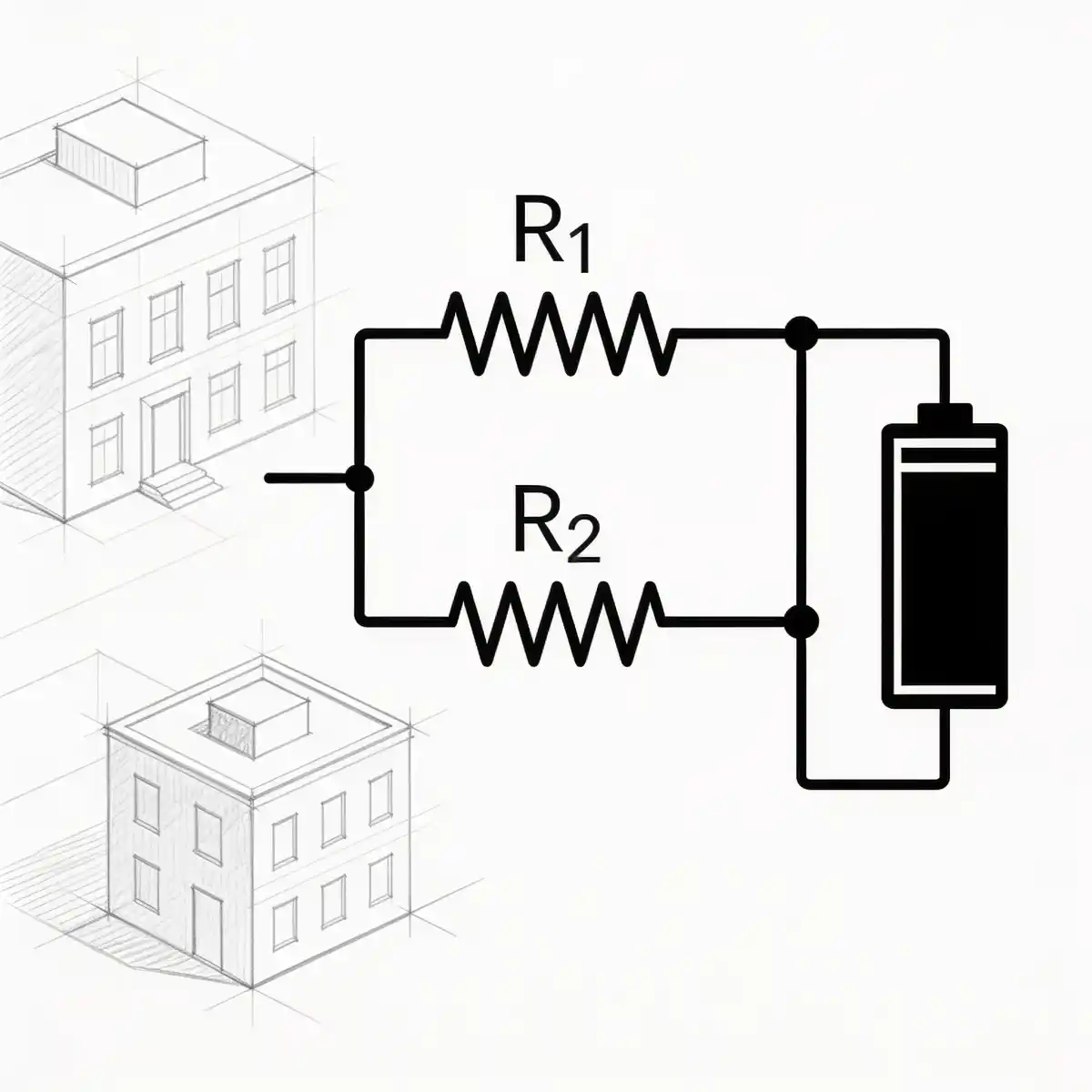
In an electrical circuit, a total constant current ##I## is split between two parallel resistors ##R_1## and ##R_2##. Let the currents through the two branches be ##I_1## and ##I_2## respectively. Therefore,
###I_1 + I_2 = I###
The total rate of heat generation, or power dissipation, in the two resistors is given by Joule’s law:
###H = I_1^2R_1 + I_2^2R_2###
Using the Cauchy-Schwarz inequality, determine the minimum possible value of ##H## in terms of ##I##, ##R_1##, and ##R_2##. Also identify the relationship between ##I_1## and ##I_2## when this minimum heat dissipation is achieved.
| Quantity | Symbol / Formula | Physical Meaning |
|---|---|---|
| Total Current | ##I## | The total current entering the parallel network. |
| Branch Currents | ##I_1, I_2## | The currents flowing through resistors ##R_1## and ##R_2## respectively. |
| Current Constraint | ##I_1 + I_2 = I## | The total current is divided between the two parallel branches. |
| Heat Dissipation / Power | ##H = I_1^2R_1 + I_2^2R_2## | The total rate at which electrical energy is converted into heat. |
Worked Solution and Step-by-Step Explanation
We use the Cauchy-Schwarz inequality to obtain a lower bound for the expression ##I_1^2R_1 + I_2^2R_2## under the condition ##I_1+I_2=I##.
The Cauchy-Schwarz inequality states that for any two real sequences ##(a_1,a_2)## and ##(b_1,b_2)##,
###(a_1^2+a_2^2)(b_1^2+b_2^2) \geq (a_1b_1+a_2b_2)^2###
Equality holds when the two sequences are proportional.
Step 1: Choose Suitable Variables
We want the expression ##a_1^2+a_2^2## to become the heat dissipation expression ##H##. Therefore, we choose:
###a_1 = I_1\sqrt{R_1}, \qquad a_2 = I_2\sqrt{R_2}###
Then,
###a_1^2+a_2^2 = I_1^2R_1 + I_2^2R_2 = H###
Now we choose ##b_1## and ##b_2## so that the product sum ##a_1b_1+a_2b_2## gives the current constraint ##I_1+I_2=I##. For this, take:
###b_1 = \frac{1}{\sqrt{R_1}}, \qquad b_2 = \frac{1}{\sqrt{R_2}}###
| Cauchy-Schwarz Term | Chosen Expression | Purpose |
|---|---|---|
| ##a_1## | ##I_1\sqrt{R_1}## | Produces the term ##I_1^2R_1## after squaring. |
| ##a_2## | ##I_2\sqrt{R_2}## | Produces the term ##I_2^2R_2## after squaring. |
| ##b_1## | ##\dfrac{1}{\sqrt{R_1}}## | Cancels ##\sqrt{R_1}## in the product ##a_1b_1##. |
| ##b_2## | ##\dfrac{1}{\sqrt{R_2}}## | Cancels ##\sqrt{R_2}## in the product ##a_2b_2##. |
Step 2: Compute the Components of the Inequality
First, compute the sum of squares of the first sequence:
###a_1^2+a_2^2 = (I_1\sqrt{R_1})^2 + (I_2\sqrt{R_2})^2###
Therefore,
###a_1^2+a_2^2 = I_1^2R_1 + I_2^2R_2 = H###
Next, compute the sum of squares of the second sequence:
###b_1^2+b_2^2 = \left(\frac{1}{\sqrt{R_1}}\right)^2 + \left(\frac{1}{\sqrt{R_2}}\right)^2###
Thus,
###b_1^2+b_2^2 = \frac{1}{R_1} + \frac{1}{R_2}###
Combining the fractions gives:
###b_1^2+b_2^2 = \frac{R_1+R_2}{R_1R_2}###
Finally, compute the product sum:
###a_1b_1+a_2b_2 = \left(I_1\sqrt{R_1}\right)\left(\frac{1}{\sqrt{R_1}}\right) + \left(I_2\sqrt{R_2}\right)\left(\frac{1}{\sqrt{R_2}}\right)###
Hence,
###a_1b_1+a_2b_2 = I_1+I_2 = I###
Step 3: Apply the Cauchy-Schwarz Inequality
Now substitute these results into:
###(a_1^2+a_2^2)(b_1^2+b_2^2) \geq (a_1b_1+a_2b_2)^2###
This gives:
###H\left(\frac{R_1+R_2}{R_1R_2}\right) \geq I^2###
Solving for ##H##, we obtain:
###H \geq \frac{I^2R_1R_2}{R_1+R_2}###
Therefore, the minimum possible heat dissipation is:
###H_{\min} = \frac{I^2R_1R_2}{R_1+R_2}###
Since the equivalent resistance of two resistors in parallel is:
###R_p = \frac{R_1R_2}{R_1+R_2}###
we can also write:
###H_{\min} = I^2R_p###
Minimum Heat Dissipation
The lower bound obtained from the Cauchy-Schwarz inequality is:
###H \geq \frac{I^2R_1R_2}{R_1+R_2}###
Therefore,
###\boxed{H_{\min} = \frac{I^2R_1R_2}{R_1+R_2}}###
Since ##R_p=\dfrac{R_1R_2}{R_1+R_2}##, this can also be written as:
###\boxed{H_{\min}=I^2R_p}###
Step 4: Find the Condition for Minimum Dissipation
Equality in the Cauchy-Schwarz inequality occurs when the two chosen sequences are proportional. That is,
###\frac{a_1}{b_1} = \frac{a_2}{b_2}###
Substituting the chosen values:
###\frac{I_1\sqrt{R_1}}{\frac{1}{\sqrt{R_1}}} = \frac{I_2\sqrt{R_2}}{\frac{1}{\sqrt{R_2}}}###
Simplifying both sides gives:
###I_1R_1 = I_2R_2###
This is exactly the condition that the voltage across both parallel resistors must be the same:
###V_1 = V_2###
Since ##V_1=I_1R_1## and ##V_2=I_2R_2##, the condition becomes:
###I_1R_1 = I_2R_2###
Thus, the heat dissipation is minimized when the branch currents are distributed inversely proportional to the resistances.
From ##I_1R_1=I_2R_2##, we get:
###\frac{I_1}{I_2} = \frac{R_2}{R_1}###
Therefore, the smaller resistance carries the larger current, and the larger resistance carries the smaller current.
| Result | Expression | Meaning |
|---|---|---|
| Minimum Heat Dissipation | ##H_{\min} = \dfrac{I^2R_1R_2}{R_1+R_2}## | The least possible rate of heat generation for the given total current ##I##. |
| Parallel Equivalent Resistance | ##R_p = \dfrac{R_1R_2}{R_1+R_2}## | The equivalent resistance of the two-resistor parallel network. |
| Compact Form | ##H_{\min} = I^2R_p## | The minimum dissipation is the same as the power dissipated in the equivalent resistance. |
| Current Condition | ##I_1R_1 = I_2R_2## | The voltage across both parallel resistors is equal. |
| Current Ratio | ##\dfrac{I_1}{I_2} = \dfrac{R_2}{R_1}## | Current divides inversely in proportion to resistance. |
Physical Interpretation
This result has a direct physical meaning. In a parallel circuit, the current does not divide equally unless the resistances are equal. Instead, more current flows through the smaller resistance and less current flows through the larger resistance.
The condition
###I_1R_1 = I_2R_2###
is simply the statement that both branches of a parallel circuit have the same potential difference across them. The Cauchy-Schwarz inequality shows that this natural current distribution is also the one that minimizes total heat dissipation for a fixed total current.
Final Conclusion
For two parallel resistors ##R_1## and ##R_2## carrying a total current ##I##, the total heat dissipation is:
###H = I_1^2R_1 + I_2^2R_2###
Using the Cauchy-Schwarz inequality, we obtain:
###H \geq \frac{I^2R_1R_2}{R_1+R_2}###
Therefore, the minimum possible heat dissipation is:
###\boxed{H_{\min} = \frac{I^2R_1R_2}{R_1+R_2}}###
Equivalently, since ##R_p=\dfrac{R_1R_2}{R_1+R_2}##,
###\boxed{H_{\min}=I^2R_p}###
The equality condition is:
###\boxed{I_1R_1 = I_2R_2}###
This means that minimum heat dissipation occurs when the voltage drops across the two parallel resistors are equal.
RESOURCES
- Nonclassical magnon pair generation and Cauchy-Schwarz ...link.aps.orgLiu, Y. Zhong, and J. Jing, Violation of high-dimensional Bell inequality using narrowband orbital-angular-momentum entanglement from warm atomic vapor, Phys.
- Heat flow, decay of the Fisher information, and λ-displacement ...mathoverflow.netApr 29, 2020 ... The key insight is actually a clever use of the Cauchy-Schwarz inequality to eke out a little bit extra from…
- Optimal Cycles for Low-Dissipation Heat Engines | Phys. Rev. Lett.link.aps.orgMar 19, 2020 ... ... Cauchy-Schwarz inequality. First, using the formula for the derivative of an exponential [73] : ∂ e - G /…
- Generation of sub-MHz and spectrally-bright biphotons from hot ...arxiv.orgDec 9, 2020 ... This g_{s,as}^{(2)} violates the Cauchy-Schwartz inequality for classical light by 440 folds, and demonstrates that the biphotons have a high ...
- Direct generation of time-energy-entangled W triphotons in atomic ...science.orgSep 13, 2024 ... ... hot atomic vapor cell. By using the process of ... Controllable waveform generation and the violation of the Cauchy-Schwarz…
- Generation of sub-MHz and spectrally-bright biphotons from hot ...opg.optica.orgThis g s , a s ( 2 ) violates the Cauchy-Schwarz inequality for classical light by 440 folds, and demonstrates that the biphotons…
- Why does the Cauchy-Schwarz inequality hold in any inner product ...math.stackexchange.comAug 8, 2013 ... The following is from Cauchy-Schwarz Masterclass by Michael J. Steele. The book also has a small motivation for this proof, ...
- Generation of two-color correlated photon pairs at telecom ...ui.adsabs.harvard.edu... Cauchy-Schwarz inequality by a factor of more than 650. The high generation ... Generation of two-color correlated photon pairs at telecom wavelength from…
- What is the rule for using |⋅| and ‖⋅‖ in Cauchy-Schwarz inequalitymath.stackexchange.comDec 24, 2015 ... There are three separate issues: Using ‖v‖ or just |v| to express the norm of a vector. Using an absolute…
- Understanding the Matched Filter - Signal Processing Stack Exchangedsp.stackexchange.comMay 12, 2013 ... The Cauchy-Schwarz inequality provides an answer to this question. ... It describes how a correlation receiver works and how its…
- Increasing Trends in Oceanic Surface Poleward Eddy Heat Flux ...agupubs.onlinelibrary.wiley.comAug 11, 2022 ... ... Cauchy-Schwarz inequality (Cauchy, 1821; Schwarz, 1890). One form of ... dissipation of EPE due to air-sea interactions (Bishop et…
- PHYSICAL REVIEW E 109, 064155 (2024) Refined bounds on ...par.nsf.govcosh(r). À. ⎠. Note that when z remains constant, the metric in Ref. [5] is recovered. By the Cauchy-Schwarz inequality, the minimal dissipative heat…
- Direct generation of time-energy-entangled W triphotons in atomic ...pmc.ncbi.nlm.nih.gov... hot atoms via SSWM. INTRODUCTION. Generating entangled multiphoton ... Controllable waveform generation and the violation of the Cauchy-Schwarz inequality.
- Asymptotic Behavior of a transmission Heat/Piezoelectric ... - HALhal.scienceApr 7, 2024 ... Heat/Piezoelectric smart material with internal fractional dissipation law. ... Cauchy-Schwarz and Young's inequalities, we get. . . . . .
- Velocity-informed upper bounds on the convective heat transport ...normalesup.orgApr 26, 2022 ... Inserting this inequality into (2.14) and applying the Cauchy–Schwarz inequality to both terms ... (c) Bounding the heat flux in…



0 Comments