
On This Page
Definition and Fundamental Characteristics
Formal Mathematical Definition
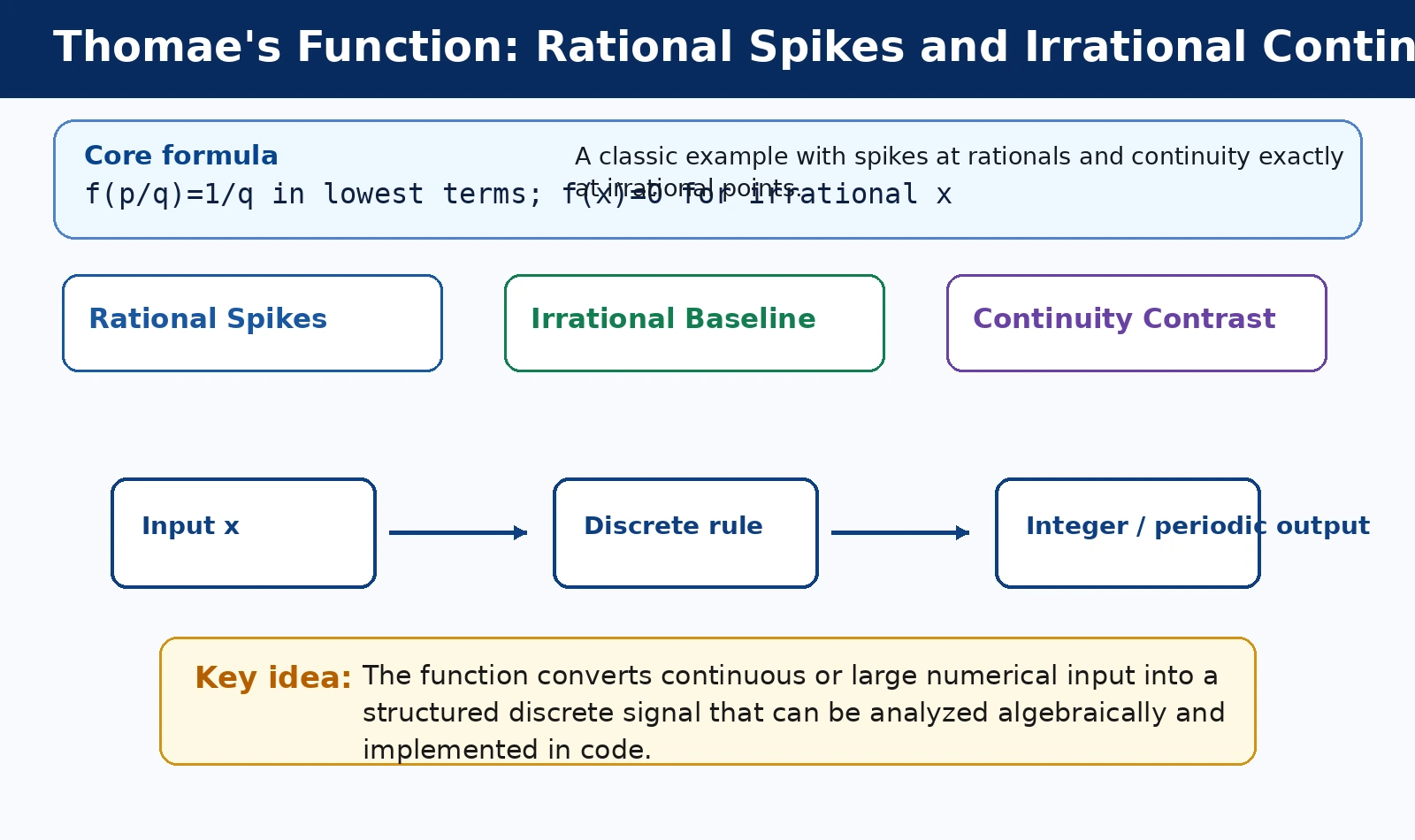
Thomae's function represents a pivotal example in mathematical analysis. It is defined specifically across the real number line. This function maps every rational number in its simplest form to a specific positive value related to its denominator structure.
For any rational number ##x = p/q##, where ##p## and ##q## are coprime integers and ##q > 0##, the function value is ##1/q##. This mapping ensures that larger denominators result in smaller functional values across the domain.
Conversely, for every irrational number ##x##, the function is defined as ##f(x) = 0##. This distinction creates a stark contrast between the two sets of real numbers. The resulting behavior is highly non-intuitive for many students.
Mathematically, the expression is written as:
This notation clearly distinguishes the two cases for analytical purposes.
This definition covers the entire real line without any gaps or undefined points. However, the distribution of these values is what makes the function "pathological." It challenges the traditional understanding of how functions behave on dense sets.
Visual Interpretation and Naming
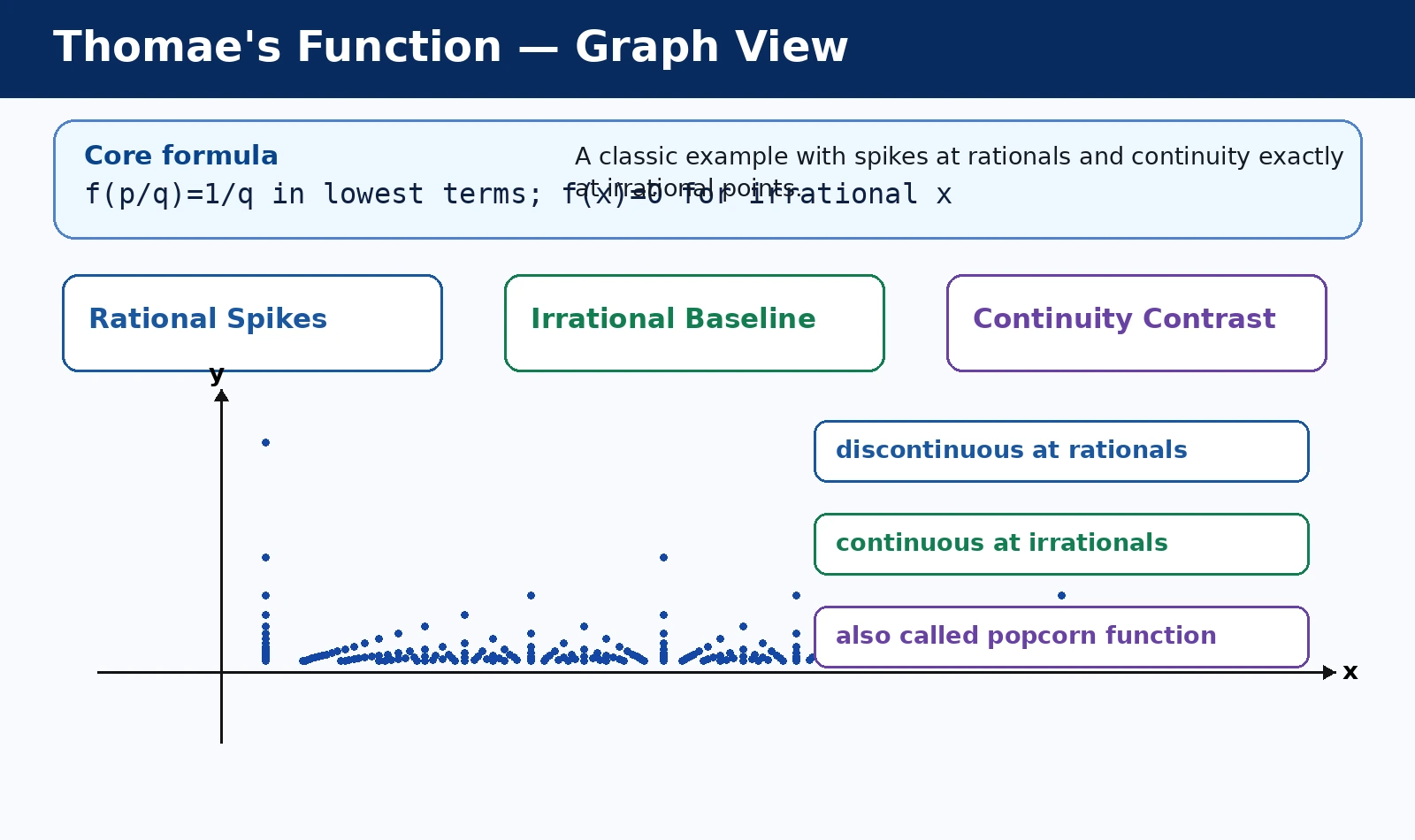
Visually, Thomae's function is often called the "Stars over Babylon" or the "Popcorn Function." When plotted, the points for rational numbers appear to float above the x-axis. These points form a cloud-like or popcorn-like pattern.
For integers, where ##q = 1##, the function value is ##1##. As the denominator ##q## increases, the points get closer and closer to the x-axis. This creates a tapering effect as we look at finer rational divisions.
The irrational points all lie exactly on the x-axis. Since the irrationals are dense, there is a solid line of points at ##y = 0##. This visual density is deceptive when considering the function's continuity properties.
The graph looks like a series of spikes that get shorter as the denominators of the rational numbers grow. This visual representation helps mathematicians conceptualize why the function behaves differently at rational versus irrational points.
Despite the seemingly chaotic distribution, there is a strict order defined by the denominators. This order is the key to proving various analytical properties. The visual spikes provide an intuitive bridge to the rigorous epsilon-delta proofs.
Analyzing Continuity at Irrational Points
The Epsilon-Delta Perspective
To analyze the continuity of Thomae's function, we must use the formal epsilon-delta definition. This requires showing that for any given small value epsilon, we can find a corresponding interval delta around our chosen point.
For an irrational number ##c##, the function value ##f(c)## is zero. Therefore, we need to prove that the limit of ##f(x)## as ##x## approaches ##c## is also zero. This involves examining the rational values.
Given ##\epsilon > 0##, there are only finitely many rational numbers in any bounded interval with a denominator ##q## such that ##1/q \ge \epsilon##. This is a crucial observation for the proof's success.
We can choose a delta small enough so that the interval ##(c - \delta, c + \delta)## contains none of these specific rational numbers. This leaves only irrationals and rationals with very large denominators.
In this small interval, all values of ##f(x)## will be less than epsilon. Since this holds for any epsilon, the limit at the irrational point ##c## is zero, satisfying the definition of continuity.
Limiting Behavior Near Irrationals
The limiting behavior near irrationals is unique because the function "settles" toward zero. Even though rational numbers are dense, those with small denominators are spaced out. This allows the function to approach zero smoothly.
As we zoom in on an irrational number, the rational numbers we encounter have increasingly larger denominators. Consequently, their functional values ##1/q## become increasingly smaller. This trend continues indefinitely as we get closer.
This behavior contrasts with many standard functions. Usually, continuity implies a smooth connection between points. Here, continuity is maintained because the "spikes" of the rational points vanish as they approach the irrational target.
The set of points where the function is greater than a certain threshold is always discrete. This property ensures that the limit from both the left and right sides of an irrational point is consistently zero.
Therefore, the function is continuous at every irrational point in its domain. This result is often surprising because there are no intervals where the function is continuous, only isolated points of irrationality.
We Also Published
Exploring Discontinuity at Rational Points
The Failure of Limits for Rationals
At any rational point ##a = p/q##, the function value ##f(a)## is ##1/q##, which is strictly greater than zero. For continuity to exist, the limit of the function as ##x## approaches ##a## must equal ##1/q##.
However, every interval around the rational number ##a## contains infinitely many irrational numbers. For all these irrational numbers ##x##, the function value ##f(x)## is exactly zero. This creates a persistent discrepancy.
No matter how small we make the interval around ##a##, we will always find points where the function is zero. Thus, the limit cannot be ##1/q##. The function constantly jumps back to the axis.
This means that for any ##\epsilon < 1/q##, we cannot find a delta that keeps all functional values within epsilon of ##f(a)##. The irrational points will always fall outside this narrow range.
Consequently, Thomae's function is discontinuous at every rational point. The "jump" at these points is equal to the value ##1/q##. This makes every rational point a point of simple jump discontinuity.
Comparing with Dirichlet's Function
It is helpful to compare Thomae's function with the Dirichlet function. The Dirichlet function is defined as one for all rationals and zero for all irrationals. It is discontinuous at every single point.
Thomae's function is often seen as a "modified" Dirichlet function. By changing the rational output from a constant to ##1/q##, we introduce a level of "decay" that allows for continuity at the irrationals.
While the Dirichlet function is nowhere continuous, Thomae's function is continuous on a massive set. Specifically, it is continuous on the set of irrationals, which has full Lebesgue measure on the real line.
This comparison highlights how small changes in a function's definition can lead to vastly different topological properties. One remains completely chaotic, while the other gains continuity on a dense set of points.
Understanding this distinction is vital for students of real analysis. It demonstrates that the distribution and "size" of the rational values determine the local behavior of the function across the entire domain.
Topological Significance and Applications
Role as a Pathological Counterexample
In topology and analysis, Thomae's function is a classic "pathological" example. It provides a counterexample to the intuitive idea that a function continuous on a dense set must be continuous elsewhere.
It shows that the set of points of continuity of a function can be exactly the set of irrational numbers. This set is a ##G_\delta## set, which is a fundamental concept in topology.
Conversely, it is impossible to construct a function that is continuous at every rational point and discontinuous at every irrational point. Thomae's function helps prove this asymmetry in real analysis.
The function also serves as an example of a function that is Riemann integrable despite having infinitely many discontinuities. This property is particularly useful when teaching the criteria for Riemann integrability.
By studying such "strange" functions, mathematicians can refine their definitions and theorems. Thomae's function pushes the boundaries of what we consider a "well-behaved" or "predictable" mathematical mapping in a real space.
Integration and Measure Theory Context
From the perspective of integration, Thomae's function is quite well-behaved. Since it is discontinuous only on a set of measure zero (the rationals), it is Riemann integrable over any closed interval.
The Riemann integral of Thomae's function over any interval ##[a, b]## is always zero. This is because the function is zero "almost everywhere" in the sense of Lebesgue measure theory.
This result illustrates that a function can have a non-zero value at many points but still have an integral of zero. The rational spikes are too "thin" to contribute any area.
In Lebesgue integration, the function is also integrable, and its integral is zero. This consistency across different types of integration reinforces its importance in advanced calculus and measure theory curriculum.
Ultimately, Thomae's function serves as an elegant bridge between elementary continuity and advanced measure theory. It remains a favorite tool for educators to challenge and expand the mathematical horizons of students.
From our network :
- Vite 6/7 'Cold Start' Regression in Massive Module Graphs
- https://www.themagpost.com/post/analyzing-trump-deportation-numbers-insights-into-the-2026-immigration-crackdown
- 98% of Global MBA Programs Now Prefer GRE Over GMAT Focus Edition
- https://www.themagpost.com/post/trump-political-strategy-how-geopolitical-stunts-serve-as-media-diversions
- Mastering DB2 12.1 Instance Design: A Technical Deep Dive into Modern Database Architecture
- EV 2.0: The Solid-State Battery Breakthrough and Global Factory Expansion
- Mastering DB2 LUW v12 Tables: A Comprehensive Technical Guide
- AI-Powered 'Precision Diagnostic' Replaces Standard GRE Score Reports
- 10 Physics Numerical Problems with Solutions for IIT JEE
RESOURCES
- Thomae's function - Wikipedia
- Prove continuity/discontinuity of the Popcorn Function (Thomae's ...
- How to plot Thomae's function : r/Julia - Reddit
- The Thomae Function: Fractal Insights - arXiv
- why is thomae's function riemann integrable but dirichlet's ... - Reddit
- Pendulum waves: A model of Thomae's function - AIP Publishing
- [2510.20832] The Thomae Function: Fractal Insights - arXiv
- Popcorn Function (Thomae's function): Definition, Formula and Graph
- Quotient Spaces Generated by Thomae's Function over the Real Line
- The Popcorn Function - ThatsMaths
- Thomae's function and the space of ergodic measures
- Video. Riemann Integrable Functions - Advanced Analysis
- Continuity of Thomae's Function - UBC Blogs
- Modifications of Thomae's Function and Differentiability - JSTOR
- Multifractal analysis of Thomae's function - 2025 - ORBi

0 Comments