On This Page
Introduction to the Signum Function
Formal Definition and Notation
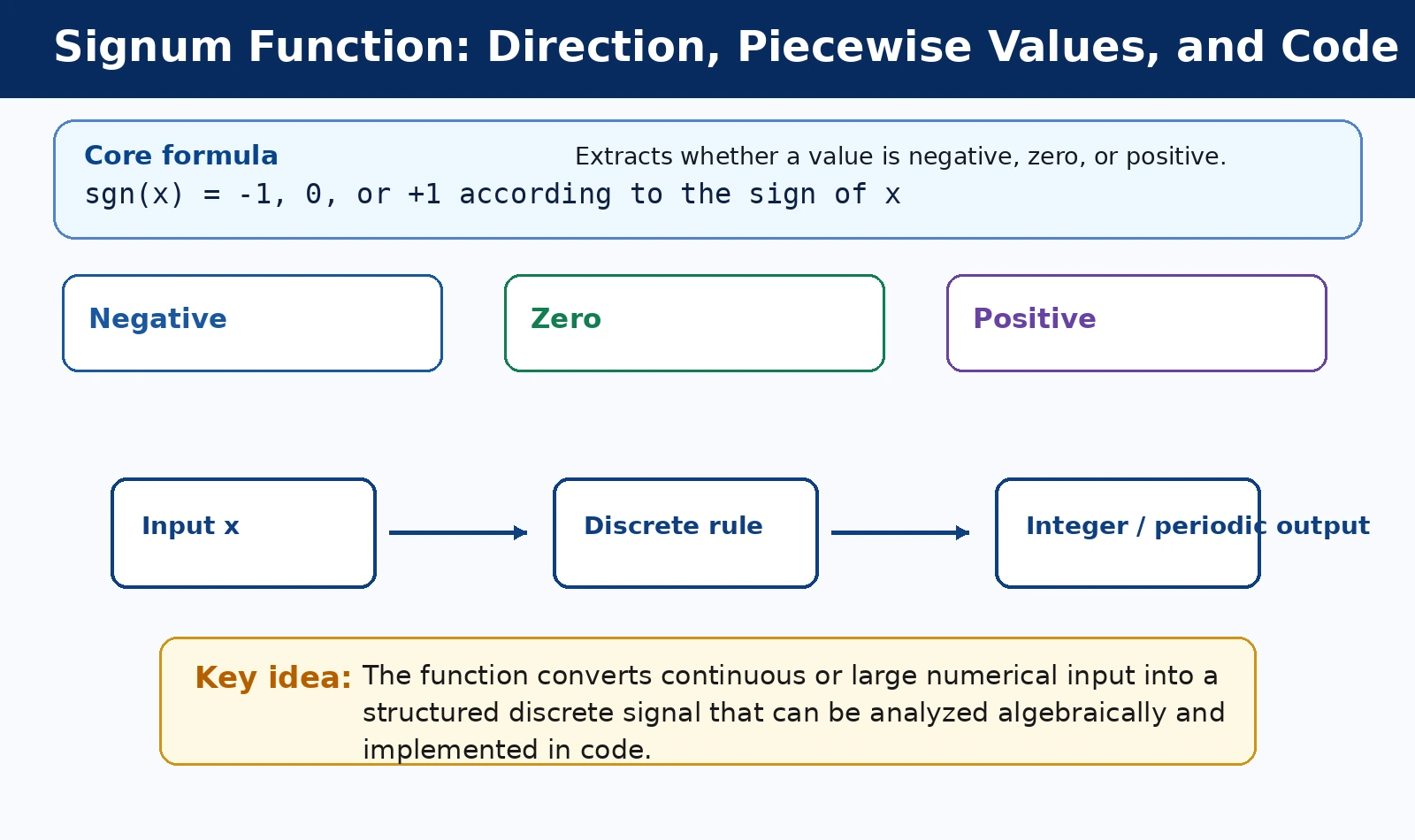
The signum function is a fundamental mathematical operation used to determine whether a real number is positive, negative, or zero. It is traditionally denoted by the symbol ##\text{sgn}(x)## or sometimes written as sign(x) in various programming environments. This function is essential for isolation.
Unlike many continuous functions, the signum function focuses entirely on the direction of a value rather than its size. It maps the infinite set of real numbers onto a very small set of just three discrete integers. This simplification is useful.
In most mathematical contexts, the domain of the signum function includes all real numbers. The range, however, is strictly limited to the values ##\{-1, 0, 1\}##. This specific output set makes it a classic example of a step-like function.
The name "signum" comes from the Latin word for "sign," which perfectly describes its primary purpose in algebraic expressions. By stripping away magnitude, it allows mathematicians to focus purely on the polarity of variables within complex equations or models.
Understanding the signum function is a prerequisite for studying more advanced topics like generalized functions or distribution theory. It provides a bridge between basic arithmetic and the higher-level analysis required in modern physics and engineering disciplines today.
Piecewise Functional Representation
To understand how the signum function operates, one must look at its piecewise definition. This definition splits the function into three distinct rules based on the input value of ##x##. It ensures that every real number has a result.
The formal piecewise representation is shown below to clarify the logic. Each condition covers a specific part of the real number line, ensuring there are no overlaps or gaps in the function's definition across the entire domain of numbers.
When the input ##x## is any positive value, the output is always positive one. This remains true whether ##x## is a tiny fraction or a massive integer. The magnitude is completely ignored in favor of the positive sign.
Conversely, for any negative input, the function returns negative one. If the input is exactly zero, the function returns zero. This middle case is important for maintaining symmetry and providing a clear output for the origin point.
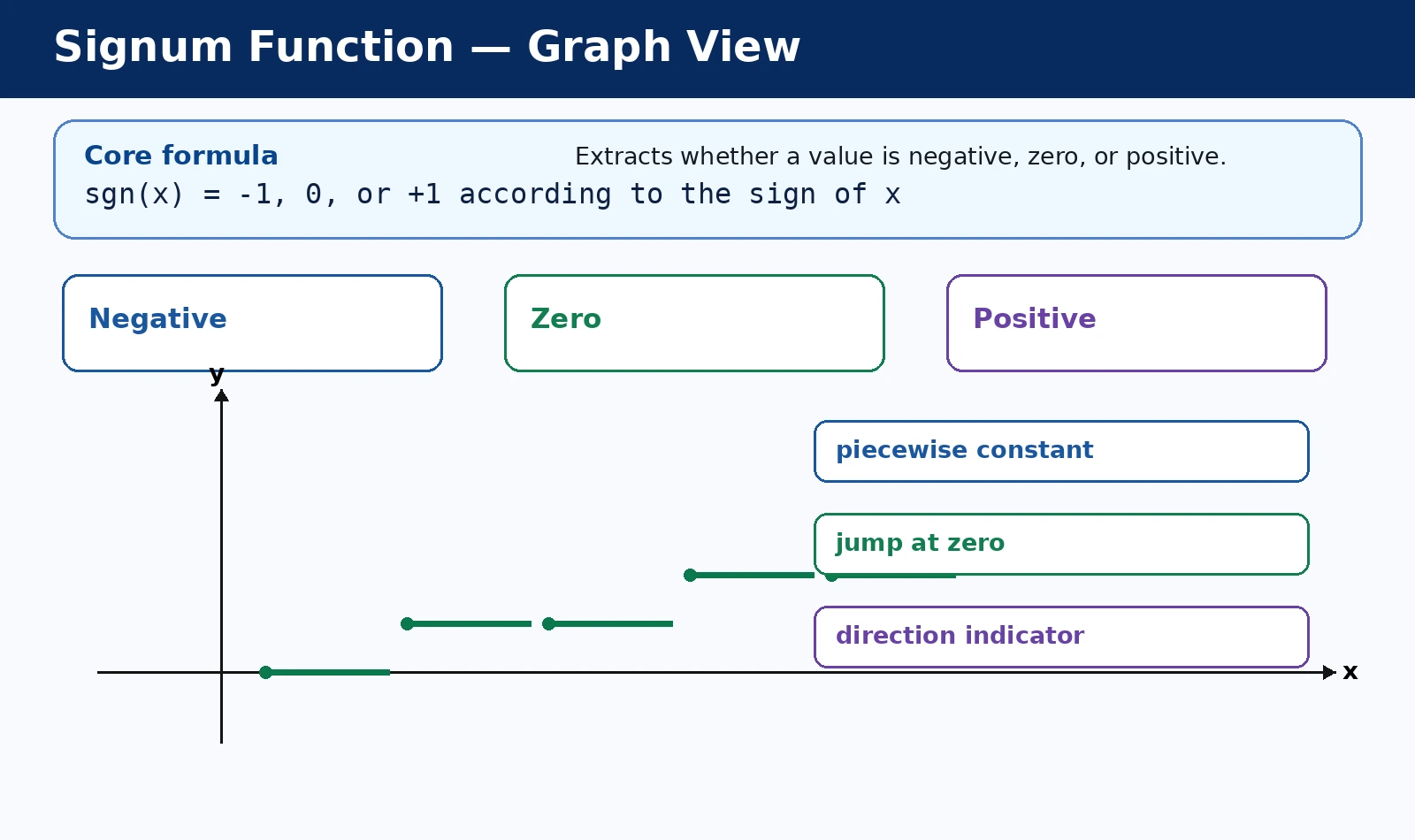
Graphically, the signum function appears as two horizontal rays and a single point at the origin. There is a jump discontinuity at ##x = 0##, which is a defining characteristic that influences how the function is treated in calculus.
Mathematical Identities and Calculus
Relationship with the Absolute Value
One of the most important identities involving the signum function is its relationship with the absolute value function. For any non-zero real number ##x##, the signum of ##x## can be expressed as the ratio of the number to its magnitude.
This relationship is often written as ##\text{sgn}(x) = \frac{x}{|x|}##. This formula highlights how the function effectively "normalizes" a number to a unit value while preserving its original sign. It is a common identity used in many proofs.
Alternatively, the absolute value of a number can be defined as the product of the number and its signum. Multiplying ##x## by ##\text{sgn}(x)## always results in ##|x|##, which is a useful algebraic substitution in various mathematical derivations.
These identities are particularly helpful when simplifying expressions that involve square roots of squares. Since ##\sqrt{x^2} = |x|##, the signum function naturally appears when one needs to handle the sign of the square root across different quadrants.
In vector calculus, this concept is extended to define unit vectors. Just as the signum function provides a unit direction for a scalar, dividing a vector by its magnitude provides a unit vector in the same direction.
Continuity and the Dirac Delta
In standard calculus, the signum function is differentiable everywhere except at the point ##x = 0##. At the origin, the function experiences an abrupt jump from -1 to 1, making it non-continuous and therefore not traditionally differentiable there.
However, in the context of distribution theory, the derivative of the signum function can be defined. It is related to the Dirac delta function, which is a generalized function used to represent impulses in physics and engineering systems.
Specifically, the derivative of ##\text{sgn}(x)## is equal to twice the Dirac delta function, denoted as ##2\delta(x)##. This relationship is vital for solving differential equations that involve sudden changes or impulsive forces within a physical system.
The signum function is also closely related to the Heaviside step function, often denoted as ##H(x)##. The relationship can be expressed as ##\text{sgn}(x) = 2H(x) - 1##, assuming the standard convention where ##H(0) = 0.5## is used.
These connections allow engineers to use the signum function within Fourier transforms and Laplace transforms. It plays a significant role in analyzing signals that switch states instantaneously, providing a mathematical framework for discontinuous phenomena in nature.
We Also Published
Engineering and Algorithmic Applications
Signal Processing and Quantization
In the field of signal processing, the signum function is used as a basic quantizer. It is often referred to as a "hard limiter" because it forces any input signal into one of two or three discrete states.
This limiting behavior is essential for converting analog signals into digital formats. By applying the signum function, a continuous waveform can be reduced to a sequence of bits representing the sign of the amplitude at specific sampling intervals.
Noise reduction algorithms also utilize the signum function. By focusing only on the sign of the signal, certain types of low-level additive noise can be ignored, allowing the primary phase or frequency information of the signal to remain.
In control theory, the signum function appears in sliding mode control. This technique uses a high-frequency switching logic to force the state of a system to "slide" along a desired equilibrium path, ensuring robustness against external disturbances.
The function is also used in the design of digital filters and modulators. Its simplicity allows for very fast computation, which is necessary for real-time processing in telecommunications equipment and audio hardware found in modern consumer electronics today.
Implementation in Computational Logic
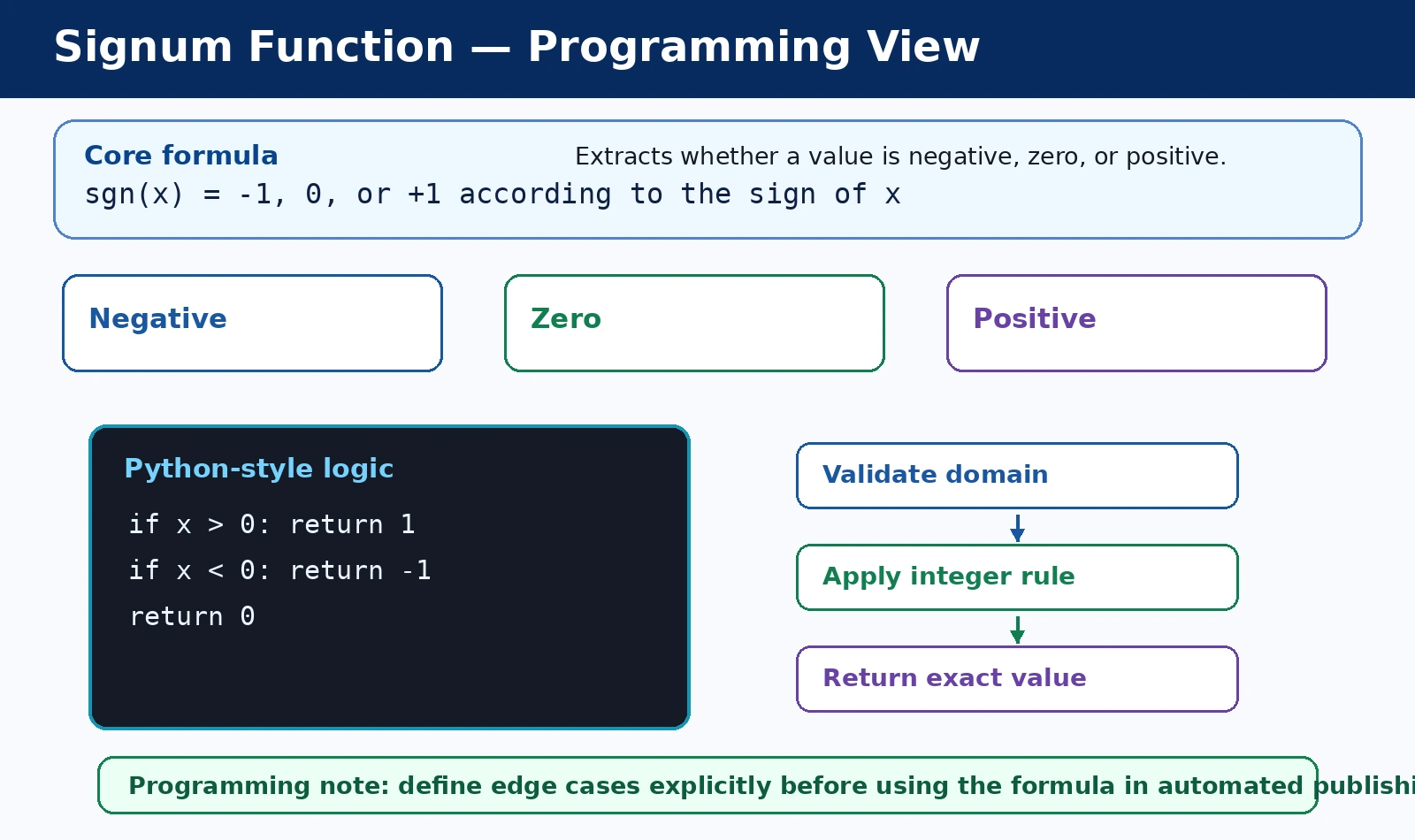
From a programming perspective, the signum function is a common utility in almost every standard library. Most languages like C++, Python, and Java provide a built-in method to calculate the sign of an integer or a floating-point number.
Implementing the function manually is straightforward using conditional logic. A simple "if-else" structure or a ternary operator can return the appropriate value. This is often one of the first logic exercises taught to beginning computer science students.
In high-performance computing, developers often use "branchless" implementations of the signum function. These use bitwise operations to avoid the performance penalty associated with CPU branch prediction failures, which can occur during heavy numerical processing of large datasets.
Machine learning models, particularly neural networks, sometimes use variations of the signum function as activation functions. While non-differentiable at zero, they are useful in binary classification tasks where the goal is to categorize data into two groups.
The function is also prevalent in game development for physics engines. It helps determine the direction of friction forces or collision responses, ensuring that objects move realistically according to the signs of their velocity and acceleration vectors.
Theoretical Generalizations
The Complex Signum Function
While the standard signum function is defined for real numbers, it can be generalized for complex numbers as well. For a complex number ##z##, the signum is defined as the number divided by its complex magnitude or modulus.
The formula for the complex signum is
for all ##z \neq 0##. If ##z = 0##, the result is typically defined as 0. This extension maps complex numbers to the unit circle in the complex plane.
This generalization is important because it preserves the "direction" of the complex number while setting its magnitude to one. It is essentially the complex equivalent of a unit vector, providing the phase information of the complex value.
In complex analysis, this function helps in the study of polar forms and rotations. It allows mathematicians to isolate the angular component of a complex variable, which is useful in electromagnetism and fluid dynamics where phases are critical.
The complex signum function is not holomorphic, meaning it does not satisfy the Cauchy-Riemann equations. Despite this, it remains a valuable tool in theoretical physics, particularly in the study of wave functions and quantum mechanics representations.
Role in Differential Equations
The signum function frequently appears in non-linear differential equations, especially those modeling systems with dry friction or "bang-bang" control laws. These systems change their behavior abruptly when a variable crosses a zero threshold during operation.
Solving such equations requires specialized techniques because the discontinuity at zero prevents the use of standard power series or linear methods. Mathematicians often use Filippov's theory to define solutions for these types of discontinuous differential equations.
In mechanical systems, the signum function models Coulomb friction. The force of friction is proportional to the signum of the relative velocity, meaning it always opposes the direction of motion regardless of how fast the object moves.
Optimization problems also leverage the signum function through the use of subgradients. In L1 regularization, the derivative of the absolute value term is the signum function, which leads to sparse solutions in statistical modeling and data science.
Overall, the signum function is a deceptively simple tool that provides profound utility across diverse fields. From basic algebra to advanced theoretical physics, its ability to extract directionality makes it an indispensable part of the mathematical toolkit.
From our network :
- Vite 6/7 'Cold Start' Regression in Massive Module GraphsIn-depth analysis of Vite 6/7 cold start regressions in massive module graphs. Learn about barrel file issues, pre-bundling optimizations, and how to improve Vite dev server performance.
- Mastering DB2 LUW v12 Tables: A Comprehensive Technical GuideComprehensive guide on DB2 LUW v12 tables. Explore CREATE TABLE syntax, BLU Acceleration, range partitioning, data types, and security features for IBM DB2 LUW v12.
- Analyzing Trump Deportation Numbers Insights Into The 2026 Immigration Crackdown
- Mastering DB2 12.1 Instance Design: A Technical Deep Dive into Modern Database ArchitectureComprehensive guide to DB2 12.1 Instance Design. Explore architectural components, HADR setup, buffer pool tuning, and security policies for IBM DB2 12.1. Includes 10 functional SQL and Shell samples.
- 10 Physics Numerical Problems with Solutions for IIT JEEPrepare for IIT JEE with 10 physics numerical problems, complete with detailed solutions and conceptual explanations. Ideal for mastering kinematics, thermodynamics, electromagnetism, and optics.
- AI-Powered 'Precision Diagnostic' Replaces Standard GRE Score ReportsDiscover the new GRE Precision Diagnostic. Learn how AI-powered behavioral analytics and time-to-solve tracking are replacing standard GRE score reports to empower students.
- Trump Political Strategy How Geopolitical Stunts Serve As Media Diversions
- EV 2.0: The Solid-State Battery Breakthrough and Global Factory ExpansionDiscover the impact of the Solid-State Battery Breakthrough on the EV market. Learn about CATL and BYD stock growth, global factory expansion in Europe, and the future of EV 2.0 technology.
- 98% of Global MBA Programs Now Prefer GRE Over GMAT Focus EditionExplore why 98% of global MBA programs now prefer the GRE over GMAT Focus. Learn about the shorter GRE format, verbal logic importance, and strategic versatility for students.
RESOURCES
- Sign function - Wikipedia
- signum function - Google Groups
- signum function - sign(x) - Development - Arduino Forum
- Sign -- from Wolfram MathWorld
- How to define my own signum function - MATLAB Answers
- Signum function - RStan - The Stan Forums
- sign - Sign function (signum function) - MATLAB - MathWorks
- Can you redefine the signum function (sign of a number ... - Reddit
- sign() function - CUDA - NVIDIA Developer Forums
- Is there a standard sign function (signum, sgn) in C/C++?
- What is the Latex convention for sign function? [closed]
- The signum function expressed using a single formula
- Signum and Dirac Delta Functions - Use of Results - PTC Community
- Why doesn't Python have a sign function? - Stack Overflow
- SIGN Function - Alteryx Community



0 Comments