On This Page
Formal Definition of the Modulo Operation
The modulo function serves as a fundamental operation within various branches of discrete mathematics and computer science. It essentially calculates the remainder remaining after the division of one number by another, providing a consistent result based on these specific rules.
This operation is frequently encountered in programming languages, where it is denoted by the percent symbol or the word mod. Understanding its formal definition is crucial for developers and mathematicians who require precision when handling periodic data or cyclical patterns.
Unlike simple division, the modulo operation focuses specifically on what is left over after the divisor has been subtracted as many times as possible. This makes it an indispensable tool for tasks involving constraints, rotations, and modular arithmetic systems.
The function is not merely a computational convenience but a rigorous mathematical concept with deep roots in number theory. It allows for the classification of integers into congruence classes, which simplifies the analysis of large numbers and complex algebraic structures.
In this technical guide, we will dissect the formulaic definition of the modulo function. We will explore how it utilizes the floor function to maintain consistency across the set of real numbers, including both positive and negative integer dividends.
The Mathematical Formula
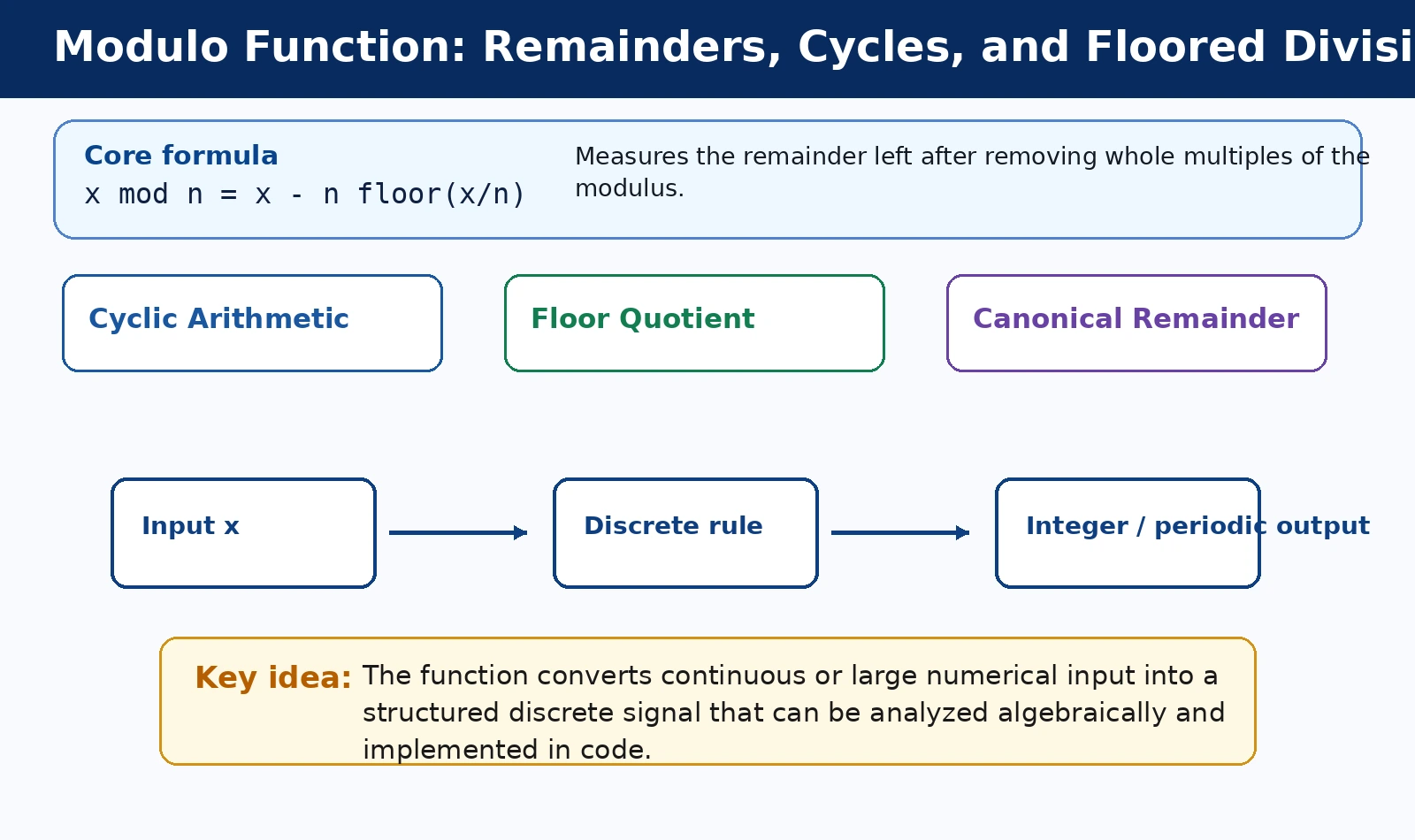
The mathematical definition of the modulo function is typically expressed using the dividend ##x## and the divisor ##n##. The specific formula used to calculate the remainder is
in most technical contexts.
In this equation, the term ##x## represents the total value being divided, while ##n## represents the size of the divisor. The result of the operation is the remainder, which must satisfy the conditions set by the Euclidean division theorem.
By using this precise formula, mathematicians can ensure that the result of the modulo operation is always predictable. This predictability is essential when implementing algorithms that rely on modular arithmetic to manage data indices or to perform complex cryptographic calculations.
The formula highlights the relationship between the original number and its quotient when divided by the divisor. By subtracting the product of the divisor and the floor of the quotient, we isolate the fractional part that constitutes the remainder.
It is important to note that the divisor ##n## must be a non-zero value for the operation to be defined. Division by zero remains undefined in this context, just as it does in standard arithmetic and other mathematical functional operations.
Understanding the Floor Function Component
The floor function, denoted by the symbols ##\lfloor \rfloor##, is a vital component of the modulo definition. It maps a real number to the largest integer that is less than or equal to that number, effectively rounding down the value.
In the context of the modulo formula, the floor function determines how many full units of the divisor fit into the dividend. This ensures that the calculation accounts for the direction of the number line, especially when dealing with negatives.
Without the floor function, the remainder might not consistently fall within the desired range of zero to the divisor. The floor function provides the necessary anchoring to the nearest lower integer, which is the standard approach in most definitions.
For positive numbers, the floor function simply truncates the decimal portion of the division result. However, for negative numbers, it moves further away from zero toward the next lower integer, which significantly impacts the final value of the modulo result.
Understanding this rounding behavior is the key to mastering modular arithmetic in technical applications. It explains why different programming languages might return different results if they use truncation instead of the floor function for their internal modulo operator implementations.
Behavior with Positive and Negative Integers
The behavior of the modulo function varies depending on whether the dividend and divisor are positive or negative. This section examines how the formula handles these different scenarios to produce a remainder that always lies within the half-open interval.
When both the dividend and the divisor are positive, the operation is straightforward and aligns with basic division remainders. However, the introduction of negative values requires a more rigorous application of the floor function to maintain the mathematical consistency required.
Mathematical consistency ensures that the modulo function remains periodic across the entire number line. This property is vital for functions that model repeating cycles, such as the hands of a clock or the phases of a recurring digital signal.
By strictly adhering to the definition involving the floor function, we avoid the ambiguities that arise from simple remainder calculations. This technical approach provides a unified method for calculating remainders regardless of the sign of the input values.
We will now look at specific examples to illustrate how the formula works in practice. These examples will demonstrate the calculation steps for both positive and negative dividends, highlighting the influence of the floor function on the output.
Positive Dividend and Divisor
Consider the example where we calculate ##7 \pmod 3## to find the remainder. Applying the formula, we first divide seven by three to get approximately two point three three, then we apply the floor function to get the integer two.
Next, we multiply the divisor three by the floor result two, which gives us six. Subtracting this six from the original dividend seven yields a remainder of one. This result is consistent with our intuitive understanding of division and remainders.
In this case, the remainder one is clearly within the expected range of zero to three. The process is simple because the floor of a positive fraction is just the integer part, making the calculation very easy to perform mentally.
Most elementary students learn this form of the modulo operation without ever hearing the term modulo. They simply call it the remainder, which works perfectly fine as long as all the numbers involved in the calculation remain strictly positive.
However, the technical definition becomes much more important when we move beyond these simple cases. As we introduce negative numbers, the floor function ensures that the mathematical properties of the operation are preserved across the entire set of integers.
Negative Dividend and Modular Consistency
When calculating ##(-7) \pmod 3##, the floor function’s behavior becomes the critical factor. Dividing negative seven by three results in approximately negative two point three three. The floor of this value is negative three, not negative two, as expected.
Applying the formula, we multiply the divisor three by negative three to get negative nine. We then subtract this negative nine from the original dividend of negative seven. This calculation results in a positive remainder of two for the operation.
This result might seem counterintuitive at first, but it ensures that the remainder remains positive. By producing a two instead of a negative one, the function satisfies the requirement that the result must always be within the range ##[0, n)##.
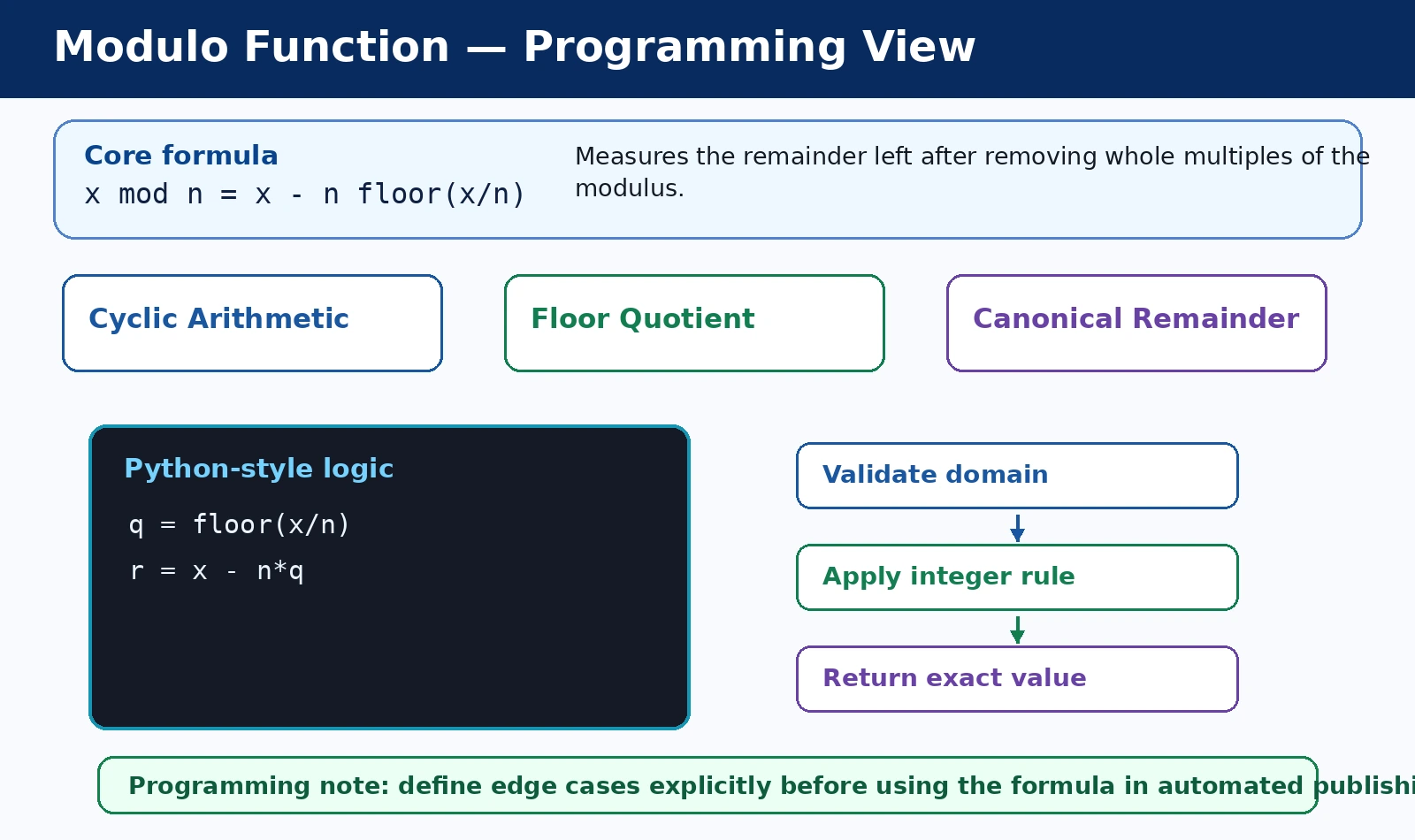
This consistency is what distinguishes the mathematical modulo function from the remainder operator found in some programming languages. Some languages use truncation, which would return negative one, potentially causing errors in algorithms that expect only non-negative results for remainders.
Understanding this distinction is vital for software engineers who work across different platforms. It highlights the importance of using the floor function definition when a truly periodic and non-negative remainder is required for the logic of the application.
We Also Published
Properties and Range of the Remainder
The properties of the modulo function define its utility in theoretical and applied mathematics. This section focuses on the specific range of the output and how the function behaves over a continuous sequence of inputs, emphasizing its inherent cyclic nature.
One of the most important properties is that the result is always bounded by the divisor. This constraint allows mathematicians to map an infinite set of integers onto a finite set of remainders, which is the basis of modular arithmetic systems.
Furthermore, the modulo function is distributive over addition and multiplication, which simplifies complex calculations. These properties allow for the reduction of large numbers before performing operations, making it possible to handle extremely large values in fields like modern cryptography.
The function also exhibits a clear pattern of periodicity, which means it repeats its values at regular intervals. This makes it an ideal tool for modeling any system that returns to a starting state after a certain number of steps.
We will explore these properties in more detail by looking at the interval constraints and the cyclic behavior. These concepts are fundamental to understanding how modular arithmetic functions as a consistent and reliable mathematical system for various technical scientific fields.
The Interval Constraint [0, n)
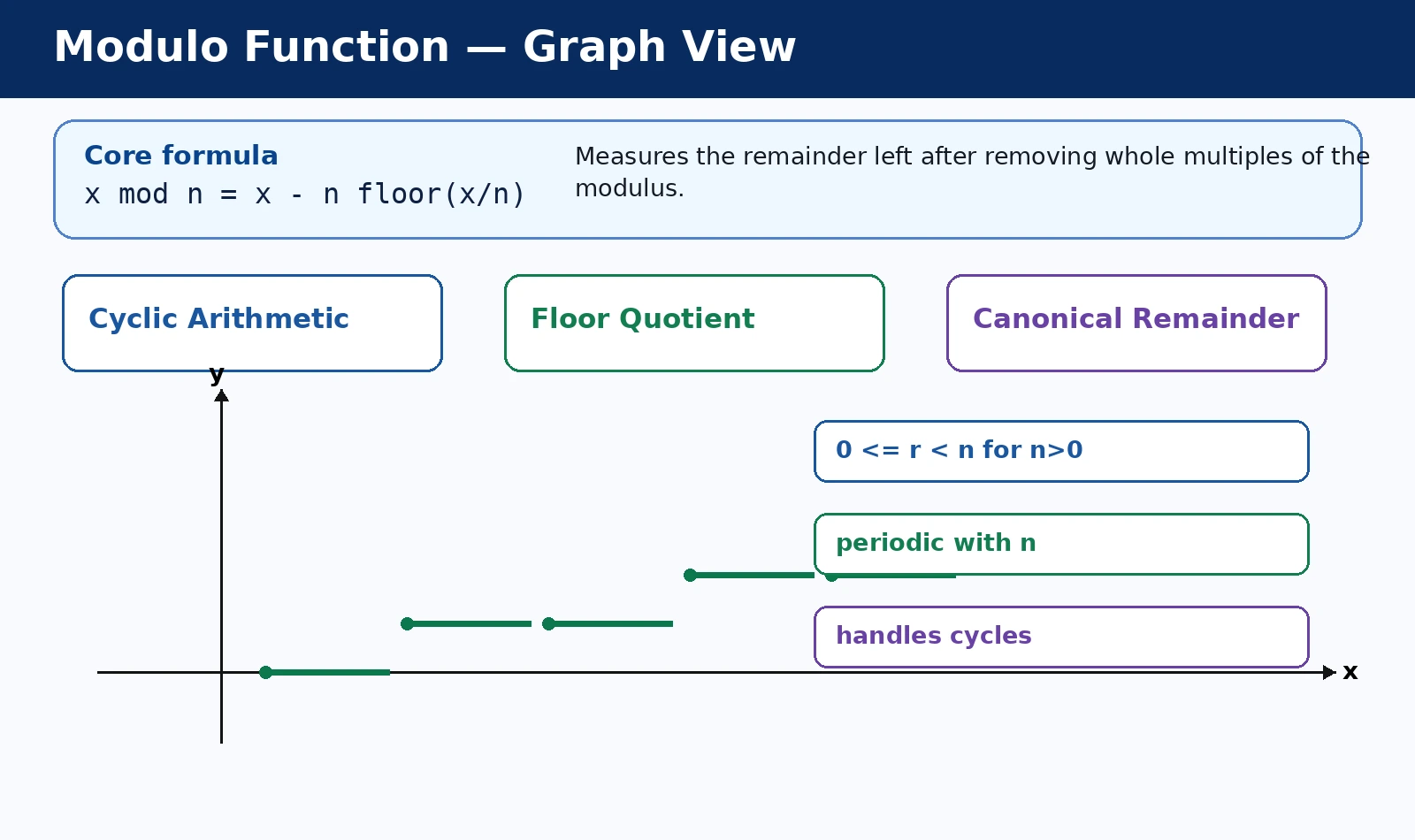
The remainder produced by the modulo function ##x \pmod n## is strictly confined to the interval ##[0, n)##. This means the result is always greater than or equal to zero and strictly less than the value of the divisor used.
This specific range is a direct consequence of the floor function used in the definition. By always rounding down to the nearest integer, the formula ensures that the subtracted product is large enough to leave a non-negative remainder every time.
If the dividend ##x## is a multiple of the divisor ##n##, the remainder will be zero. This indicates that the divisor fits perfectly into the dividend, leaving nothing over, which is the lower bound of our defined interval range.
As the dividend increases, the remainder also increases until it reaches ##n-1##. At the next increment, the remainder resets to zero, maintaining the boundary. This boundary is essential for keeping data within specific limits, such as array index values.
In technical terms, this interval constraint ensures that the modulo operation is a well-defined function. Every input corresponds to exactly one output within the set range, providing the mathematical certainty needed for complex logical operations in modern computing environments.
Periodicity and Cyclic Behavior
The modulo function is naturally periodic with a period equal to the divisor ##n##. This means that for any integer ##k##, the value of ##(x + k \cdot n) \pmod n## is always equal to the value of ##x \pmod n##.
This periodicity creates a cyclic pattern that can be visualized as a circle or a clock face. As we move along the number line, the modulo result cycles through the same sequence of values over and over again indefinitely.
This property is extensively used in computer science to implement circular buffers and wrap-around counters. It allows developers to keep a value within a specific range without needing complex conditional statements to check for upper and lower boundary limits.
In the study of waves and oscillations, modular arithmetic helps in describing the phase of a periodic signal. By taking the modulo of the time or position, researchers can determine the exact point within the cycle at any time.
The cyclic nature also plays a role in group theory, where the set of integers modulo ##n## forms a cyclic group. This algebraic structure is the foundation for many advanced topics in mathematics and provides a way to study symmetry.
Practical Applications in Computing and Science
The modulo function is not just a theoretical concept; it has numerous practical applications across various scientific and technical disciplines. This final section explores how the function is implemented in real-world scenarios to solve complex problems and optimize systems.
From the way computers store data to the methods used to secure online communications, the modulo operation is everywhere. Its ability to handle large numbers and create predictable cycles makes it an essential tool for modern technology and engineering.
In the field of computer science, the function is used in everything from simple loops to advanced data structures. It provides a quick and efficient way to map keys to slots in hash tables, ensuring even distribution of data.
Engineers also rely on the modulo function for tasks involving timing and synchronization. By using modular arithmetic, they can ensure that different parts of a system remain in sync, even when they are operating at different speeds or frequencies.
We will now look at two specific areas where the modulo function is particularly important: cryptography and digital signal processing. These examples will illustrate the power and versatility of this simple yet profound mathematical operation in our modern world.
Cryptography and Hash Functions
In cryptography, the modulo function is the cornerstone of many encryption algorithms, such as RSA and Diffie-Hellman. These systems rely on the difficulty of reversing modular exponentiation, a problem that provides the security for most of our online transactions.
By performing calculations within a finite field defined by a large prime number and the modulo operation, cryptographers can create secure keys. The properties of modular arithmetic ensure that the results are unpredictable to anyone without the correct key.
Hash functions also make extensive use of the modulo operation to transform input data into a fixed-size string of characters. This is crucial for verifying data integrity and for the efficient retrieval of information from large databases and files.
The modulo function helps in distributing hash values uniformly across the available space, which minimizes collisions. This efficiency is vital for the performance of search engines, social media platforms, and other data-intensive applications that we use every day.
Without the mathematical properties provided by the modulo function, modern digital security would be impossible. It provides the necessary complexity and unpredictability required to protect sensitive information from unauthorized access in an increasingly connected and digital global society.
Digital Signal Processing and Timing
Digital signal processing utilizes the modulo function to manage periodic signals and digital filters. It is particularly useful for handling phase shifts and for implementing algorithms that require the wrapping of data, such as the Fast Fourier Transform process.
Timing circuits in digital electronics also use modular counters to keep track of clock cycles. These counters reset to zero after reaching a certain value, which is exactly what the modulo function describes in its most basic mathematical form.
In computer graphics, the modulo operation is used to create repeating textures and patterns. By applying the function to coordinate values, developers can tile an image across a large surface without needing to store multiple copies of the data.
This technique saves memory and processing power, making it possible to render complex scenes in real-time. It is a perfect example of how a simple mathematical concept can lead to significant optimizations in high-performance computing and software development.
In conclusion, the modulo function is a versatile and essential tool that bridges the gap between theoretical mathematics and practical engineering. Its formal definition using the floor function ensures consistency and reliability across a wide range of technical applications.
From our network :
- 98% of Global MBA Programs Now Prefer GRE Over GMAT Focus Edition
- Vite 6/7 'Cold Start' Regression in Massive Module Graphs
- https://www.themagpost.com/post/trump-political-strategy-how-geopolitical-stunts-serve-as-media-diversions
- Mastering DB2 12.1 Instance Design: A Technical Deep Dive into Modern Database Architecture
- EV 2.0: The Solid-State Battery Breakthrough and Global Factory Expansion
- Mastering DB2 LUW v12 Tables: A Comprehensive Technical Guide
- https://www.themagpost.com/post/analyzing-trump-deportation-numbers-insights-into-the-2026-immigration-crackdown
- AI-Powered 'Precision Diagnostic' Replaces Standard GRE Score Reports
- 10 Physics Numerical Problems with Solutions for IIT JEE
RESOURCES
- Modulo - Wikipedia
- Meaning of "modulo the fact" - English Stack Exchange
- Why do we define modulo as a relation and not as a binary operator?
- Modulo (mathematics) - Wikipedia
- Integration of the modulo function : r/askmath - Reddit
- Add a floored or euclidean modulo implementation to wgsl #3987
- Indefinite Integral of Modulo Function - Mathematics Stack Exchange
- Using the MOD expression on an SQL Feature Class is not possible?
- C remainder/modulo operator definition for positive arguments
- Is the modulo operation signature in sync with the mathematical ...
- Distinguishing modulo (Euclidean division) from remainder
- Can I use MOD in Query Builder? - Esri Community
- Down the Rabbit Hole: Defining a guard-safe modulo operation in ...
- How to interpret conflicting formal proofs about "a mod 0 = ? "
- 6. Expressions — Python 3.14.5 documentation


0 Comments