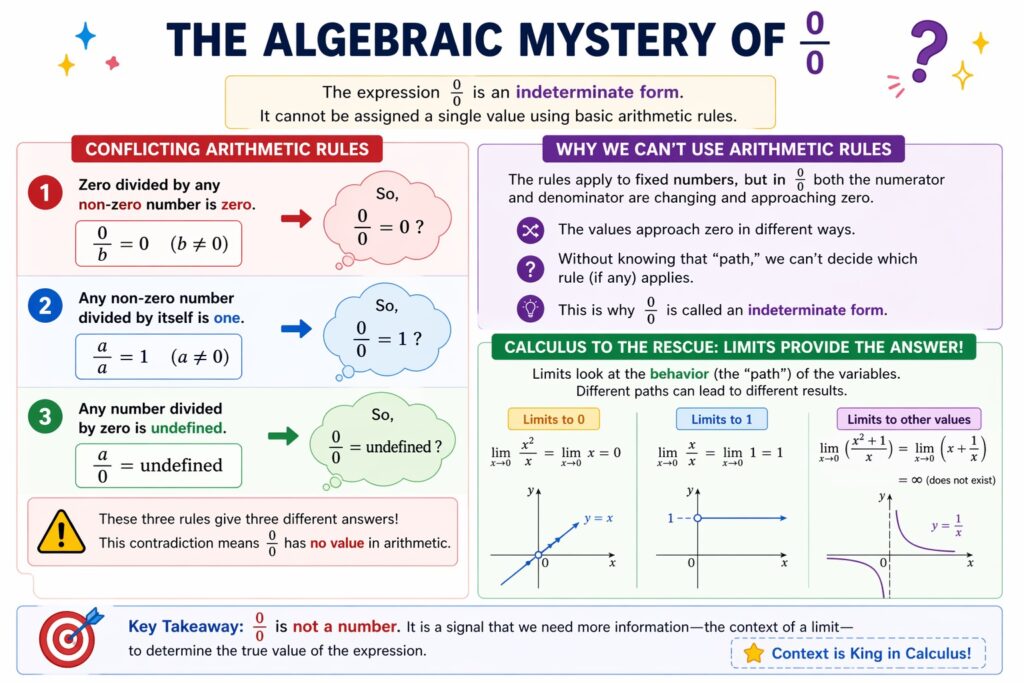
It explains that limits resolve the mystery by using the surrounding functional context.
On This Page
Defining the Indeterminate Form 0/0
The Concept of Undefined vs. Indeterminate
In basic arithmetic, we learn that dividing by zero is impossible. When we have a constant like ##5## divided by ##0##, we call the result undefined. This is because no number multiplied by zero can ever result in five.
The expression ##\dfrac{0}{0}## is fundamentally different from a standard undefined fraction. We call it indeterminate because the expression itself does not provide enough information to determine a specific value. It suggests a hidden limit exists within the function.
When you encounter ##\dfrac{0}{0}## in a limit problem, do not assume the answer does not exist. Instead, view it as a signal to keep working. The actual value could be any real number, zero, or even infinity.
Calculus focuses on what happens as numbers get closer to zero, rather than reaching zero itself. This distinction allows us to analyze the behavior of functions at points where they appear to break down. We look for the trend.
Understanding this distinction is vital for mastering limits. If a form is undefined, the vertical asymptote usually prevents a solution. If it is indeterminate, a specific hole in the graph often hides a perfectly valid numerical coordinate.
Why Division by Zero Fails
To understand why ##\dfrac{0}{0}## is a mystery, we must look at the definition of division. Division is the inverse of multiplication. If ##\dfrac{a}{b} = c##, then it must be true that ##b \times c = a##.
Apply this logic to ##\dfrac{0}{0} = x##. This implies that ##0 \times x = 0##. In this specific case, any real number substituted for ##x## makes the equation true. Because ##x## could be anything, the value is not determined.
If ##x## is ##5##, then ##0 \times 5 = 0##. If ##x## is ##-100##, then ##0 \times -100 = 0##. This lack of a unique solution is why mathematicians use the term indeterminate. There is no single answer.
In a typical fraction, the numerator and denominator compete for control. A zero in the numerator usually pulls the value toward zero. A zero in the denominator usually pushes the value toward infinity. They clash here.
This conflict creates a mathematical stalemate that arithmetic cannot resolve. To break the tie, we must use the context of the function. We examine the rates at which the top and bottom approach zero to find the winner.
The Algebraic Mystery of Zero Over Zero
Conflicting Arithmetic Rules
Students often try to apply three conflicting rules to ##\dfrac{0}{0}##. The first rule states that zero divided by any non-zero number is zero. This suggests the answer to our mystery expression should be zero.
The second rule states that any non-zero number divided by itself is one. This suggests that because the numerator and denominator are identical, the answer should be one. Both rules seem logical but lead to different results.
The third rule states that any number divided by zero is undefined. This adds a third possibility to the mix. These three rules create a logical contradiction that prevents a simple arithmetic definition for the expression ##\dfrac{0}{0}##.
Because these rules overlap and conflict, we cannot rely on them. Calculus provides the framework to move past these contradictions. It shifts our focus from the static values to the dynamic behavior of the variables involved.
By using limits, we can see which rule "wins" in a specific context. Sometimes the result is zero, sometimes it is one, and often it is something else entirely. The context of the surrounding function provides the answer.
Visualizing Limits and Holes
Imagine a graph of a function that results in ##\dfrac{0}{0}## at a specific point. On a graphing calculator, this point often looks like a solid line. However, a "hole" or point discontinuity exists at that exact coordinate.
As you move your finger along the curve toward that hole from the left, you approach a specific height. As you move from the right, you approach that same height. This height is the value of the limit.
The function f(x) = \dfrac{x^2 - 1}{x - 1} is a perfect example. If you plug in x = 1, you get ##\dfrac{0}{0}##. However, the graph looks like a straight line with a tiny missing dot at the height of two.
Limits allow us to talk about that height without actually standing on the missing dot. We describe the destination rather than the location. This conceptual shift is the key to resolving indeterminate forms in calculus.
Visualizing these "holes" helps demystify the algebra. When you see ##\dfrac{0}{0}##, imagine a bridge with one missing plank. You can see where the plank should be by looking at the rest of the bridge structure.
Strategies for Evaluating 0/0 Limits
Factoring and Simplification
The most common strategy for resolving ##\dfrac{0}{0}## is algebraic factoring. Many rational functions contain a common factor in both the numerator and denominator that causes the zero values. Removing this factor reveals the limit.
When you factor the expression, you are essentially "canceling out" the problem. Since limits look at values near the point but not at the point, this cancellation is mathematically valid. It simplifies the function into a manageable form.
Once the common factor is removed, you can use direct substitution. You plug the target value into the simplified expression to find the result. This result is the numerical value the original function was approaching.
Evaluate the following limit using factoring techniques: Solution:
1. Recognize the numerator as a difference of squares: ##(x - 3)(x + 3)##.
2. Rewrite the limit: 3. Cancel the ##(x - 3)## terms:4. Substitute ##x = 3##: ##3 + 3 = 6##.
This technique works whenever the numerator and denominator are polynomials. It is the first tool every student should try. It effectively bridges the hole in the graph by revealing the underlying continuous function.
Always check for common factors like ##(x - a)## when the limit approaches ##a##. If substituting ##a## results in ##\dfrac{0}{0}##, then ##(x - a)## is guaranteed to be a factor of both the top and bottom expressions.
Rationalization Techniques
When a limit involves square roots and results in ##\dfrac{0}{0}##, factoring might not be obvious. In these cases, we use a technique called rationalization. This involves multiplying the expression by the conjugate of the radical term.
The conjugate of an expression like ##\sqrt{x} - a## is ##\sqrt{x} + a##. Multiplying by the conjugate creates a difference of squares. This process moves the radical or eliminates it, often allowing for subsequent simplification.
Remember that you must multiply both the numerator and the denominator by the conjugate. This is equivalent to multiplying by one, so the value of the expression remains unchanged. It simply changes the appearance of the function.
Find the limit of the following expression: Solution:
1. Multiply top and bottom by the conjugate ##\sqrt{x+1} + 1##.
2. Simplify the numerator: ##(\sqrt{x+1})^2 - (1)^2 = x + 1 - 1 = x##.
3. The expression becomes: 4. Cancel ##x##:5. Substitute ##x = 0##: ##\dfrac{1}{\sqrt{1} + 1} = \dfrac{1}{2}##.
Rationalization is a powerful algebraic trick. It transforms a difficult indeterminate form into a standard fraction where direct substitution works. It is especially useful in introductory calculus exams and homework sets.
Practice recognizing when to use this method. If you see a square root added to or subtracted from another term, and substitution yields ##\dfrac{0}{0}##, rationalization is almost certainly the required path forward.
Advanced Tools for Resolving 0/0
Introduction to L'Hôpital's Rule
When algebra fails, we turn to L'Hôpital's Rule. This rule uses derivatives to find the limit of indeterminate forms. It states that the limit of ##\dfrac{f(x)}{g(x)}## is equal to the limit of their derivatives.
Specifically, if the limit results in ##\dfrac{0}{0}##, you can take the derivative of the numerator and the derivative of the denominator separately. You then evaluate the limit of this new fraction to find the answer.
It is important to note that you are not using the quotient rule here. You treat the top and bottom as independent functions. This rule works because derivatives measure the rate at which the functions approach zero.
Use derivatives to evaluate the following limit: Solution:
1. Confirm the form: ##\sin(0) = 0## and ##x = 0##, so it is ##\dfrac{0}{0}##.
2. Differentiate the numerator: ##\dfrac{d}{dx}[\sin(x)] = \cos(x)##.
3. Differentiate the denominator: ##\dfrac{d}{dx}[x] = 1##.
4. Apply the rule:5. Substitute ##x = 0##: ##\cos(0) = 1##.
This rule is a favorite among students because it often bypasses complex algebra. However, you must ensure the limit is truly indeterminate before applying it. Applying it to a standard limit will result in an incorrect answer.
L'Hôpital's Rule can be applied multiple times if the first derivative still results in ##\dfrac{0}{0}##. You simply continue differentiating until a determinate value is reached. It is a robust tool for higher-level calculus problems.
Real-World Applications of Indeterminate Forms
Indeterminate forms are not just academic puzzles. they appear frequently in physics and engineering. For example, calculating instantaneous velocity involves a limit that often takes the form of zero divided by zero as time intervals shrink.
In economics, marginal analysis uses limits to determine the cost of producing "one more unit." As the change in quantity approaches zero, the resulting formula often requires resolving an indeterminate form to find the exact rate.
Engineers use these concepts when studying stress and strain on materials. When analyzing a point of impact or a specific joint, the equations may temporarily appear undefined. Resolving the limit ensures the structure remains safe and stable.
Computer science also deals with these forms in algorithm analysis. When measuring the efficiency of a program as the input size approaches a specific limit, indeterminate forms help define the upper and lower bounds of performance.
Ultimately, the "problem" with zero over zero is actually an opportunity. It forces us to look deeper into the relationship between variables. By mastering these techniques, you gain the ability to solve complex, real-world problems with precision.
RESOURCES
- Why is 0/0 undefined and not 0 or 1? : r/mathematics - Reddit
- When I did a calculus limits problem and evaluated it to 'zero over ...
- I'm curious, why is it impossible to divide by 0? : r/learnmath - Reddit
- Zero Over Time Process Drives Existing Portfolios Toward Net ... - RMI
- Reading pulmonary vascular pressure tracings. How to ... - PubMed
- Zero Divided By Zero: Undefined and Indeterminate
- Acados only computes zero control inputs - User Questions
- Negative zero leading to unexpected issue in Rule Engine
- The problem isn't AI, it's the zero-sum future we're being sold
- Making a Dent in the Trillion-Dollar Problem: Toward Zero Defects
- Problems I Have with the Die with Zero Philosophy
- Solving the Problems of Zeros in Grading - Thomas R. Guskey
- How do i move the zero over to the left side of my screen? - Facebook
- The Problem With "Net Zero" | Sierra Club
- Division by zero - Wikipedia
0 Comments