Problem: Triangle Inequality in Vector Addition
In classical mechanics and vector algebra, physical quantities such as displacement, velocity, acceleration, and force are represented by vectors. Let ##\vec{A}## and ##\vec{B}## be two vectors in a Euclidean vector space. Their resultant vector is defined as:
###\vec{R}=\vec{A}+\vec{B}###
Prove, using vector algebra and the dot product, that the magnitude of the resultant vector satisfies the triangle inequality:
###\left|\left|\vec{A}\right|-\left|\vec{B}\right|\right| \le \left|\vec{A}+\vec{B}\right| \le \left|\vec{A}\right|+\left|\vec{B}\right|###
Also analyze the physical and geometric conditions under which equality holds.
Worked Solution and Step-by-Step Explanation
To prove the result clearly, use the following notation:
###A=\left|\vec{A}\right|,\qquad B=\left|\vec{B}\right|,\qquad R=\left|\vec{R}\right|=\left|\vec{A}+\vec{B}\right|###
Here, ##A##, ##B##, and ##R## are non-negative scalar magnitudes. This distinction is important because ##\vec{A}## and ##\vec{B}## are vectors, while ##A## and ##B## are their scalar lengths.
Step 1: Express the Resultant Using the Dot Product
Since the magnitude squared of any vector is equal to its dot product with itself, we write:
###R^2=\vec{R}\cdot\vec{R}###
Using ##\vec{R}=\vec{A}+\vec{B}##:
###R^2=(\vec{A}+\vec{B})\cdot(\vec{A}+\vec{B})###
Expanding the dot product:
###R^2=\vec{A}\cdot\vec{A}+\vec{A}\cdot\vec{B}+\vec{B}\cdot\vec{A}+\vec{B}\cdot\vec{B}###
Since the dot product is commutative,
###\vec{A}\cdot\vec{B}=\vec{B}\cdot\vec{A}###
and since
###\vec{A}\cdot\vec{A}=A^2,\qquad \vec{B}\cdot\vec{B}=B^2###
we obtain:
###R^2=A^2+B^2+2(\vec{A}\cdot\vec{B})###
If ##\theta## is the angle between ##\vec{A}## and ##\vec{B}##, then:
###\vec{A}\cdot\vec{B}=AB\cos\theta###
Therefore:
###R^2=A^2+B^2+2AB\cos\theta###
This is the standard magnitude formula for the resultant of two vectors.
Step 2: Proving the Upper Bound
For every real angle ##\theta##,
###-1\le \cos\theta \le 1###
To obtain the maximum possible value of ##R##, use ##\cos\theta \le 1##:
###R^2=A^2+B^2+2AB\cos\theta \le A^2+B^2+2AB###
The right-hand side is a perfect square:
###A^2+B^2+2AB=(A+B)^2###
Hence:
###R^2\le (A+B)^2###
Since ##R##, ##A##, and ##B## are non-negative, we can safely take the principal square root of both sides:
###R\le A+B###
Substituting back the meanings of ##R##, ##A##, and ##B##:
###\left|\vec{A}+\vec{B}\right|\le \left|\vec{A}\right|+\left|\vec{B}\right|###
This proves the upper bound of the triangle inequality.
Step 3: Proving the Lower Bound
To obtain the minimum possible value of ##R##, use ##\cos\theta \ge -1##:
###R^2=A^2+B^2+2AB\cos\theta \ge A^2+B^2-2AB###
The right-hand side is also a perfect square:
###A^2+B^2-2AB=(A-B)^2###
Therefore:
###R^2\ge (A-B)^2###
Taking the principal square root requires care. The quantity ##A-B## may be positive, negative, or zero. Therefore:
###\sqrt{(A-B)^2}=\left|A-B\right|###
Hence:
###R\ge \left|A-B\right|###
Substituting back the vector magnitudes:
###\left|\vec{A}+\vec{B}\right|\ge \left|\left|\vec{A}\right|-\left|\vec{B}\right|\right|###
This proves the lower bound.
Step 4: Combining the Two Bounds
From Step 2:
###\left|\vec{A}+\vec{B}\right|\le \left|\vec{A}\right|+\left|\vec{B}\right|###
From Step 3:
###\left|\vec{A}+\vec{B}\right|\ge \left|\left|\vec{A}\right|-\left|\vec{B}\right|\right|###
Combining both results:
###\boxed{\left|\left|\vec{A}\right|-\left|\vec{B}\right|\right| \le \left|\vec{A}+\vec{B}\right| \le \left|\vec{A}\right|+\left|\vec{B}\right|}###
This is the triangle inequality for vector addition.
Geometric Interpretation
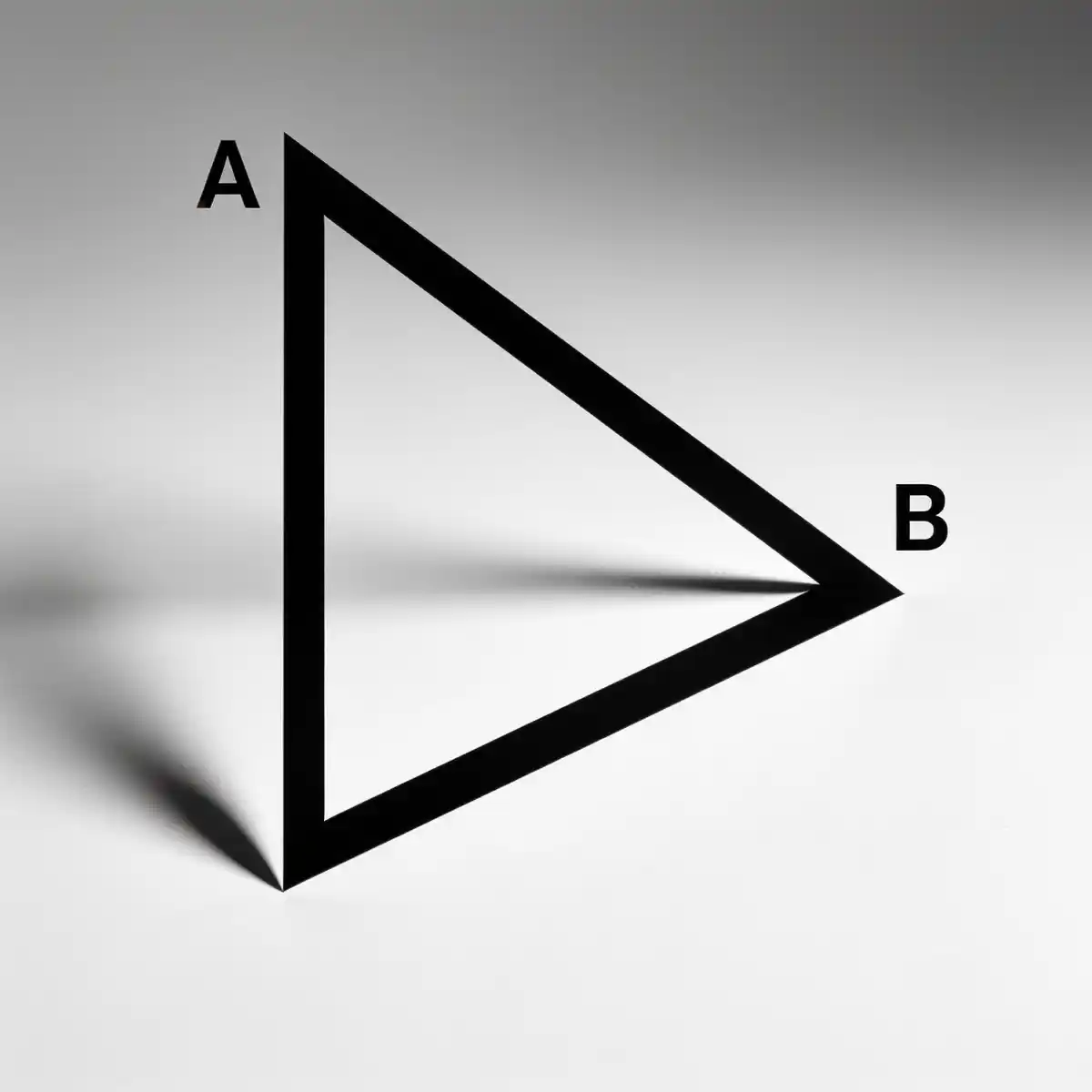
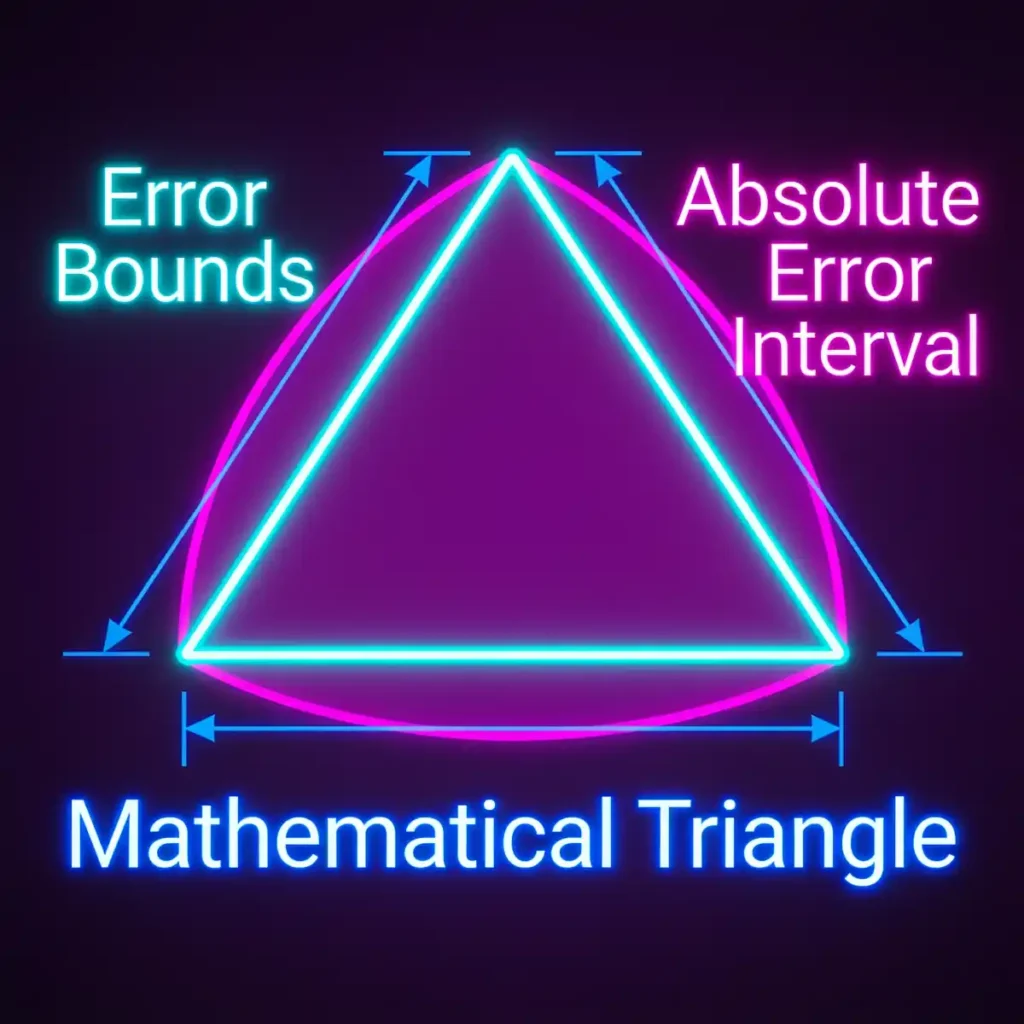
Vector addition can be represented geometrically by placing the tail of ##\vec{B}## at the head of ##\vec{A}##. The resultant vector ##\vec{R}=\vec{A}+\vec{B}## joins the initial point of ##\vec{A}## to the final point of ##\vec{B}##.
This forms a triangle whose side lengths are ##A##, ##B##, and ##R##. In any triangle, one side cannot be greater than the sum of the other two sides. Therefore:
###R\le A+B###
Similarly, one side cannot be smaller than the absolute difference of the other two sides. Therefore:
###R\ge |A-B|###
Thus, geometry gives the same result:
###|A-B|\le R\le A+B###
Equality Conditions
The equality cases occur when the two vectors are collinear, meaning they lie along the same straight line.
1. Upper Equality Case
The upper equality
###\left|\vec{A}+\vec{B}\right|=\left|\vec{A}\right|+\left|\vec{B}\right|###
holds when ##\vec{A}## and ##\vec{B}## point in the same direction. In this case:
###\theta=0,\qquad \cos\theta=1###
Then:
###R^2=A^2+B^2+2AB=(A+B)^2###
So:
###R=A+B###
Physically, this means that two vector effects reinforce each other completely. For example, if two forces act on an object in the same direction, the resultant force is the sum of their magnitudes.
2. Lower Equality Case
The lower equality
###\left|\vec{A}+\vec{B}\right|=\left|\left|\vec{A}\right|-\left|\vec{B}\right|\right|###
holds when ##\vec{A}## and ##\vec{B}## point in exactly opposite directions. In this case:
###\theta=\pi,\qquad \cos\theta=-1###
Then:
###R^2=A^2+B^2-2AB=(A-B)^2###
So:
###R=|A-B|###
Physically, this means that the two vector effects oppose each other. For example, if two forces act in opposite directions, the resultant force is the difference between their magnitudes.
3.Special Case: Zero Vector
If either ##\vec{A}## or ##\vec{B}## is the zero vector, then both the upper and lower bounds become equal. For example, if ##\vec{B}=\vec{0}##, then:
###\left|\vec{A}+\vec{0}\right|=\left|\vec{A}\right|###
and the inequality becomes:
###\left|\vec{A}\right|\le \left|\vec{A}\right|\le \left|\vec{A}\right|###
So equality holds throughout.
Final Conclusion
For any two vectors ##\vec{A}## and ##\vec{B}## in a Euclidean vector space, the magnitude of their resultant vector ##\vec{A}+\vec{B}## is always bounded between the absolute difference and the sum of their individual magnitudes:
###\boxed{\left|\left|\vec{A}\right|-\left|\vec{B}\right|\right| \le \left|\vec{A}+\vec{B}\right| \le \left|\vec{A}\right|+\left|\vec{B}\right|}###
The upper limit occurs when the vectors point in the same direction. The lower limit occurs when the vectors point in exactly opposite directions. In all other cases, the resultant magnitude lies strictly between these two limits.
RESOURCES
- Proof for triangle inequality for vectors - Mathematics Stack Exchangemath.stackexchange.comDec 13, 2011 ... Generally,the length of the sum of two vectors is not equal to the sum of their lengths. To see this…
- Triangle inequality - Wikipediaen.wikipedia.orgIn Euclidean geometry and some other geometries, the triangle inequality is a theorem about vectors and vector lengths (norms): ... vector sum u +…
- Triangle Inequality -- from Wolfram MathWorldmathworld.wolfram.comLet x and y be vectors. Then the triangle inequality is given by |x|-|y|
- Is it possible to prove the triangle inequality for vectors without ...reddit.comAug 4, 2025 ... The first section talks about 2D vectors, their magnitude, direction, addition, scalar multiplication, properties, and little else. One of ...
- Vectors Triangle Inequality | Solved Examples | Geometry- Cuemathcuemath.comIt is simply an expression of the fact that any side in a triangle is less than the sum of the other two sides,…
- gn.general topology - Why the triangle inequality? - MathOverflowmathoverflow.netMay 20, 2011 ... ... vector space and the distance). ii) If your space is quite nice ... Add a comment |. This answer…
- Triangle Inequality - Ximera - The Ohio State Universityximera.osu.edu4.1Addition and Scalar Multiplication of Matrices. 4.2Matrix Multiplication ... Triangle Inequality For any vectors and in ,. Proof: We will use Lemma lem ...
- Is there any geometry where the triangle inequality fails?mathoverflow.netApr 30, 2010 ... I just wanted to add that in the Lorentzian case, the triangle inequality gets reversed for a certain class of…
- How can one lone picture prove the Triangle Inequality, $|x−y|≤|x|+matheducators.stackexchange.comOct 21, 2023 ... A different visualization of the four inequalities is obtained by drawing the usual parallelogram showing vector addition, that is, the ...
- a. Triangle Inequality - Proof | 5. Vectors - MYMathAppsmymathapps.com5. Vectors. b. Vector Addition. 3. Properties. a. Triangle Inequality - Proof. Triangle Inequality Let ...
- TRIM: Accelerating High-Dimensional Vector Similarity Search with ...dl.acm.orgDec 5, 2025 ... These functions provide larger lower bounds than strict triangle inequality bounds by adding a positive term to the standard formula ...
- Problem 61 Verify the triangle inequality f... [FREE SOLUTION] - Vaiavaia.comTo begin, compute the sum of the vectors u and v . This is accomplished by adding the corresponding components of the vectors together…
- Lesson 9 - Vector Addition And Triangle Inequalities (Linear Algebra)youtube.comAug 18, 2016 ... This is just a few minutes of a complete course. Get full lessons & more subjects at: http://www.MathTutorDVD.com.
- Problem 88 The Triangle Inequality Suppose ... [FREE SOLUTION]vaia.comAccording to the Triangle Rule for adding vectors, if two sides of a triangle represent two vector magnitudes in direction and length, their sum…
- Triangle inequality | Theorem, Geometry, & Degenerate - Britannicabritannica.comMay 29, 2026 ... A vector space given a norm, such as the Euclidean norm (the square ... For example, the triangle inequality states…
0 Comments