Standard Trigonometric Limits (Expanded)
In this reading, we strengthen our understanding of standard trigonometric limits in calculus, with particular focus on the important limit
###\lim_{x \to 0} \frac{1 – \cos x}{x^2} = \frac{1}{2}.###
Up to now, we have repeatedly used two basic standard trigonometric limits in calculus:
- ###\lim_{x \to 0} \frac{\sin x}{x} = 1###
- ###\lim_{x \to 0} \frac{\tan x}{x} = 1###
We now add a third key result and show how all three work together. Our goals are to:
- Derive and understand ###\lim_{x \to 0} \dfrac{1 – \cos x}{x^2} = \dfrac{1}{2}###.
- Use identities to convert difficult problems into simpler standard trigonometric limits in calculus.
- Practise multi-step manipulations that combine algebra and trigonometry.
1. The three core standard trigonometric limits
With angles in radians, the main standard trigonometric limits in calculus are:
- ###\displaystyle \lim_{x \to 0} \frac{\sin x}{x} = 1###
- ###\displaystyle \lim_{x \to 0} \frac{\tan x}{x} = 1###
- ###\displaystyle \lim_{x \to 0} \frac{1 – \cos x}{x^2} = \frac{1}{2}###
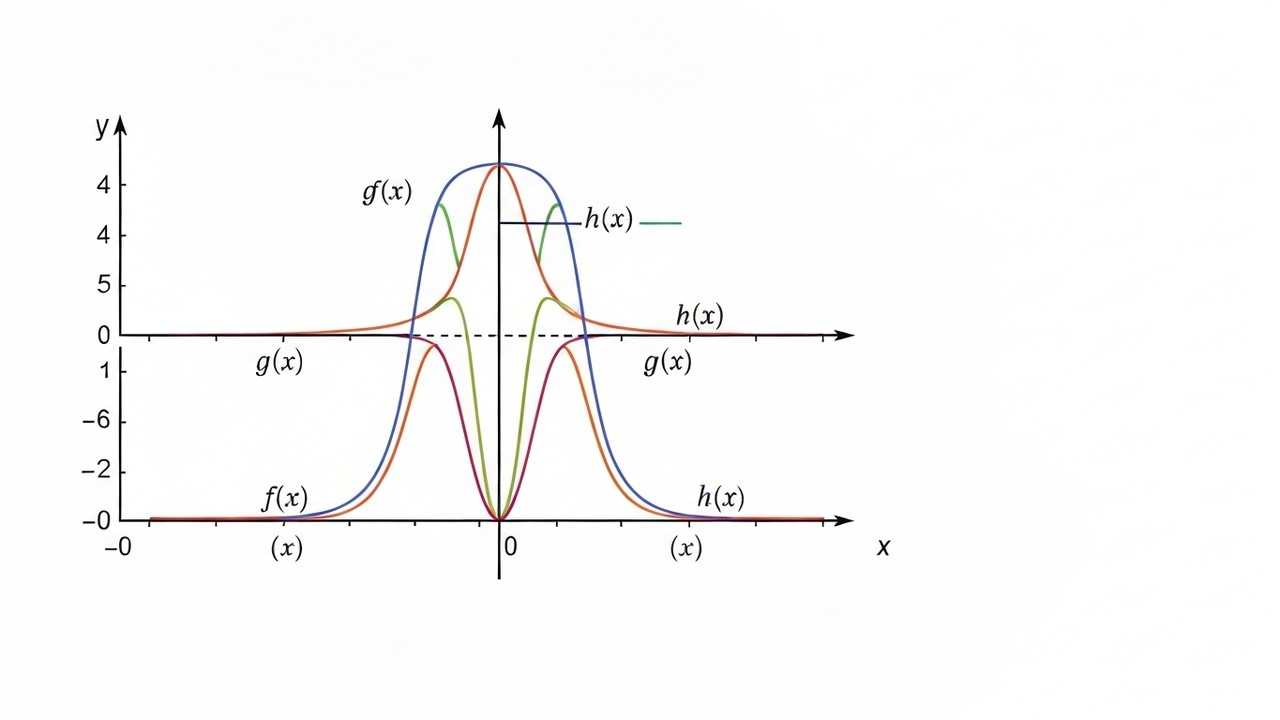
The first two describe the behaviour of ##\sin x## and ##\tan x## near zero. The third shows that, for small ##x##,
###1 – \cos x \approx \frac{x^2}{2}.###
This approximation is extremely useful when working with standard trigonometric limits in calculus and later when studying derivatives.
2. Deriving \(\displaystyle \lim_{x \to 0} \frac{1 – \cos x}{x^2} = \frac{1}{2}\)
We start from the identity
###1 – \cos x = 2 \sin^2 \left(\frac{x}{2}\right).###
Consider
###L = \lim_{x \to 0} \frac{1 – \cos x}{x^2}.###
Substituting the identity,
###L = \lim_{x \to 0} \frac{2 \sin^2(x/2)}{x^2}.###
We rewrite this as
###L = 2 \cdot \lim_{x \to 0} \frac{\sin^2(x/2)}{x^2}.###
Note that
###\frac{\sin^2(x/2)}{x^2} = \left(\frac{\sin(x/2)}{x}\right)^2
= \left(\frac{\sin(x/2)}{x/2} \cdot \frac{1}{2}\right)^2
= \left(\frac{\sin(x/2)}{x/2}\right)^2 \cdot \frac{1}{4}.###
Therefore,
###L = 2 \cdot \left(\frac{\sin(x/2)}{x/2}\right)^2 \cdot \frac{1}{4}
= \frac{1}{2} \left(\frac{\sin(x/2)}{x/2}\right)^2.###
As ##x \to 0##, ##x/2 \to 0## and ###\dfrac{\sin(x/2)}{x/2} \to 1###. Hence
###\lim_{x \to 0} \frac{1 – \cos x}{x^2} = \frac{1}{2}.###
3. Generalisation: \(\displaystyle \lim_{x \to 0} \frac{1 – \cos (ax)}{x^2}\)
We extend this to
###\lim_{x \to 0} \frac{1 – \cos (ax)}{x^2},###
where ##a## is a constant. Using
###1 – \cos(ax) = 2 \sin^2\left(\frac{ax}{2}\right),###
we obtain
###\frac{1 – \cos(ax)}{x^2} = 2 \cdot \frac{\sin^2(ax/2)}{x^2}.###
Now write
###\frac{\sin^2(ax/2)}{x^2}
= \left(\frac{\sin(ax/2)}{(ax/2)}\right)^2 \cdot \left(\frac{ax/2}{x}\right)^2
= \left(\frac{\sin(ax/2)}{(ax/2)}\right)^2 \cdot \left(\frac{a}{2}\right)^2.###
Therefore,
###\frac{1 – \cos(ax)}{x^2}
= 2 \cdot \left(\frac{\sin(ax/2)}{(ax/2)}\right)^2 \cdot \left(\frac{a}{2}\right)^2.###
As ##x \to 0##, ###\dfrac{\sin(ax/2)}{(ax/2)} \to 1###, so
###\lim_{x \to 0} \frac{1 – \cos(ax)}{x^2} = 2 \cdot 1^2 \cdot \frac{a^2}{4} = \frac{a^2}{2}.###
This compact formula is extremely useful in problems involving standard trigonometric limits in calculus.
4. Using identities to reduce to standard limits
Typical identities that help us convert complex expressions into standard trigonometric limits in calculus include:
- ###1 – \cos x = 2 \sin^2(x/2)###
- ###\cos(2x) = 1 – 2\sin^2 x = 2\cos^2 x – 1###
- ###\tan x = \frac{\sin x}{\cos x}###
- ###\sin 2x = 2 \sin x \cos x###
We now practise with worked examples.
5. Worked examples on standard trig limits
Example 1
Evaluate ###\displaystyle \lim_{x \to 0} \frac{1 – \cos 3x}{x^2}.###
Solution.
Using the general result with ##a = 3##,
###\lim_{x \to 0} \frac{1 – \cos 3x}{x^2} = \frac{3^2}{2} = \frac{9}{2}.###
Example 2
Evaluate ###\displaystyle \lim_{x \to 0} \frac{1 – \cos 5x}{x^2}.###
Solution.
Again, using the formula,
###\lim_{x \to 0} \frac{1 – \cos 5x}{x^2} = \frac{5^2}{2} = \frac{25}{2}.###
Example 3
Evaluate ###\displaystyle \lim_{x \to 0} \frac{1 – \cos x}{x \sin x}.###
Solution.
We write
###\frac{1 – \cos x}{x \sin x}
= \left(\frac{1 – \cos x}{x^2}\right)\left(\frac{x}{\sin x}\right).###
As ##x \to 0##,
- ###\dfrac{1 – \cos x}{x^2} \to \dfrac{1}{2},###
- ###\dfrac{x}{\sin x} \to 1.###
Therefore,
###\lim_{x \to 0} \frac{1 – \cos x}{x \sin x} = \frac{1}{2}.###
Example 4
Evaluate ###\displaystyle \lim_{x \to 0} \frac{1 – \cos^2 x}{x^2}.###
Solution.
We know ###1 – \cos^2 x = \sin^2 x###, so
###\frac{1 – \cos^2 x}{x^2} = \frac{\sin^2 x}{x^2}
= \left(\frac{\sin x}{x}\right)^2.###
As ##x \to 0##, ###\frac{\sin x}{x} \to 1###, so
###\lim_{x \to 0} \frac{1 – \cos^2 x}{x^2} = 1.###
Example 5
Evaluate ###\displaystyle \lim_{x \to 0} \frac{1 – \cos 2x}{x^2 \sin x}.###
Solution.
Rewrite as
###\frac{1 – \cos 2x}{x^2 \sin x}
= \left(\frac{1 – \cos 2x}{x^2}\right)\left(\frac{1}{\sin x}\right).###
Using the general result with ##a = 2##,
###\frac{1 – \cos 2x}{x^2} \to 2### and ###\sin x \to 0### while ###\frac{1}{\sin x} \to \infty###, so the limit diverges to infinity. The expression grows without bound near zero.
Example 6
Evaluate ###\displaystyle \lim_{x \to 0} \frac{\sin x (1 – \cos x)}{x^3}.###
Solution.
We write
###\frac{\sin x (1 – \cos x)}{x^3}
= \left(\frac{\sin x}{x}\right)\left(\frac{1 – \cos x}{x^2}\right).###
As ##x \to 0##,
- ###\frac{\sin x}{x} \to 1,###
- ###\frac{1 – \cos x}{x^2} \to \frac{1}{2}.###
Therefore,
###\lim_{x \to 0} \frac{\sin x (1 – \cos x)}{x^3} = \frac{1}{2}.###
Example 7
Evaluate ###\displaystyle \lim_{x \to 0} \frac{\sin^2 x}{x^2 (1 – \cos x)}.###
Solution.
We write
###\frac{\sin^2 x}{x^2 (1 – \cos x)}
= \left(\frac{\sin x}{x}\right)^2 \cdot \frac{1}{1 – \cos x}.###
Using ###1 – \cos x \approx \frac{x^2}{2}### for small ##x##, we have
###\frac{1}{1 – \cos x} \approx \frac{2}{x^2}.###
At the same time, ###\left(\frac{\sin x}{x}\right)^2 \to 1###. Therefore the overall limit diverges to infinity.
Example 8
Evaluate ###\displaystyle \lim_{x \to 0} \frac{\sin 2x – 2\sin x}{x^3}.###
Solution.
Using ###\sin 2x = 2 \sin x \cos x###, we get
###\sin 2x – 2 \sin x = 2 \sin x (\cos x – 1).###
Hence
###\frac{\sin 2x – 2\sin x}{x^3}
= 2 \cdot \frac{\sin x}{x} \cdot \frac{\cos x – 1}{x^2}.###
We know ###\frac{\cos x – 1}{x^2} = -\frac{1 – \cos x}{x^2} \to -\frac{1}{2}### and ###\frac{\sin x}{x} \to 1###, so
###\lim_{x \to 0} \frac{\sin 2x – 2\sin x}{x^3}
= 2 \cdot 1 \cdot \left(-\frac{1}{2}\right) = -1.###
Example 9
Evaluate ###\displaystyle \lim_{x \to 0} \frac{1 – \cos x + \frac{x^2}{2}}{x^4}.###
Solution.
For small ##x##, the expansion of ##\cos x## is
###\cos x = 1 – \frac{x^2}{2} + \frac{x^4}{24} + \cdots.###
Then
###1 – \cos x + \frac{x^2}{2}
= 1 – \left(1 – \frac{x^2}{2} + \frac{x^4}{24} + \cdots\right) + \frac{x^2}{2}
= \frac{x^2}{2} – \frac{x^4}{24} + \cdots + \frac{x^2}{2}
= x^2 – \frac{x^4}{24} + \cdots.###
Thus
###\frac{1 – \cos x + x^2/2}{x^4}
\approx \frac{x^2 – x^4/24}{x^4}
= \frac{1}{x^2} – \frac{1}{24}.###
As ##x \to 0##, the term ##1/x^2## dominates and the limit diverges to infinity.
Example 10
Evaluate ###\displaystyle \lim_{x \to 0} \frac{\sin x – x \cos x}{x^3}### once more, now using the idea that ##\sin x \approx x – \frac{x^3}{6}## and ##\cos x \approx 1 – \frac{x^2}{2}##.
Solution (expansion-based).
Near zero,
###\sin x \approx x – \frac{x^3}{6}, \quad \cos x \approx 1 – \frac{x^2}{2}.###
Then
###x \cos x \approx x \left(1 – \frac{x^2}{2}\right) = x – \frac{x^3}{2}.###
Therefore,
###\sin x – x \cos x \approx \left(x – \frac{x^3}{6}\right) – \left(x – \frac{x^3}{2}\right)
= -\frac{x^3}{6} + \frac{x^3}{2}
= x^3 \left(-\frac{1}{6} + \frac{1}{2}\right)
= \frac{x^3}{3}.###
Hence
###\frac{\sin x – x \cos x}{x^3} \approx \frac{x^3/3}{x^3} = \frac{1}{3},###
confirming the earlier value ###\frac{1}{3}###.
6. Additional examples combining patterns
Example 11
Evaluate ###\displaystyle \lim_{x \to 0} \frac{1 – \cos 4x}{x^2 \sin 2x}.###
Solution.
Rewrite as
###\frac{1 – \cos 4x}{x^2 \sin 2x}
= \left(\frac{1 – \cos 4x}{x^2}\right) \cdot \frac{1}{\sin 2x}.###
We know
###\frac{1 – \cos 4x}{x^2} \to \frac{4^2}{2} = 8.###
Also, ###\sin 2x \sim 2x### near zero, so ###\frac{1}{\sin 2x} \sim \frac{1}{2x}###, and the product behaves like ###\frac{8}{2x} = \frac{4}{x}### which diverges. So the limit does not exist as a finite number (it grows without bound).
Example 12
Evaluate ###\displaystyle \lim_{x \to 0} \frac{\sin^2 3x}{x^2}.###
Solution.
We write
###\frac{\sin^2 3x}{x^2}
= \left(\frac{\sin 3x}{3x}\right)^2 \cdot 9.###
As ##x \to 0##, ###\frac{\sin 3x}{3x} \to 1###, so
###\lim_{x \to 0} \frac{\sin^2 3x}{x^2} = 9.###
7. References for further exploration
- The general discussion of trigonometric functions and their limits on Wikipedia provides useful background and visualisations.
- Introductory materials and problem collections from organisations such as the American Mathematical Society (AMS) and the National Institute of Standards and Technology (NIST) often include standard trigonometric limits and related examples.
0 Comments