Limits appear whenever we talk about quantities that are “almost” at some value, or when change happens in very small intervals of time or space. In modern mathematics, physics, engineering, and even finance, limits form the bridge between ordinary algebra and the powerful tools of calculus. Understanding why we need limits helps me see why derivatives, integrals, and many real-world models are built on this single idea.
In this lesson, we explore why limits are necessary, how they describe “approaching” behaviour, and how they help when simple substitution fails. Along the way, we work through many examples, from very simple numeric patterns to realistic problems involving motion, temperature, and finance, each with a neat solution.
1. Approaching A Number Without Reaching It
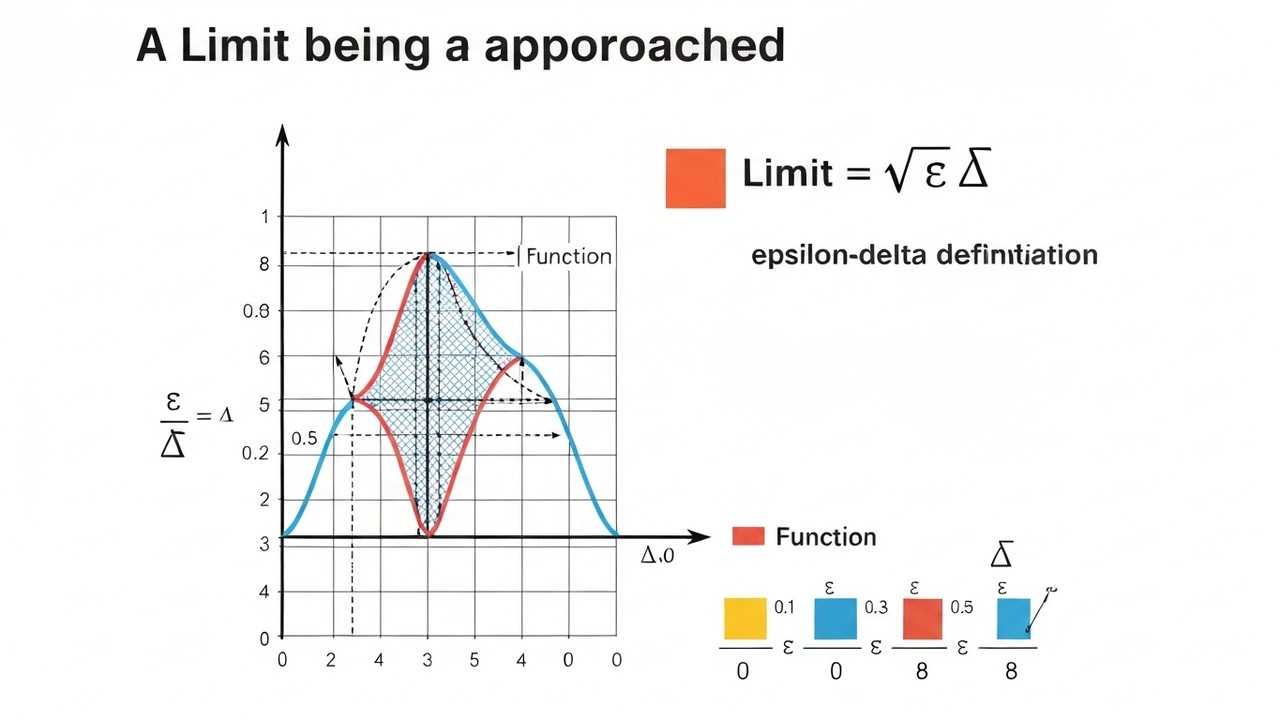
In everyday language, we often say, “we are almost there” or “the temperature is nearly 30 °C.” Mathematically, this idea is captured using limits. Instead of insisting that a variable equals a number, we focus on what happens as the variable gets closer and closer to that number.
For a variable ##x## approaching a number ##a##, we might look at values like
###a – 0.1,\; a – 0.01,\; a – 0.001,\; a + 0.1,\; a + 0.01,\; a + 0.001###
and study what happens to ##f(x)##. If these values of ##f(x)## settle down near some number ##L##, we say that the limit of ##f(x)## as ##x## approaches ##a## is ##L## and write
###\lim_{x \to a} f(x) = L.###
2. Simple Numerical Patterns And Limits
Before going to real-life situations, we first train my intuition with basic numerical examples.
Example 1: A Simple Fraction Pattern
Consider the expression
###f(x) = \frac{x – 1}{x}.###
we want to know what happens as ##x## approaches 1 from values greater than 1.
The values of ##f(x)## get closer and closer to 0. So we say
###\lim_{x \to 1} \frac{x – 1}{x} = 0.###
Example 2: Approaching Using Squares
Consider
###g(x) = x^2.###
As ##x## approaches 3, we check:
The values of ##g(x)## cluster around 9, so
###\lim_{x \to 3} x^2 = 9.###
Here, direct substitution works, but we still interpret the result as a limit statement: the function values approach 9 as ##x## approaches 3.
Example 3: A Function Not Defined At The Limit Point
Consider
###h(x) = \frac{x^2 – 1}{x – 1}, \quad x \neq 1.###
If we try to substitute ##x = 1##, we get ##\frac{0}{0}##, which is not defined. However, we can simplify:
###\frac{x^2 – 1}{x – 1} = \frac{(x – 1)(x + 1)}{x – 1} = x + 1,\quad x \neq 1.###
Now we look at values close to 1:
The values approach 2, so
###\lim_{x \to 1} \frac{x^2 – 1}{x – 1} = 2.###
Even though the function is not defined at ##x = 1##, the limit exists and equals 2. This shows why limits are more flexible than simple function values.
3. Instantaneous Speed And The Need For Limits
One of the most important reasons for limits comes from motion. Average speed over a time interval is:
###\text{Average speed} = \frac{\text{distance travelled}}{\text{time taken}}.###
But when we talk about speed “at this instant,” the time interval becomes extremely small. we cannot use a time interval of exactly zero, because that would make the denominator zero. Instead, we consider a very small time interval ##h## and compute
###\frac{\text{distance travelled in time } h}{h}.###
To get the speed at a precise instant, we let ##h## approach 0, and the limit of this ratio defines the instantaneous speed.
Example 4: A Simple Position Function
Suppose a moving object has position (in metres) given by
###s(t) = t^2,###
where ##t## is time in seconds. we want the speed at ##t = 3## seconds. Average speed from ##t = 3## to ##t = 3 + h## is
###\frac{s(3 + h) – s(3)}{h} = \frac{(3 + h)^2 – 3^2}{h} = \frac{9 + 6h + h^2 – 9}{h} = \frac{6h + h^2}{h} = 6 + h.###
As ##h \to 0##, this expression approaches 6. So the speed at ##t = 3## is
###\lim_{h \to 0} (6 + h) = 6 \text{ m/s}.###
This shows how limits turn average speed into instantaneous speed.
Example 5: Interpreting Data From A Table
Imagine we know the position of a cyclist at different times near ##t = 2## seconds:
The average speed between 1.9 s and 2.1 s is close to 4 m/s, and as we use smaller time intervals around 2 seconds, the average speeds get closer to 4 m/s. we describe this pattern using a limit:
###\lim_{h \to 0} \frac{s(2 + h) – s(2)}{h} = 4.###
4. Temperature, Equilibrium, And Approaching A Stable Value
Limits are also useful when a quantity settles towards a steady value over time. Consider a room with an air conditioner switched on. The temperature might follow a function ##T(t)## that gets closer to a comfortable temperature as time passes.
Example 6: Cooling Towards A Target Temperature
Suppose the temperature in a room after ##t## minutes is modeled by
###T(t) = 24 + 8e^{-0.2t},###
where 24 °C is the final comfortable temperature and the exponential term decreases over time.
As ##t \to \infty##, the exponential term ##8e^{-0.2t} \to 0##. So
###\lim_{t \to \infty} T(t) = 24^\circ \text{C}.###
The room temperature approaches 24 °C but may never be exactly equal to it in the model. This is another reason limits are needed: they describe long-time behaviour precisely.
Example 7: Population Approaching A Carrying Capacity
In biology, a population might grow quickly at first and then slow down as resources become limited. A simple model is
###P(t) = \frac{1000}{1 + 9e^{-0.5t}},###
where ##P(t)## is the population size. As ##t \to \infty##, ##e^{-0.5t} \to 0## and the denominator tends to 1. Therefore
###\lim_{t \to \infty} P(t) = 1000.###
The population approaches 1000 as a limiting value, called the carrying capacity. Again, limits describe what happens in the long run.
5. When Direct Substitution Fails: Indeterminate Forms
Sometimes, substituting a value directly in an expression gives an undefined or ambiguous result such as ##\frac{0}{0}##. Limits allow me to look beyond this by simplifying the expression and studying the nearby behaviour.
Example 8: Removable Discontinuity With A Quadratic
Evaluate
###\lim_{x \to 2} \frac{x^2 – 4}{x – 2}.###
Step 1: Direct substitution gives ##\frac{0}{0}##, so we must simplify.
Step 2: Factor the numerator:
###x^2 – 4 = (x – 2)(x + 2).###
Step 3: Cancel the common factor ##x – 2## for ##x \neq 2## to get
###\frac{x^2 – 4}{x – 2} = x + 2, \quad x \neq 2.###
Step 4: Take the limit of the simpler expression:
###\lim_{x \to 2} (x + 2) = 4.###
The function is not defined at ##x = 2##, but the limit is 4, so the “missing” point on the graph would lie at height 4.
Example 9: A More Involved Polynomial
Evaluate
###\lim_{x \to 3} \frac{x^2 – 5x + 6}{x – 3}.###
Step 1: Direct substitution gives ##\frac{9 – 15 + 6}{0} = \frac{0}{0}##.
Step 2: Factor the numerator:
###x^2 – 5x + 6 = (x – 2)(x – 3).###
Step 3: Cancel ##x – 3## (for ##x \neq 3##):
###\frac{x^2 – 5x + 6}{x – 3} = x – 2.###
Step 4: Now take the limit:
###\lim_{x \to 3} (x – 2) = 3 – 2 = 1.###
Example 10: Symmetric Difference Quotient
Consider the expression
###\frac{(2 + h)^2 – 4}{h}.###
Here ##h## is a small number, and we want to see what happens as ##h## approaches 0.
Step 1: Expand the numerator:
###(2 + h)^2 – 4 = 4 + 4h + h^2 – 4 = 4h + h^2.###
Step 2: The expression becomes
###\frac{4h + h^2}{h} = 4 + h, \quad h \neq 0.###
Step 3: Now
###\lim_{h \to 0} (4 + h) = 4.###
This kind of expression appears frequently in the definition of derivatives.
6. Limits In Finance And Growth
Limits also appear in finance when we study interest that is compounded more and more frequently. The idea of continuously compounded interest is defined using a limiting process.
Example 11: Increasing Compounding Frequency
Suppose we invest an amount ##P## at an annual interest rate ##r##. If interest is compounded ##n## times per year for 1 year, the amount becomes
###A_n = P \left(1 + \frac{r}{n}\right)^n.###
As ##n## increases, compounding becomes more frequent. The limiting amount as ##n \to \infty## (continuous compounding) is
###\lim_{n \to \infty} P \left(1 + \frac{r}{n}\right)^n = P e^r.###
This formula is widely used in financial mathematics and is a classical example of limits in action.
Example 12: A Numerical Illustration
Take ##P = 1000## and ##r = 0.1## (10% interest). Then
The values approach about 1105.17 as ##n## increases. The limit captures this “ultimate” value.
7. Concept Table: Typical Situations Where Limits Are Essential
Many areas of science and engineering use limits in similar ways: something approaches a value, and we want to describe that final behaviour precisely. The following table summarises a few typical patterns.
|
Context |
What Approaches? |
Limit Interpretation |
|
Car or train motion |
Time interval approaches 0 |
Instantaneous speed at a given instant |
|
Cooling or heating |
Time approaches infinity |
Final equilibrium temperature |
|
Biological population |
Time approaches infinity |
Carrying capacity or limiting population |
|
Finance with compounding |
Number of compounding periods increases |
Continuously compounded amount |
|
Stress in engineering materials |
Load approaches a critical value |
Failure threshold or safety margin |
8. Exploring Limits With Small Increment Examples
Another standard situation where limits appear is when we consider small increments in the input of a function and study the resulting change in the output.
Example 13: The Function ##f(x) = \sqrt{x}##
we want to understand how ##\sqrt{x}## behaves near ##x = 9##. Let ##x = 9 + h## where ##h## is small. Then
###f(9 + h) = \sqrt{9 + h}.###
we are interested in the change
###\Delta f = \sqrt{9 + h} – 3.###
For very small ##h##, we can approximate this change, but the exact instantaneous rate of change at 9 is given by the derivative, which is defined using the limit
###\lim_{h \to 0} \frac{\sqrt{9 + h} – 3}{h}.###
This expression again relies on the idea of taking a limit as ##h## approaches 0.
Example 14: A Linear Function As A Check
For the function
###f(x) = 5x – 2,###
the average rate of change between ##x## and ##x + h## is
###\frac{f(x + h) – f(x)}{h} = \frac{5(x + h) – 2 – (5x – 2)}{h} = \frac{5h}{h} = 5, \quad h \neq 0.###
Here the expression does not depend on ##h## at all, so
###\lim_{h \to 0} \frac{f(x + h) – f(x)}{h} = 5.###
This confirms that the instantaneous rate of change of a linear function is constant, matching the slope of its graph.
Example 15: A Quadratic Function’s Increment
Take
###f(x) = x^2 + 2x.###
The average rate of change between ##x## and ##x + h## is
###\frac{f(x + h) – f(x)}{h} = \frac{(x + h)^2 + 2(x + h) – (x^2 + 2x)}{h}.###
Expanding the numerator:
###(x + h)^2 + 2(x + h) – (x^2 + 2x)= (x^2 + 2xh + h^2) + 2x + 2h – x^2 – 2x= 2xh + h^2 + 2h.###
So
###\frac{f(x + h) – f(x)}{h} = \frac{2xh + h^2 + 2h}{h} = 2x + h + 2, \quad h \neq 0.###
Taking the limit as ##h \to 0## gives
###\lim_{h \to 0} (2x + h + 2) = 2x + 2.###
This is the instantaneous rate of change of ##f(x)## at the point ##x##, again defined using a limit.
9. Trusted References For Further Exploration
For deeper reading on limits, continuity, and calculus foundations, we can refer to:
10. Summary Of Key Ideas
In this lesson, we saw that limits are needed whenever we deal with “approaching” values, instantaneous rates, or long-term behaviour. Numerical patterns showed how values can get arbitrarily close to a number without necessarily reaching it. Motion examples converted average speed into instantaneous speed. Temperature and population models showed how systems move towards equilibrium values. Algebraic examples demonstrated how limits rescue expressions that become ##\frac{0}{0}## at a point, while financial models highlighted continuous compounding as a limit process.
All these examples share the same core idea: instead of looking only at a function’s value at a point, we study how the function behaves near that point. This shift in viewpoint is the true motivation for limits and is the foundation on which the rest of calculus is built.

0 Comments