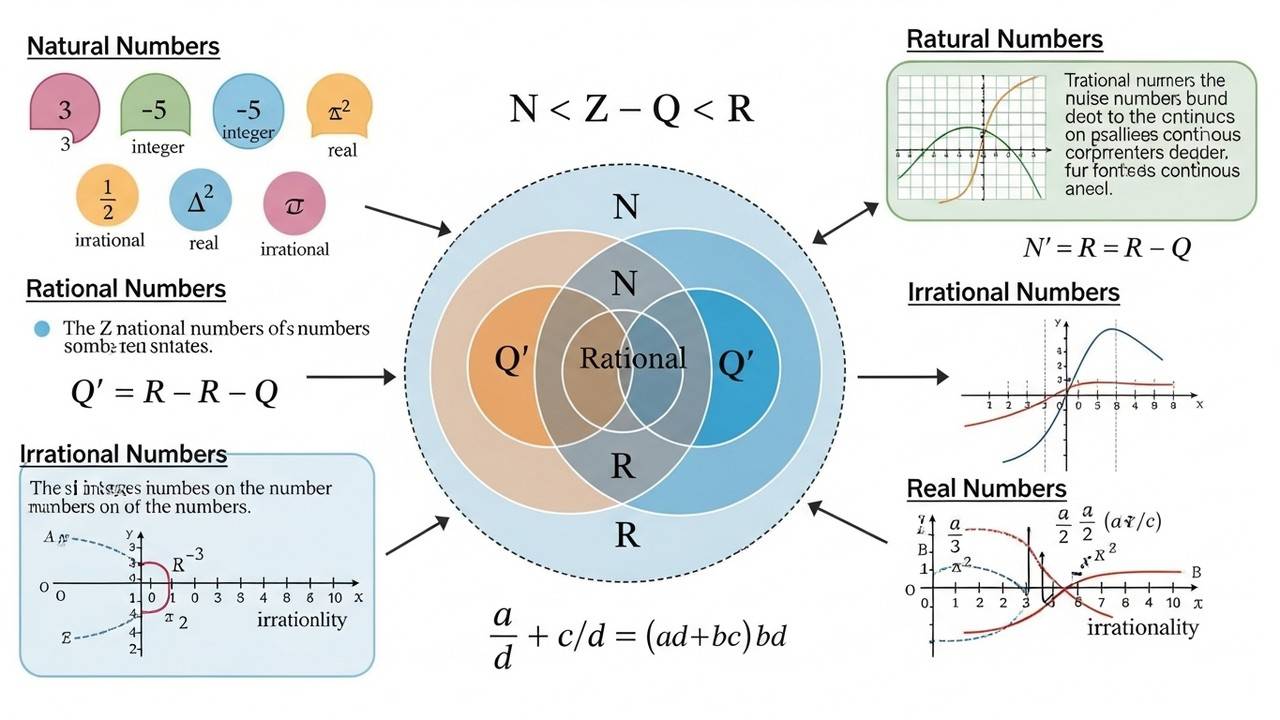
The IIT JEE is a highly competitive examination, and a strong foundation in mathematics is essential for success. One of the most fundamental areas of mathematics that forms the cornerstone of the IIT JEE syllabus is number systems. A comprehensive understanding of number systems is not only crucial for solving specific problems related to this topic but also provides a solid base for more advanced mathematical concepts. Mastering number systems gives a significant advantage. This guide aims to provide you with a detailed understanding of number systems, covering all the essential concepts and problem-solving techniques necessary to excel in the IIT JEE. This should help you build a solid foundation.
On This Page
- Understanding Number Systems Basics
- Exploring Different Number Types
- Advanced Concepts in Number Systems
- Previous Years' IIT JEE Questions
- Problem-Solving Strategies
- Mock Tests and Practice
- Time Management Techniques
- Conceptual and Tricky Problems
- Advanced Problem-Solving Techniques
- Final Preparations and Revision Strategies
- RESOURCES
Embarking on the journey to conquer the IIT JEE requires a robust foundation, and that begins with a thorough understanding of number systems. This blog post serves as your comprehensive guide, meticulously crafted to help you navigate the complexities of number systems, from the fundamentals to advanced problem-solving techniques. We'll delve into the crucial aspects of number systems, providing you with the necessary tools and strategies to excel in your IIT JEE preparation. With a focus on practice, revision, and time management, this guide aims to transform your approach to number systems, ensuring you're well-equipped to tackle the most challenging questions.
Understanding Number Systems Basics
The bedrock of mathematical proficiency, especially for the IIT JEE, lies in a firm grasp of number systems. This involves not just rote memorization, but a deep, intuitive understanding of various types of numbers and their properties. We'll start with the basics: natural numbers, whole numbers, integers, rational numbers, and irrational numbers. Each category possesses unique characteristics that influence how they interact within mathematical operations. For the IIT JEE, understanding these distinctions is crucial. This understanding is the first step towards mastering the number systems and excelling in the IIT JEE. It is necessary to have a strong command of these concepts.
Exploring Different Number Types
Beyond the foundational types, the world of number systems expands to include real and complex numbers. Real numbers encompass all rational and irrational numbers, forming the continuum upon which much of calculus and analysis is built. Complex numbers, involving imaginary units, open up new dimensions in algebra and trigonometry. The IIT JEE often presents problems that intertwine these concepts, requiring a flexible and adaptable approach. Each type of number has its own specific rules and properties that need to be understood to solve problems. Mastering these different number types is essential.
Advanced Concepts in Number Systems
Delving deeper, we encounter advanced concepts such as prime numbers, composite numbers, and modular arithmetic. Prime numbers, divisible only by themselves and 1, play a fundamental role in number theory and cryptography. Composite numbers, on the other hand, are formed by multiplying primes. Modular arithmetic, which deals with remainders, provides a powerful framework for solving problems involving divisibility and congruences. The IIT JEE often tests your ability to apply these concepts to complex problems, making a solid grasp of these topics indispensable for success in the exam. Understanding these concepts is key to solving difficult problems.
Previous Years' IIT JEE Questions
The best way to prepare for the IIT JEE is by solving previous years' questions. This allows you to familiarize yourself with the types of problems asked and the level of difficulty. We'll analyze questions from past IIT JEE papers, focusing on number systems. This will help you understand how different concepts are applied in exam scenarios. We'll break down each question, explaining the underlying principles and the strategies used to arrive at the correct solution. This section provides invaluable insights into the exam pattern and the importance of number systems. Practicing past papers is the key to exam success.
Problem-Solving Strategies
Effective problem-solving strategies are crucial for success in the IIT JEE. This involves more than just knowing the formulas; it requires the ability to analyze a problem, identify the relevant concepts, and apply the appropriate methods to solve it. We'll explore techniques such as breaking down complex problems into smaller parts, using visual aids to understand the concepts, and checking your answers for accuracy. Mastering these strategies will not only enhance your problem-solving skills but also boost your confidence. Time management is key here, and we will cover that too. It is necessary to be able to solve the problems efficiently.
Mock Tests and Practice
Practice makes perfect, and regular mock tests are essential for success in the IIT JEE. These tests simulate the actual exam environment, allowing you to assess your preparation level and identify areas where you need to improve. We'll provide a series of mock tests, each designed to test your understanding of different aspects of number systems. Analyze your performance after each test, focusing on the types of questions you struggled with and the mistakes you made. This will help you refine your approach and improve your overall performance. Practicing mock tests is crucial for success.
Time Management Techniques
Time management is a critical skill for the IIT JEE. With a limited time to solve a large number of questions, it's important to develop efficient strategies to manage your time effectively. We'll explore techniques such as prioritizing questions based on their difficulty level, allocating time for each question, and avoiding getting stuck on any single problem for too long. Effective time management can significantly improve your performance in the exam. This is one of the most important aspects of the IIT JEE. You should practice these techniques.
Conceptual and Tricky Problems
The IIT JEE often presents a mix of conceptual and tricky problems. Conceptual problems require a deep understanding of the underlying principles, while tricky problems test your ability to apply those principles in unconventional ways. We'll provide examples of both types of problems, along with detailed explanations and solutions. This will help you develop the ability to think critically and approach problems from different angles. Conceptual understanding is as important as solving tricky problems. Both are important for the exam.
Advanced Problem-Solving Techniques
To excel in the IIT JEE, you need to master advanced problem-solving techniques. This includes learning to recognize patterns, using shortcuts and tricks, and developing a systematic approach to problem-solving. We'll provide examples of advanced techniques, such as using the properties of prime numbers to solve complex problems, and applying modular arithmetic to find remainders. These techniques will give you an edge in the exam. Learning these techniques is essential.
Final Preparations and Revision Strategies
As the exam approaches, it's crucial to focus on revision and final preparations. This involves reviewing all the concepts, solving practice problems, and taking mock tests. We'll provide a comprehensive revision plan, outlining the key topics to focus on and the best strategies to revise them. Remember to stay calm and focused during the exam. This involves managing stress and anxiety, and building your confidence. Make sure to get enough rest and eat well before the exam. Proper revision and preparation are the key to success. Ensure you are well prepared to face the exam.
RESOURCES
- Solved Examples from MTG IIT JEE FOUNDATION NUMBER ...
- Set Theory and Number System-Basic concepts, Formula, Venn ...
- EXERCISE (Comprehension type) from MTG IIT JEE FOUNDATION ...
- EMS Academy - Number System Using Venn Diagram. #ems ...
- NUMBER SYSTEMS
- Binary Number System
- IIT Madras Degree in Electronic Systems
- Complex Number System - Study Material for IIT JEE | askIITians
- 1.-BASIC-MATHEMATICS-THEORY.pdf
- Syllabus for JEE (Main) - S3waas






0 Comments