DIMENSIONS
Resources & Insights
The Fabric of Illusion: A Scientific Inquiry into Simulated Realities
Explore the profound scientific and mathematical principles underpinning the concept of simulated reality, from computational models to the neuroscience of perception, inspired by ‘The Matrix’. READ MORE...

What is a Plane? A Simple Explanation
Learn the basics! This post answers the question: What is a plane? READ MORE...

Understanding the Concept: What is a Point?
Explore the fundamental concept: What is a point? Learn its definition and significance in various contexts. READ MORE...

Dark Energy and String Theory: New Evidence from DESI
New data from DESI suggests a link between dark energy and string theory. Discoveries could offer the first observational evidence. READ MORE...
Calculating Distance in 3D: Understanding Triangular Relationships
Learn how to calculate distance in 3D using triangular relationships and trigonometric ratios. READ MORE...

Navigating the CBSE Board Exams 2025: A Comprehensive Guide
Conquer the CBSE Board Exams 2025 with our guide! Learn effective study strategies, time management tips, and overcome exam anxiety for success. READ MORE...

Physics: Motion in One Dimension
Motion in One Dimension forms the foundational block in understanding the Physics of movement. This topic delves into the specifics of how objects move in a straight line under the influence of various forces. By exploring the key concepts of displacement, velocity, and acceleration, one can grasp how these parameters interrelate to describe the kinematic motion of particles or bodies in a single-dimensional plane. Understanding Motion in One Dimension Motion in One Dimension, also known as Rectilinear Motion, focuses on the movement of objects along a straight path. This type of motion simplifies the analysis of movement as it restricts the scenario to a single axis, usually the x-axis. To comprehend this, we examine three primary components: displacement, velocity, and […] READ MORE...
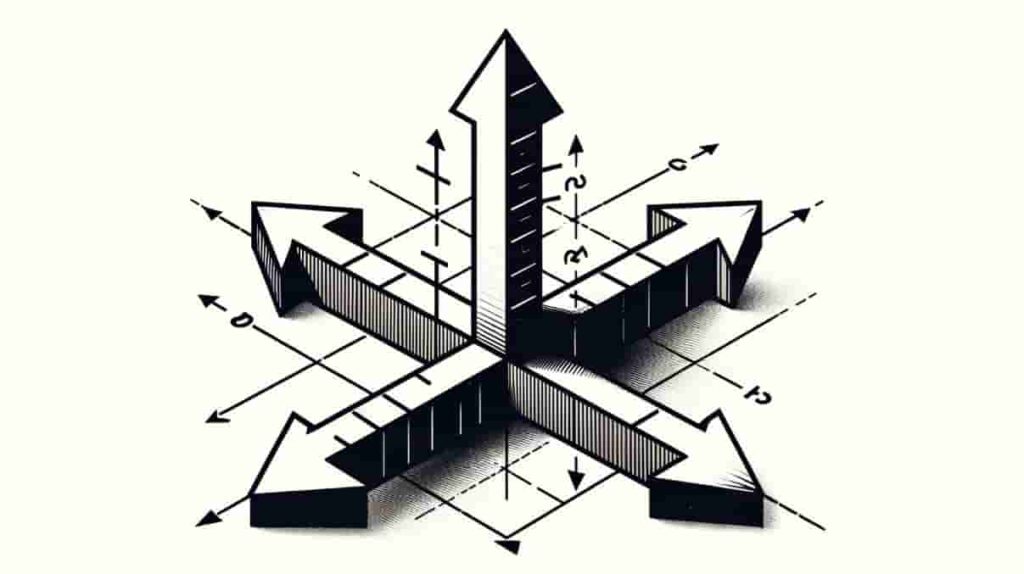
The Three Dimensions
In physics and geometry, the concept of "three dimensions" refers to a spatial framework necessary to describe the position or location of an object fully. Each dimension provides a unique axis that, together with the others, can describe any point in space. Here’s a breakdown of the three dimensions typically used: We also published: Scientific Notations 1. X-Axis (First Dimension) This is often thought of as the horizontal dimension. In a Cartesian coordinate system, it typically defines width or length. 2. Y-Axis (Second Dimension) This axis is perpendicular to the x-axis. In a Cartesian coordinate system, it typically defines height or breadth when considered in a two-dimensional plane along with the x-axis. 3. Z-Axis (Third Dimension) The z-axis is perpendicular […] READ MORE...