DIFFERENTIATION
Resources & Insights
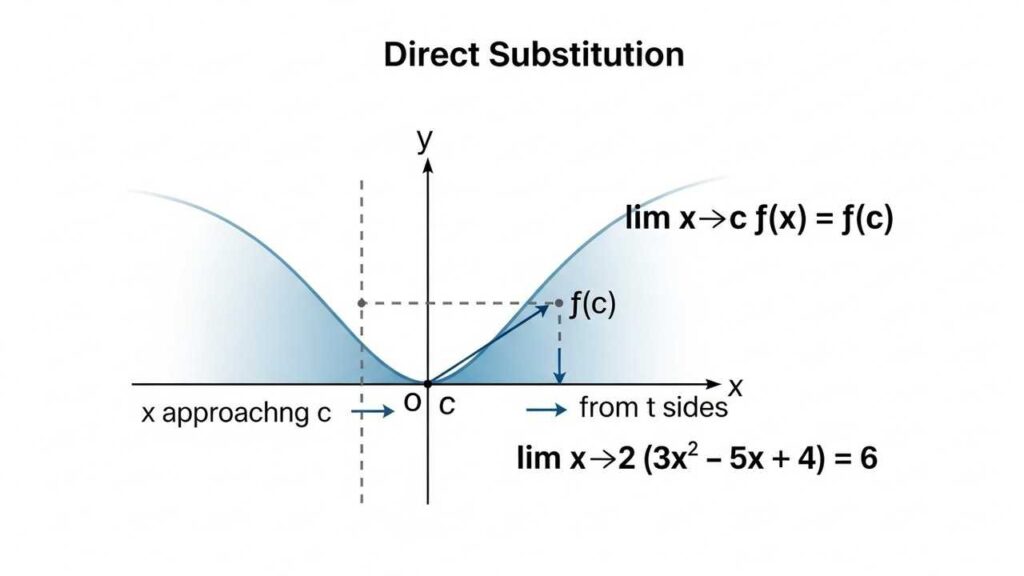
Evaluating Limits
Learn how to easily evaluate limits using direct substitution! This guide provides clear examples and explanations to help you master this essential calculus skill. The SEO Keyphrase is Evaluating Limits. READ MORE...

Understanding Derivatives Simply: A Beginner's Guide
Understanding derivatives simply involves grasping how functions change. This guide offers an intuitive explanation for beginners. READ MORE...

Fractional Differentiability of Functions
Explore fractional differentiability functions and how they behave with non-integer derivatives. Learn about constructing functions with specific differentiability. READ MORE...

Finding Minimum Value Function
Learn how to find the minimum value function using calculus. Step-by-step guide included! READ MORE...

Derivative of \(\mathsf { x^{n} }\) using the First Principle
Let y = \(\mathsf {x^{n} }\) ∴ y + δy = \(\mathsf { {(x + δx)^{n}} }\) ∴ δy = y + δy - y = \(\mathsf { (x + δx)^{n} }\) - \(\mathsf { x^{n} }\) or δy = \(\mathsf { [\text{ }^{n}C_0 x^{n}{(δx)}^{0} }\) + \(\mathsf {\text{ }^{n}C_1 x^{n-1}{(δx)}^{1}}\) + \(\mathsf {\text{ }^{n}C_2 x^{n-2}{(δx)}^{2}}\) + \(\mathsf {\text{ }^{n}C_3 x^{n-3}{(δx)}^{3}}\) \(\mathsf {+\ ... higher\ powers\ of\ δx\ ] }\) - \(\mathsf {x^{n} }\) or δy = \(\mathsf { [\text{ }^{n}C_0 x^{n} }\) + \(\mathsf {\text{ }^{n}C_1 x^{n-1}{(δx)}^{1}}\) + \(\mathsf {\text{ }^{n}C_2 x^{n-2}{(δx)}^{2}}\) + \(\mathsf {\text{ }^{n}C_3 x^{n-3}{(δx)}^{3}}\) \(\mathsf{+\ ... \ ]} \) - \(\mathsf {x^{n} }\) Now, \(\mathsf { ^{n}C_0 x^{n} = 1.x^{n} = x^{n} }\) Cancelling \(\mathsf { […] READ MORE...

Derivative of \({e}^x\) using First Principle
Derivative of \({e}^x\) using the First Principle Let \(y\) = \({e}^x\)∴ \(y + δy\) = \({e}^{x + δx}\)∴ \(δy\) = \({e}^{x + δx}\) - \({e}^x\)or \(δy\) = \({e}^{x}\) . \( [ {e}^{δx} - 1 ]\)Dividing each side by δx </h3>or \(\dfrac {δy}{δx}\) = \( \dfrac { {e}^{x} . [ {e}^{δx} - 1 ] } {δx}\) ∴ \(\dfrac {dy}{dx} = \) \( \lim_{δx \to 0} \) \( \dfrac { {e}^{x} . [ {e}^{δx} - 1 ] } {δx}\)or \(\dfrac {dy}{dx}\) = \( {e}^{x} .\) \( \lim_{δx \to 0} \) \( \dfrac { [ {e}^{δx} - 1 ] } {δx}\) ----- (1) Now, \( \lim_{δx \to 0} \) \( \dfrac { [ {e}^{δx} - 1 ] } {δx}\) =\( \lim_{δx \to 0} […] READ MORE...
Derivative of sinθ using the First Principle
Derivative of \( sinθ \) using the First Principle Let \(y\) = \( sinθ \) ∴ \(y + δy\) = \( sin(θ + δθ) \) ∴ \(δy\) = \( sin(θ + δθ) \) - \( sinθ \)From Trigonometry , we have \( sin(A-B) \) = 2.\( sin \dfrac {(A-B)}{2} \).\( cos \dfrac {(A+B)}{2} \)Using the above rule, we get\(δy\) = 2.\( sin \dfrac {(θ+δθ - θ)}{2} \).\( cos \dfrac {(θ+δθ + θ)}{2} \) or \(δy\) = 2\( cos (θ+ \dfrac{δθ}{2}) \) . \( sin( \dfrac {δθ}{2}) \)∴ \(\dfrac {δy}{δθ}\) = 2 \( \dfrac { cos (θ+ \dfrac{δθ}{2}) sin( \dfrac {δθ}{2}) } {δθ}\)or \(\dfrac {δy}{δθ}\) = 2 \(cos (θ+ \dfrac{δθ}{2}) \) \( \dfrac { sin( \dfrac {δθ}{2}) } {δθ}\) ∴ \(\dfrac […] READ MORE...
Derivative of cosθ using the First Principle
Derivative of \( cosθ \) using the First Principle Let \(y\) = \( cosθ \) ∴ \(y + δy\) = \( cos(θ + δθ) \) ∴ \(δy\) = \( cos(θ + δθ) \) - \( cosθ \)From Trigonometry , we have \( cos(A-B) \) = -2.\( sin \dfrac {(A+B)}{2} \).\( sin \dfrac {(A-B)}{2} \)Using the above rule, we get\(δy\) = -2.\( sin \dfrac {(θ+δθ + θ)}{2} \).\( sin \dfrac {(θ+δθ - θ)}{2} \) or \(δy\) = -2\( sin (θ+ \dfrac{δθ}{2}) \) . \( sin( \dfrac {δθ}{2}) \)∴ \(\dfrac {δy}{δθ}\) = -2 \( \dfrac { sin (θ+ \dfrac{δθ}{2}) sin( \dfrac {δθ}{2}) } {δθ}\)or \(\dfrac {δy}{δθ}\) = -2 \(sin (θ+ \dfrac{δθ}{2}) \) \( \dfrac { sin( \dfrac {δθ}{2}) } {δθ}\) ∴ \(\dfrac […] READ MORE...