On This Page
Understanding the Evolution of Measurement Systems
The Definition of a System of Units
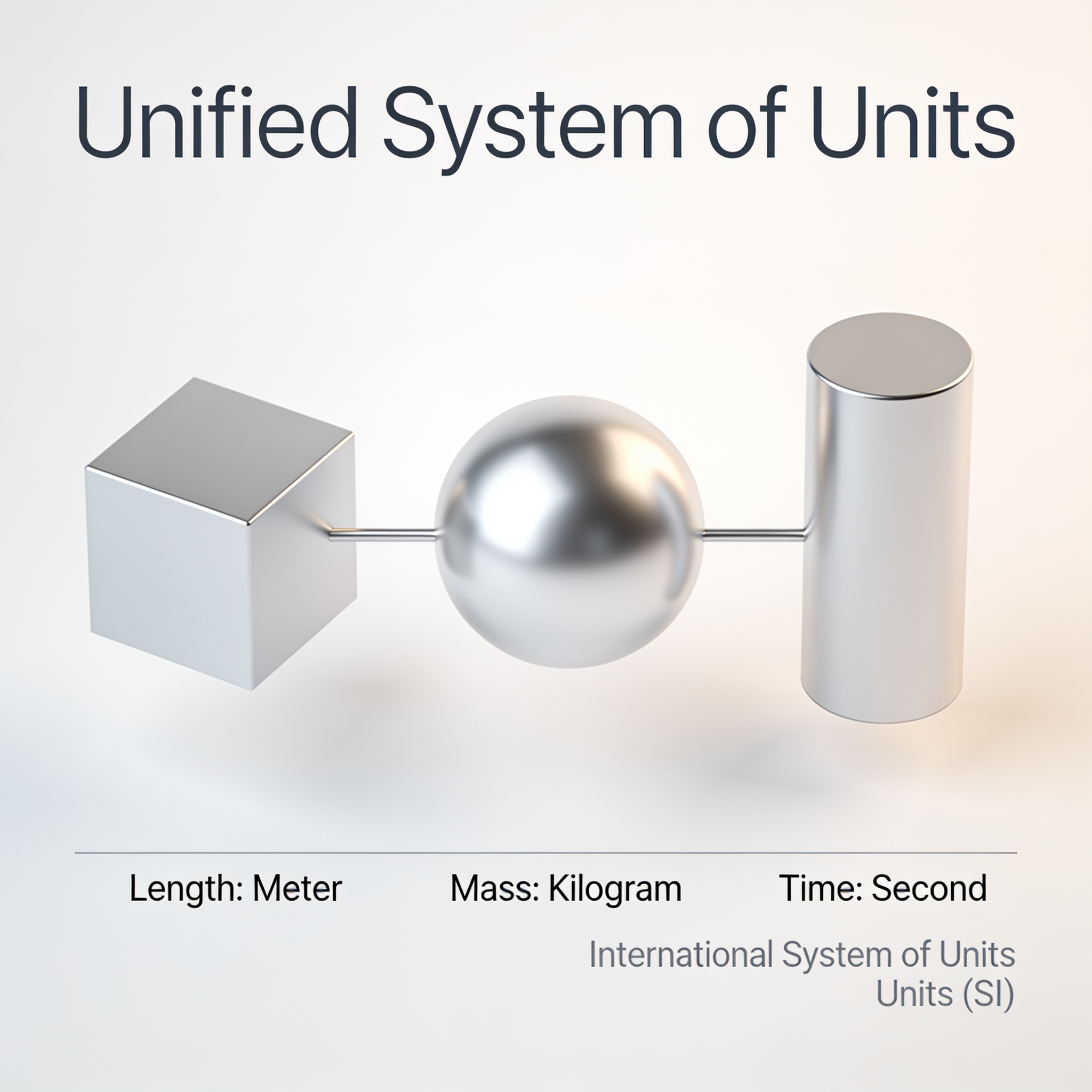
A system of units acts as a structured framework containing sets of base and derived units for physical quantities. Physics requires consistency in these measurements to ensure that scientific results remain reproducible across different laboratories, countries, and various research institutions worldwide.
Historically, humanity relied on arbitrary standards such as handspans or footsteps to measure length. While these methods worked for local trade, they lacked the precision needed for modern science, leading to the development of rigorous, globally accepted measurement systems today.
A comprehensive system typically defines fundamental units for length, mass, and time. By combining these, scientists derive units for more complex concepts like force, energy, and power. This mathematical structure allows physicists to translate abstract laws into verifiable numerical data.
Without a unified system, scientific communication would collapse into chaos due to conflicting standards. Imagine trying to build a bridge if different engineers used unique, incompatible units. A robust system prevents such catastrophic errors and ensures global technical alignment throughout.
Students must recognize that a system of units is not merely a collection of names. It is a logical foundation that defines how we quantify reality. Mastering these foundations is the first step toward solving complex problems in physics courses.
Historical Systems: CGS, FPS, and MKS
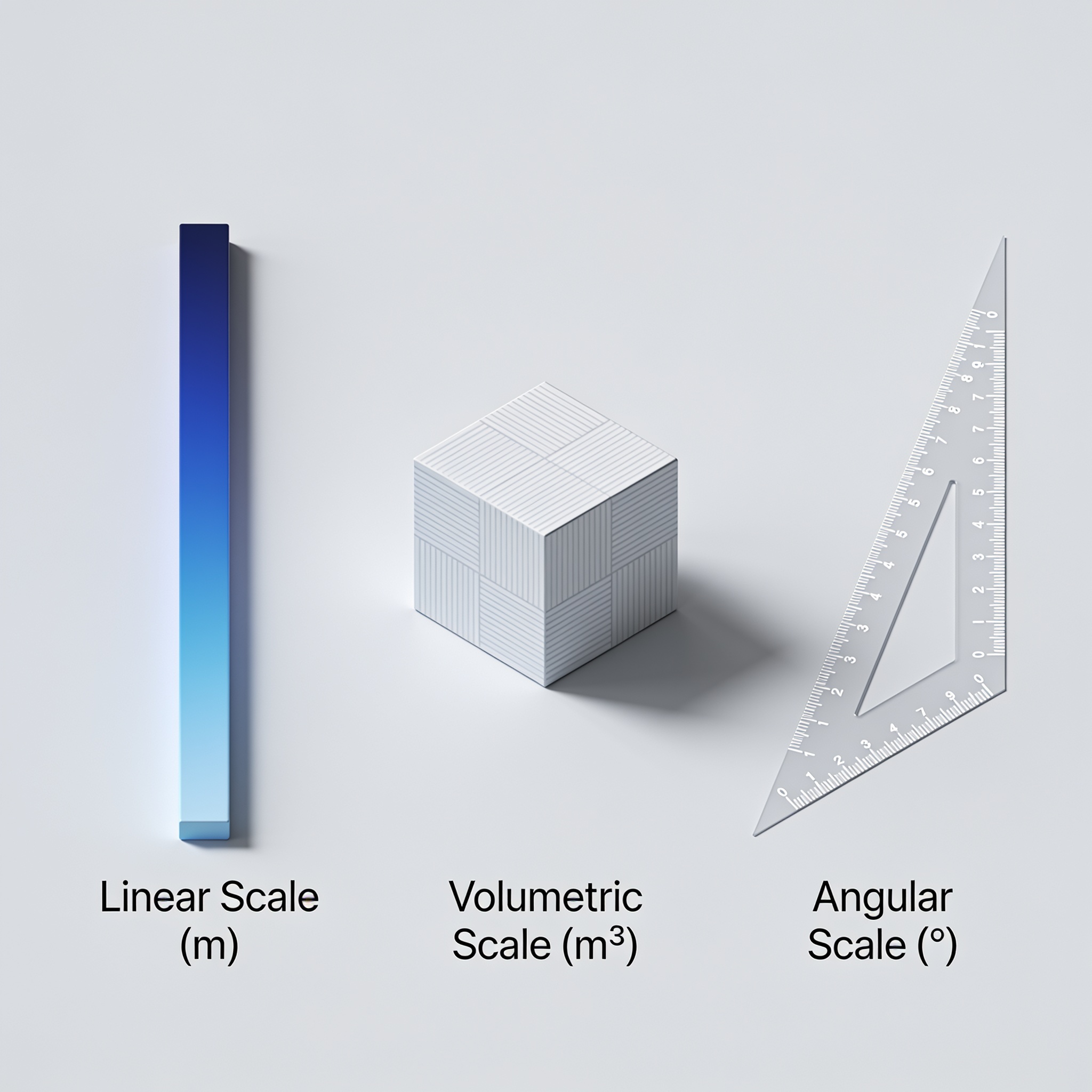
The CGS system, which stands for Centimeter-Gram-Second, served as the primary scientific standard for many years. It remains useful today in specific branches of physics, particularly in electromagnetism, where Gaussian units simplify certain equations involving electric and magnetic fields.
The FPS system, or Foot-Pound-Second, originated in the British imperial tradition. While it remains common in everyday commerce and engineering within the United States, it is rarely utilized in modern scientific research due to its lack of decimal consistency.
The MKS system evolved as a more practical successor to CGS, utilizing Meter-Kilogram-Second. This system aligns better with human-scale measurements, making it significantly easier to use in engineering projects compared to the very small units found in the CGS framework.
Each system represents a different choice of base units for the primary dimensions of mass, length, and time. While they serve the same physical purpose, converting between them requires specific scaling factors that every physics student must learn to apply.
Although these systems provided the necessary scaffolding for early scientific advancement, they often caused confusion during international collaboration. The need for a universal standard eventually led to the development of the International System of Units, which dominates modern physics.
The International System of Units (SI)
Structure and Advantages of SI
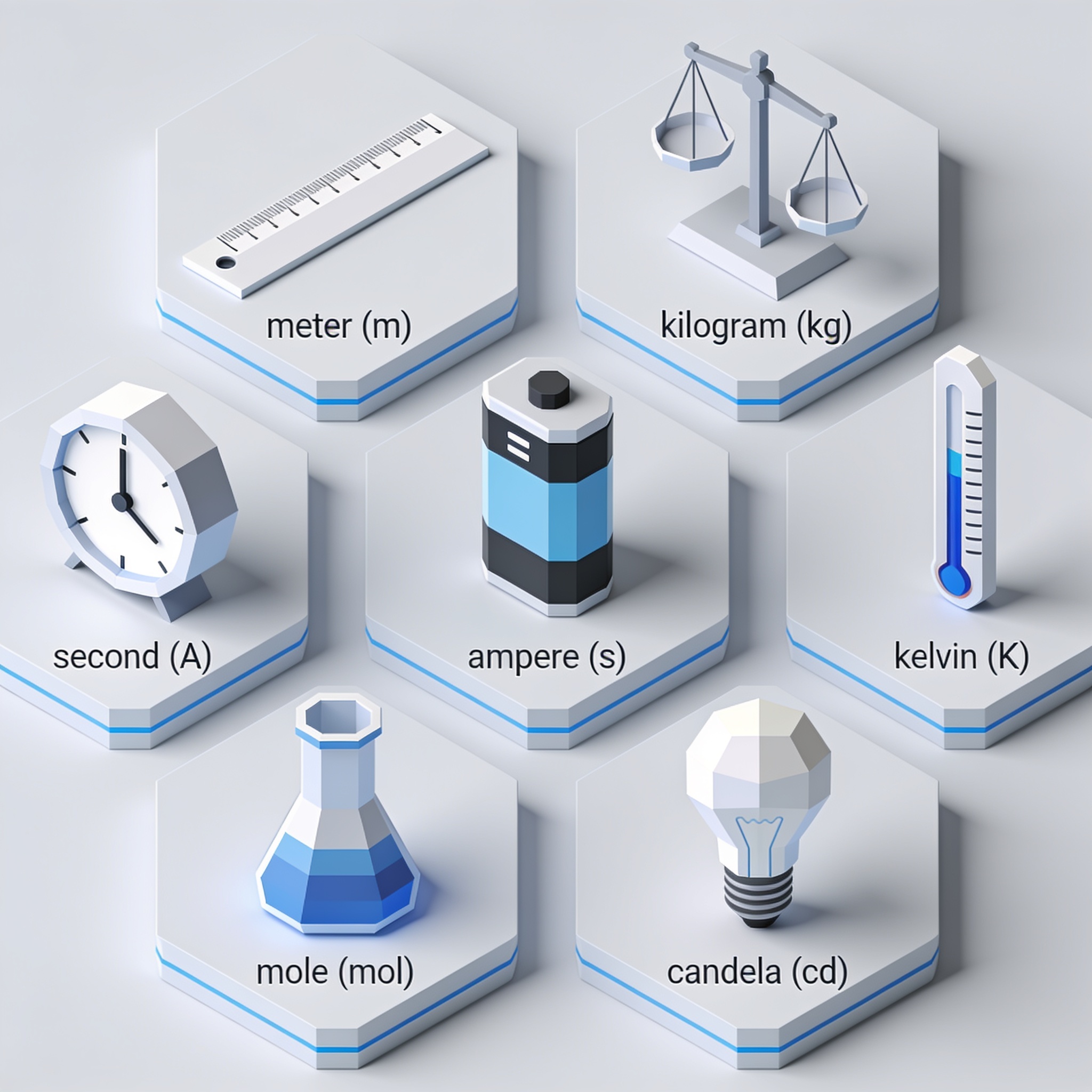
The International System of Units, abbreviated as SI, is the modern standard for scientific measurement. It evolved from the MKS system and provides a coherent set of seven base units that define all other physical quantities used in current research.
One primary advantage of the SI system is its decimal-based structure. By using prefixes like kilo, milli, and micro, scientists can express extremely large or small values without changing the base unit, which simplifies calculations and reduces potential conversion errors.
SI units are defined by universal physical constants, such as the speed of light or the Planck constant. This ensures that the standards remain invariant across time and space, providing a stable foundation for high-precision measurements in all scientific fields.
The system is also internationally recognized, ensuring that a value measured in one laboratory is perfectly understood in another. This global consensus is vital for modern technology, space exploration, and the advancement of theoretical physics across diverse international research communities.
For students preparing for competitive exams, internalizing the SI system is non-negotiable. Most JEE and NEET numerical problems require the final answer to be expressed in SI units, making familiarity with these base and derived units a major advantage.
Base Units and Supplementary Quantities
The SI system is built upon seven fundamental base units: meter for length, kilogram for mass, second for time, ampere for current, kelvin for temperature, mole for substance amount, and candela for luminous intensity. These are the building blocks of physics.
Beyond these base units, the system includes two supplementary units: the radian for plane angles and the steradian for solid angles. Although these are dimensionless, they are crucial for defining quantities like angular velocity, torque, and various wave-related physical parameters.
Derived units are created by combining these base units through multiplication or division. For example, velocity is defined as length divided by time, leading to the SI unit of meters per second. This logic allows us to quantify every physical phenomenon.
Understanding the dimensional integrity of these units is essential. If a derived unit does not match the physical definition of the quantity it represents, an error has occurred. This awareness helps students identify mistakes during the derivation of complex equations.
The following table summarizes the primary base units used in the SI system to ensure standardized reporting of physical data across all scientific disciplines, providing a clear reference for students engaging in laboratory experiments or solving theoretical physics problems.
| Quantity | SI Unit | Symbol |
|---|---|---|
| Length | Meter | m |
| Mass | Kilogram | kg |
| Time | Second | s |
Mastering Unit Conversions
Techniques for Conversion
Unit conversion is a fundamental skill that every student must master to avoid losing marks in competitive exams. The process involves multiplying the given value by a conversion factor, which is essentially a ratio equal to one between different units.
For instance, converting centimeters to meters requires multiplying by ##10^{-2}##. Because ##100\text{ cm} = 1\text{ m}##, the conversion factor is ##\dfrac{1\text{ m}}{100\text{ cm}}##. Applying this correctly ensures that the physical value remains identical while the numerical representation changes accordingly.
Students frequently struggle with converting units of derived quantities, such as force or energy. For example, converting force from newtons to dynes requires careful attention to the powers of ten involved in both mass and length unit transformations simultaneously.
A common mistake involves forgetting to convert all components of a derived unit. If you are converting a density value from ##\text{g/cm}^3## to ##\text{kg/m}^3##, you must convert both the mass unit and the volume unit independently before completing the final calculation.
Practice is the only way to gain speed and accuracy in these tasks. By working through various examples, students develop an intuitive sense for the magnitude of units, which helps in quickly spotting incorrect answers during high-pressure examination scenarios like JEE.
To calculate the conversion of energy from joules to ergs, we use the dimensional formula for energy, which is ##[ML^2T^{-2}]##. Given that ##1\text{ J} = 1\text{ kg} \cdot \text{m}^2/\text{s}^2##, we can derive the exact equivalence using the following mathematical steps for precision.
Similarly, when converting pressure from Pascals to CGS units, we must account for the area component. Since pressure is force divided by area, the conversion factor involves both mass, length, and time units, leading to the standard conversion ratio displayed below.
Finally, consider the conversion of acceleration due to gravity from SI to CGS. If we take ##g = 9.8\text{ m/s}^2##, we multiply by ##100\text{ cm/m}## to find the equivalent value in centimeters, ensuring that the time component remains constant in both systems.
Practical Application and Common Pitfalls
Avoiding Common Errors
Students often treat unit conversion as a memory task rather than a logical process. This leads to frequent errors, such as confusing the base unit with the quantity or forgetting that numerical values change inversely when the unit size increases.
Another major pitfall is the failure to include units in intermediate calculation steps. When solving complex problems, writing units alongside every number acts as a safety mechanism, allowing students to spot dimensional inconsistencies before they reach a final, incorrect result.
Many learners incorrectly assume that the numerical value of a quantity is fixed. In reality, the numerical value is entirely dependent on the unit chosen. If the unit becomes smaller, the numerical value must increase to represent the same physical quantity.
Confusing quantity with unit is a hallmark of beginners. For example, stating that "kg" is a quantity is incorrect; it is the unit of mass. Such conceptual errors reveal a lack of depth that can hinder performance in advanced physics topics.
Always verify that your units match before adding or subtracting quantities. You cannot add a length to a time, nor can you add a force to an energy. The principle of homogeneity demands that only identical physical dimensions can be combined.
The Significance of Standards in JEE and NEET
Competitive exams like JEE and NEET emphasize dimensional analysis and unit consistency because they reflect a student's ability to think like a scientist. Problems are often designed to trap students who ignore units or fail to convert them correctly.
Standard units allow for the clear definition of physical laws. When a formula is presented, its validity relies on the fact that both sides of the equation represent the same physical quantity. This is the cornerstone of all engineering and research.
In the laboratory, understanding the least count of instruments and the standard units they measure is crucial for error analysis. Without a solid grasp of SI standards, interpreting experimental data or calibrating equipment becomes impossible for any aspiring engineering student.
The following table lists common unit conversions that frequently appear in physics problems, providing a quick-reference guide to help students navigate the transition between different systems without falling into common traps during the heat of an examination session.
| Conversion Type | Factor |
|---|---|
| Newton to Dyne | ##10^5## |
| Joule to Erg | ##10^7## |
| 1 Inch to cm | 2.54 |
By consistently applying the principles of the SI system, students build a reliable toolkit for problem-solving. Whether calculating the force on a particle or the energy stored in a capacitor, unit discipline remains the most effective way to ensure accuracy.
RESOURCES
- Resources will be updated soon.
0 Comments