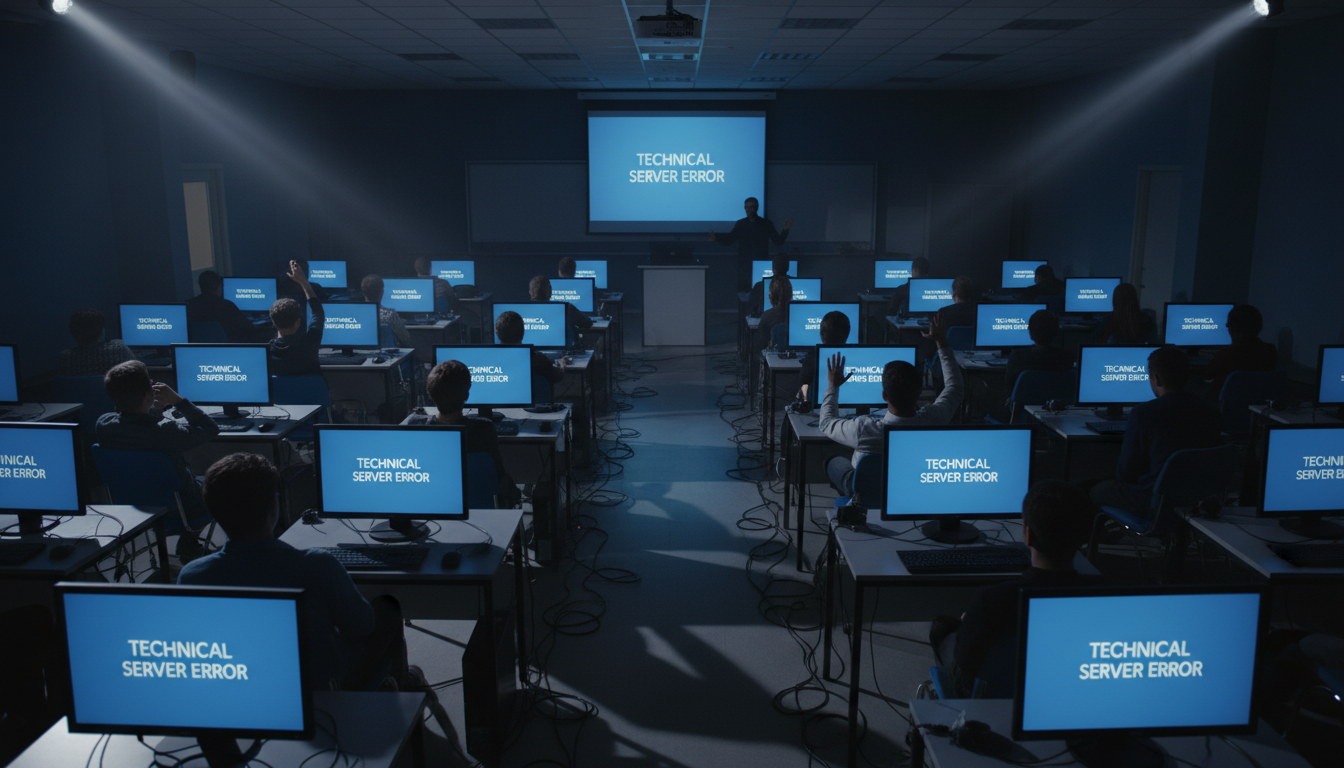
The academic landscape for the Class 12 CBSE Biology Practical 2026 has been momentarily destabilized by a significant technical failure within the 'Pariksha Sangam' portal. As schools across major metropolitan hubs like Delhi, Mumbai, and Bengaluru commenced their intensive laboratory assessments today, the centralized digital infrastructure reached a critical bottleneck. The failure, characterized by session timeouts and cryptographic failures during One-Time Password (OTP) generation, has not only disrupted the immediate schedule but has also raised profound questions regarding the scalability of India's educational IT infrastructure. For the 2026 session, the Central Board of Secondary Education (CBSE) transitioned to a rigorous "on-the-spot" digital marking system, intended to eliminate the latency between physical assessment and record finalization. However, the surge in concurrent requests from Biology labs—which require high-resolution imagery of slides and specimens—appears to have exceeded the current operational capacity of the board's cloud-hosted services.
On This Page
Biology practical examinations are unique in their technical complexity. Unlike other quantitative subjects, Biology requires the verification of complex qualitative outcomes, such as the successful preparation of pollen grain germination slides or the identification of specific Mendelian traits in floral specimens. The 2026 guidelines necessitate that external examiners upload live group photographs and individual student performance metrics in real-time. This "live-sync" requirement serves as a double-edged sword: while it ensures maximum transparency and prevents post-dated mark manipulation, it places an immense throughput demand on the 'Pariksha Sangam' servers. At 10:00 AM IST today, the portal's Load Balancer (LB) failed to effectively distribute traffic across the available virtual machines, leading to a cascading failure of the authentication microservices. This has left examiners unable to log in, effectively halting the assessment process for thousands of students.
We Also Published
Overview of the 2026 CBSE Biology Practical Framework
The 2026 Biology practical syllabus represents a modernized shift toward biotechnological proficiency and ecological modeling. Students are assessed on a 30-mark scale, divided into major experiments, minor experiments, slide preparation, and the maintenance of a comprehensive project record. The 'Pariksha Sangam' portal was designed to act as the single source of truth for these evaluations. Under the current framework, an external examiner must authenticate their presence at the exam center via a geo-tagged login. Once authenticated, the portal unlocks a series of dynamic fields corresponding to the student roll numbers present for that specific batch. The technical objective is to ensure that the marks awarded for "Spotting" (identifying various plant and animal specimens) are logged before the examiner leaves the premises, thereby maintaining a sterile and verifiable digital trail.
Furthermore, the integration of 5G-enabled uploading protocols in 2026 was supposed to facilitate the seamless transfer of "Evidence of Practical Work." This evidence includes high-definition images of the students' laboratory setups and their respective identification slides under the microscope. In Biology, where the visual confirmation of a mitosis stage or the results of a starch test are paramount, these digital assets are critical. The portal's failure to handle these binary large objects (BLOBs) during the morning session highlights a significant gap between the policy's digital vision and the server's architectural reality. The resulting chaos has forced many institutions to revert to manual ledgers, a regression that the 2026 paperless mandate specifically sought to avoid.
Technical Analysis of the 'Pariksha Sangam' Systemic Failure
Backend Congestion and OTP Latency Issues
The primary point of failure during the January 2026 practical window was the authentication gateway responsible for generating session-based OTPs. In a high-security environment like national examinations, multi-factor authentication (MFA) is mandatory to prevent unauthorized access to sensitive internal marks. However, the 'Pariksha Sangam' portal's SMS and email relay servers experienced a "thundering herd" problem, where thousands of examiners simultaneously requested access at the 10:00 AM IST mark. This led to an massive queue in the message broker system, causing the OTPs to arrive long after the web session had timed out. Without this initial handshake, the entire "on-the-spot" marking workflow remained locked, preventing examiners from even beginning the data entry process.
From a software engineering perspective, this indicates a lack of elastic scaling within the authentication microservice. While the front-end might have remained responsive, the backend database responsible for verifying credentials and logging session tokens reached its maximum concurrent connection limit. In the context of the Biology practical, this delay is particularly detrimental because the specimens—especially live botanical samples or biochemical reactants—have a limited shelf life during the examination window. If the portal is down for three hours, the biological integrity of the experiment might be compromised, leading to unfair assessment conditions for the students who were ready with their slides and titration results.
Moreover, the retry logic implemented on the examiner's interface was suboptimal. Every time an examiner clicked "Resend OTP," they inadvertently added to the server-side congestion, creating a DDoS-like (Distributed Denial of Service) effect on their own infrastructure. This feedback loop is a classic symptom of systems not designed with high-concurrency "peak-load" scenarios in mind. CBSE officials noted that the server traffic today was 400% higher than during the previous year's Physics and Chemistry windows, likely due to the larger file sizes associated with the Biology requirement of detailed specimen photography and more comprehensive observation tables.
The psychological impact on the examiner-student dynamic cannot be overlooked either. In a technical exam where precision is key, the examiner's frustration with the portal can translate into a tense atmosphere. Students on platforms like Reddit reported that the inability to generate a session OTP meant they were left standing by their laboratory benches, watching their prepared slides dry out or their chemical reactions change color over time. This technical friction directly interferes with the pedagogical goals of the CBSE curriculum, which aims to foster a calm, scientific temper during evaluations rather than a stressful environment dictated by server response times.
Data Integrity and Real-Time Asset Synchronization
The second critical failure point involves the synchronization of multi-media assets—specifically the group photographs of students performing experiments. The 2026 CBSE guidelines require these photos to be uploaded in a specific uncompressed format to ensure no digital manipulation has occurred. During the peak of the Biology exams, the portal's storage bucket (S3 or equivalent) struggled to handle the simultaneous stream of high-bitrate images. When the portal began "freezing," it was often at the point of finalizing these uploads. This led to "partial writes," where the student's marks were saved in the database, but the mandatory photographic evidence was missing, resulting in an "Incomplete Entry" status that prevented final submission.
This technical roadblock presents a massive risk to data integrity. If an examiner is forced to log out and log back in due to a portal freeze, there is no guarantee that the unsaved marks from the previous session will be recovered. In Biology, where a single student may have up to six distinct sub-scores (for major, minor, spotting, viva, etc.), the risk of data entry errors increases exponentially when the system is unstable. Examiners reported having to keep manual "rough sheets" to record marks while waiting for the portal to stabilize—a practice that introduces human error and defeats the purpose of an end-to-end encrypted digital assessment system.
Furthermore, the Pariksha Sangam portal lacks an "Offline Mode" with local caching. Ideally, in a country with varying internet stability, the application should allow examiners to enter data locally and sync with the central server once the connection is robust. The 2026 implementation, however, is strictly "cloud-live." This means that even a momentary dip in bandwidth or a backend glitch completely halts the workflow. For Biology practicals, where the examiner is often moving between different lab stations (the microscope area, the titration area, and the specimen display), a persistent and reliable connection is a technical necessity that the current portal architecture failed to provide.
The decision to extend the deadline by 48 hours is a reactive measure rather than a proactive solution. While it provides temporary relief, it does not address the underlying technical debt of the portal. The extension actually compounds the issue, as it shifts the traffic spike to a later date without increasing the server's vertical or horizontal capacity. For the Class 12 Biology students, this delay means a prolonged period of uncertainty, as their internal marks remain in a "pending" state. This creates a bottleneck for the board's final result processing engine, potentially delaying the release of the 2026 scorecard and impacting university admissions timelines.
Implications for the 100% Paperless Assessment Mandate
The 2026 academic year was heralded as the milestone for 100% paperless internal assessments within the CBSE ecosystem. The vision was to create a seamless, transparent, and environmentally friendly evaluation process. However, the 'Pariksha Sangam' glitch serves as a stark reminder that digital transformation is only as strong as its weakest link—the infrastructure layer. When the digital "paper" is inaccessible, the entire machinery of the board grinds to a halt. This incident suggests that the board may have underestimated the sheer volume of data involved in Biology assessments compared to other subjects. The high-frequency nature of the January exam season requires a "warm" standby infrastructure that can handle surges of up to 10 million requests per hour, a standard that today's outage clearly missed.
For educators and school administrators, this technical friction represents a logistical nightmare. Managing hundreds of students while a portal is down requires significant manpower to maintain order and ensure that the laboratory experiments do not lose their validity. The viral hashtag #CBSEPortalDown is more than just social media noise; it is a collective demand from the academic community for a more robust digital contract. If the board mandates a paperless system, it must also provide the high-availability (HA) environment required to support that mandate. This includes investments in Content Delivery Networks (CDNs) and more sophisticated database sharding techniques to prevent localized outages from affecting the entire national network.
Strategic Recommendations for Scalable Educational Infrastructure
To prevent a recurrence of the 'Pariksha Sangam' failure during the remaining practical windows of 2026, several technical optimizations are imperative. First, the CBSE must implement "Staggered Authentication." By assigning different login windows based on regional zones or center codes, the initial 10:00 AM IST traffic spike could be flattened into a manageable curve. Secondly, the integration of a Progressive Web App (PWA) framework for the portal would allow for "Offline-First" data entry. This would enable examiners to continue recording marks and capturing photos even during a server outage, with the data automatically syncing in the background once the 'Pariksha Sangam' backend recovers.
Additionally, the board should consider migrating to a multi-cloud architecture. Relying on a single cloud provider for a national-level examination is a point of failure that can be mitigated by distributing the workload across multiple providers (e.g., NIC, AWS, and Azure). Implementing edge computing nodes at the district level could also reduce latency for photo uploads, as the heavy binary data would be processed closer to the source before being summarized and sent to the central New Delhi servers. As we move further into the 2026 exam cycle, these technical refinements will be essential to restore trust in the digital assessment ecosystem and ensure that the hard work of Biology students is recorded accurately and without delay.
From our network :
- EV 2.0: The Solid-State Battery Breakthrough and Global Factory ExpansionDiscover the impact of the Solid-State Battery Breakthrough on the EV market. Learn about CATL and BYD stock growth, global factory expansion in Europe, and the future of EV 2.0 technology.
- 98% of Global MBA Programs Now Prefer GRE Over GMAT Focus EditionExplore why 98% of global MBA programs now prefer the GRE over GMAT Focus. Learn about the shorter GRE format, verbal logic importance, and strategic versatility for students.
- AI-Powered 'Precision Diagnostic' Replaces Standard GRE Score ReportsDiscover the new GRE Precision Diagnostic. Learn how AI-powered behavioral analytics and time-to-solve tracking are replacing standard GRE score reports to empower students.
- Vite 6/7 'Cold Start' Regression in Massive Module GraphsIn-depth analysis of Vite 6/7 cold start regressions in massive module graphs. Learn about barrel file issues, pre-bundling optimizations, and how to improve Vite dev server performance.
- 10 Physics Numerical Problems with Solutions for IIT JEEPrepare for IIT JEE with 10 physics numerical problems, complete with detailed solutions and conceptual explanations. Ideal for mastering kinematics, thermodynamics, electromagnetism, and optics.
- Trump Political Strategy How Geopolitical Stunts Serve As Media Diversions
- Mastering DB2 LUW v12 Tables: A Comprehensive Technical GuideComprehensive guide on DB2 LUW v12 tables. Explore CREATE TABLE syntax, BLU Acceleration, range partitioning, data types, and security features for IBM DB2 LUW v12.
- Mastering DB2 12.1 Instance Design: A Technical Deep Dive into Modern Database ArchitectureComprehensive guide to DB2 12.1 Instance Design. Explore architectural components, HADR setup, buffer pool tuning, and security policies for IBM DB2 12.1. Includes 10 functional SQL and Shell samples.
- Analyzing Trump Deportation Numbers Insights Into The 2026 Immigration Crackdown
RESOURCES
- How to Choose the Best SEO Keyphrase - Den Web Design
- The perfect focus keyword for your post or page + examples • Yoast
- What is an SEO Keyphrase? A Simple Guide for Beginners
- SEO Keyphrase
- How To Choose Your Target SEO Keyphrase | Conscious Connection
- SEO Guide | Narrative Help Center
- SEO keyphrase (搜索引擎优化)关键词分析(网站建设) | Focus
- YourBizName | SEO Keyphrase Here
- Optimal Keyphrase Length: What You Need to Know - ThemeXpert
- How To Optimize Blog Posts For SEO | Peaceful Media
- SEO Keyphrase Targeting with Microsites
- Impostor Syndrome (and e-commerce) - One Objective
- Resources - The Search Guru
- Being With Jesus - God's Plan and Provision for Your Life | Chad ...
- Yoast SEO recommends 4 words in the focus keyphrase section for ...


0 Comments