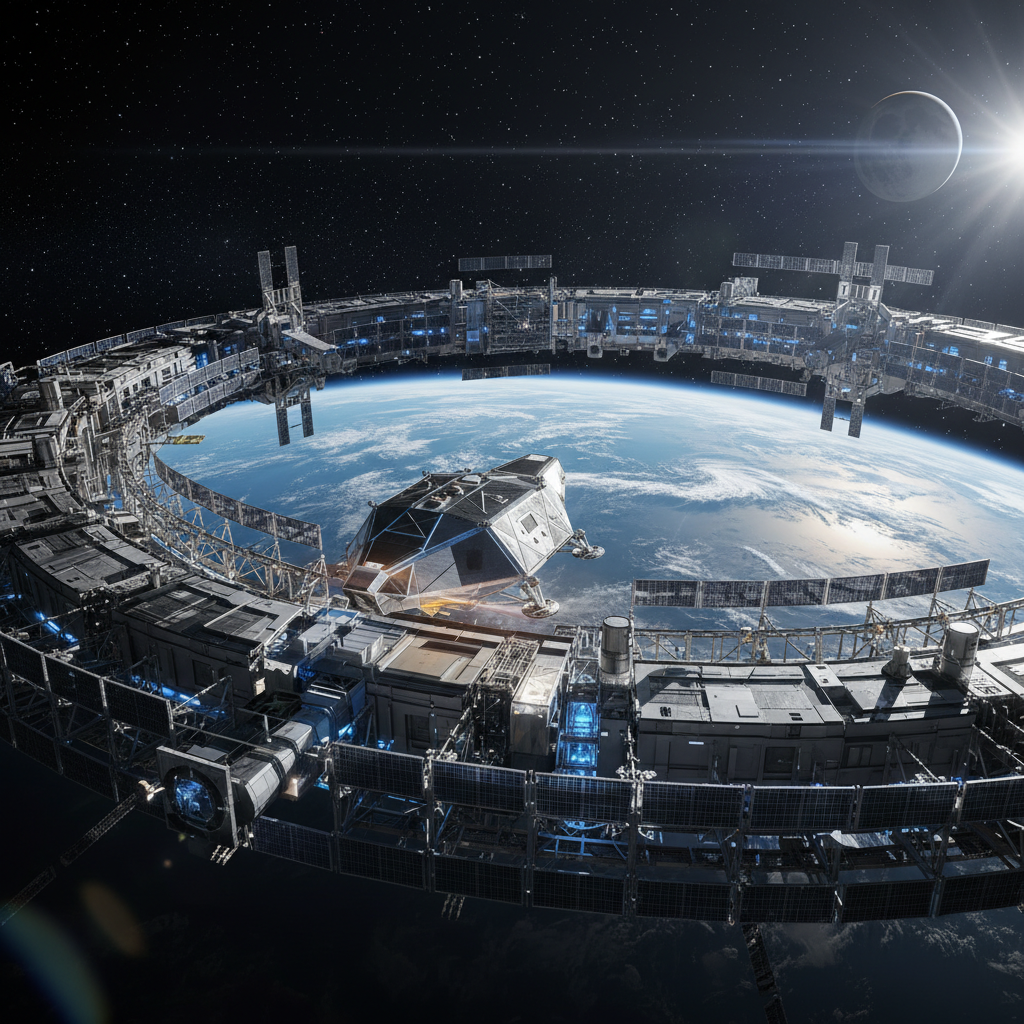
The
has entered a transformative phase following the swearing-in of Jared Isaacman as the 15th NASA Administrator, marking a pivot toward private-sector integration in deep-space exploration. This shift is not merely administrative but a fundamental reconfiguration of the aerospace engineering pipeline, moving from traditional cost-plus contracting to a fixed-price, high-cadence model. Under the "Ensuring American Space Superiority" executive order, the integration of private agility into the national space architecture is now a strategic necessity. This technical analysis explores the propulsion physics, orbital mechanics, and economic modeling required to meet the 2028 lunar mandate.
The Strategic Shift in Orbital Procurement and Systems Engineering
Historically, NASA’s procurement was defined by the Federal Acquisition Regulation (FAR) Part 15, which often led to prolonged development cycles for bespoke systems. The
leverages FAR Part 12, treating space transportation as a service rather than a government-owned asset. This allows for rapid iterative prototyping, a process visible in the development of the Starship HLS (Human Landing System).
From a systems engineering perspective, the transition reduces the "Requirements Creep" by freezing technical specifications at the contract level while allowing the contractor to optimize the internal architecture. For example, the mass fraction of a launch vehicle is a critical metric defined by:
### \epsilon = \frac{m_{structure}}{m_{initial}} ###
In traditional models, ##\epsilon## remained high due to conservative safety margins and legacy materials. The new era emphasizes high-strength-to-weight ratios using advanced carbon composites and 300-series stainless steel alloys, optimizing the vehicle for reusability.
Mathematical Modeling of Propulsion Systems in the Private Sector
A core component of the
is the advancement of high-pressure combustion cycles. The Raptor engines, utilized by SpaceX, employ a full-flow staged combustion cycle (FFSCC). The efficiency of these engines is measured by their Specific Impulse (##I_{sp}##), which is defined as:
### I_{sp} = \frac{F}{\dot{m} g_0} ###
Where:
- F is the thrust generated (Newtons).
- \dot{m} is the propellant mass flow rate (kg/s).
- g_0 is the standard gravity (approx. 9.80665 m/s²).
For methalox engines (CH₄/LOX), the theoretical maximum ##I_{sp}## in a vacuum can exceed 380 seconds. The stoichiometric ratio for methane combustion is:
### CH_4 + 2O_2 \rightarrow CO_2 + 2H_2O ###
However, to optimize for engine cooling and prevent soot formation, most commercial engines run "fuel-rich" or "oxygen-rich" depending on the pre-burner configuration. The full-flow cycle is particularly advantageous because it allows for higher chamber pressures (##P_c > 300## bar), directly increasing the thrust-to-weight ratio.
The Physics of the Lunar Gateway and Orbital Mechanics
The Artemis program relies heavily on the Near-Rectilinear Halo Orbit (NRHO), a specific solution within the circular restricted three-body problem (CR3BP). Unlike a standard circular orbit, the NRHO maintains stability through a balance of Earth and Moon gravitational gradients. The position of a spacecraft in this system is described by the Jacobi constant:
Economics of the Commercial Space Revolution: A $50 Billion Trajectory
The executive order calling for $50 billion in private investment by 2028 reflects a shift toward a "space economy" model. In this model, the government acts as an anchor tenant, reducing the risk for venture capital. The internal rate of return (IRR) for space startups is increasingly tied to the reduction in the cost-per-kilogram to orbit. If we model the cost reduction using Wright's Law (the experience curve), we see that the cost ##C_n## of the ##n^{th}## launch is: ### C_n = C_1 \cdot n^{-k} ### Where ##k## is the learning rate. In a Commercial Space Revolution environment, the learning rate is accelerated through rapid reuse. Current projections suggest that if launch frequency doubles, costs could decrease by as much as 20% per iteration. This financial agility is what allows for the ambitious 2028 lunar landing timeline. For a comprehensive look at the mission architecture, visit the NASA Artemis Program page.Material Science and Structural Resilience for 2028 Lunar Missions
Deep-space missions necessitate materials that can withstand extreme thermal cycling and high-energy ionizing radiation. The lunar surface experiences temperatures ranging from 100 K to 400 K. The thermal stress ##\sigma## on a structural component is given by: ### \sigma = E \alpha \Delta T ### Where:- E is Young's modulus.
- \alpha is the coefficient of thermal expansion.
- \Delta T is the temperature gradient.
Communication Protocols and Deep Space Signal Propagation
As the cadence of missions increases, the Deep Space Network (DSN) faces bandwidth constraints. The Commercial Space Revolution is pushing for a transition from Radio Frequency (RF) to Optical (Laser) communications. The data rate ##R## of a communication link is constrained by the Shannon-Hartley theorem: ### C = B \log_2(1 + \frac{S}{N}) ### Where ##B## is bandwidth and ##S/N## is the signal-to-noise ratio. Optical systems operate at much higher frequencies (terahertz range), allowing for gigabit-per-second data transfer rates across interplanetary distances. Private constellations, similar to Starlink but positioned in lunar orbit, are being developed to provide "Lunar-link" services, ensuring continuous high-definition telemetry for the Artemis 2028 mission.The Convergence of Public Interest and Private Innovation
The leadership of Jared Isaacman signifies the end of the "siloed" approach to space exploration. By integrating the technical excellence of SpaceX Starship and other commercial platforms directly into the NASA mission framework, the agency achieves a level of redundancy and cost-efficiency previously unattainable. The kinetic energy of a re-entering spacecraft, which must be dissipated by the thermal protection system (TPS), is: ### E_k = \frac{1}{2}mv^2 ### As Starship prototypes refine their ceramic hex-tile heat shields, the data gathered informs the safety parameters for government-led human missions. This symbiotic relationship ensures that the path to Mars is not just a government project, but a sustainable industry.Fluid Dynamics and Cryogenic Management in Microgravity
One of the most significant technical hurdles being addressed in the Commercial Space Revolution is the long-term storage and transfer of cryogenic propellants in orbit. In a microgravity environment, the lack of buoyancy makes it difficult to separate the liquid phase from the gaseous phase in propellant tanks. This is governed by the Bond number: ### Bo = \frac{\rho a L^2}{\sigma} ### Where:- \rho is the density of the fluid.
- a is the acceleration (very low in orbit).
- L is the characteristic length (tank diameter).
- \sigma is the surface tension.
From our network :
- Analyzing Trump Deportation Numbers Insights Into The 2026 Immigration Crackdown
- 98% of Global MBA Programs Now Prefer GRE Over GMAT Focus EditionExplore why 98% of global MBA programs now prefer the GRE over GMAT Focus. Learn about the shorter GRE format, verbal logic importance, and strategic versatility for students.
- AI-Powered 'Precision Diagnostic' Replaces Standard GRE Score ReportsDiscover the new GRE Precision Diagnostic. Learn how AI-powered behavioral analytics and time-to-solve tracking are replacing standard GRE score reports to empower students.
- 10 Physics Numerical Problems with Solutions for IIT JEEPrepare for IIT JEE with 10 physics numerical problems, complete with detailed solutions and conceptual explanations. Ideal for mastering kinematics, thermodynamics, electromagnetism, and optics.
- Mastering DB2 LUW v12 Tables: A Comprehensive Technical GuideComprehensive guide on DB2 LUW v12 tables. Explore CREATE TABLE syntax, BLU Acceleration, range partitioning, data types, and security features for IBM DB2 LUW v12.
- Trump Political Strategy How Geopolitical Stunts Serve As Media Diversions
- Mastering DB2 12.1 Instance Design: A Technical Deep Dive into Modern Database ArchitectureComprehensive guide to DB2 12.1 Instance Design. Explore architectural components, HADR setup, buffer pool tuning, and security policies for IBM DB2 12.1. Includes 10 functional SQL and Shell samples.
- Vite 6/7 'Cold Start' Regression in Massive Module GraphsIn-depth analysis of Vite 6/7 cold start regressions in massive module graphs. Learn about barrel file issues, pre-bundling optimizations, and how to improve Vite dev server performance.
- EV 2.0: The Solid-State Battery Breakthrough and Global Factory ExpansionDiscover the impact of the Solid-State Battery Breakthrough on the EV market. Learn about CATL and BYD stock growth, global factory expansion in Europe, and the future of EV 2.0 technology.
RESOURCES
- Jared Isaacman - NASA
- Jared Isaacman - Wikipedia
- NASA Welcomes 15th Administrator Jared Isaacman - NASA
- Someone found and posted the entire contents of Jared Isaacman's ...
- Jared Isaacman: What went wrong at NASA | The All-In Interview ...
- A plan written by Trump's NASA pick was leaked. Here's what to ...
- Jared Isaacman (@rookisaacman) / Posts / X
- Billionaire Jared Isaacman, an Elon Musk ally, confirmed as Nasa ...
- Jared Isaacman is confirmed as NASA chief, a year later : NPR
- Jared Isaacman makes second appeal for NASA administrator ...
- NASA's Next Chief, Jared Isaacman, Gives Answers in Senate ...
- NASA's new leader, Jared Isaacman, makes his priorities clear
- Jared Isaacman Confirmed to Run NASA as Space Program Is in ...
- Project Athena Summary From Jared Isaacman - NASA Watch
- Trump meets with Jared Isaacman about top NASA job after pulling ...



0 Comments