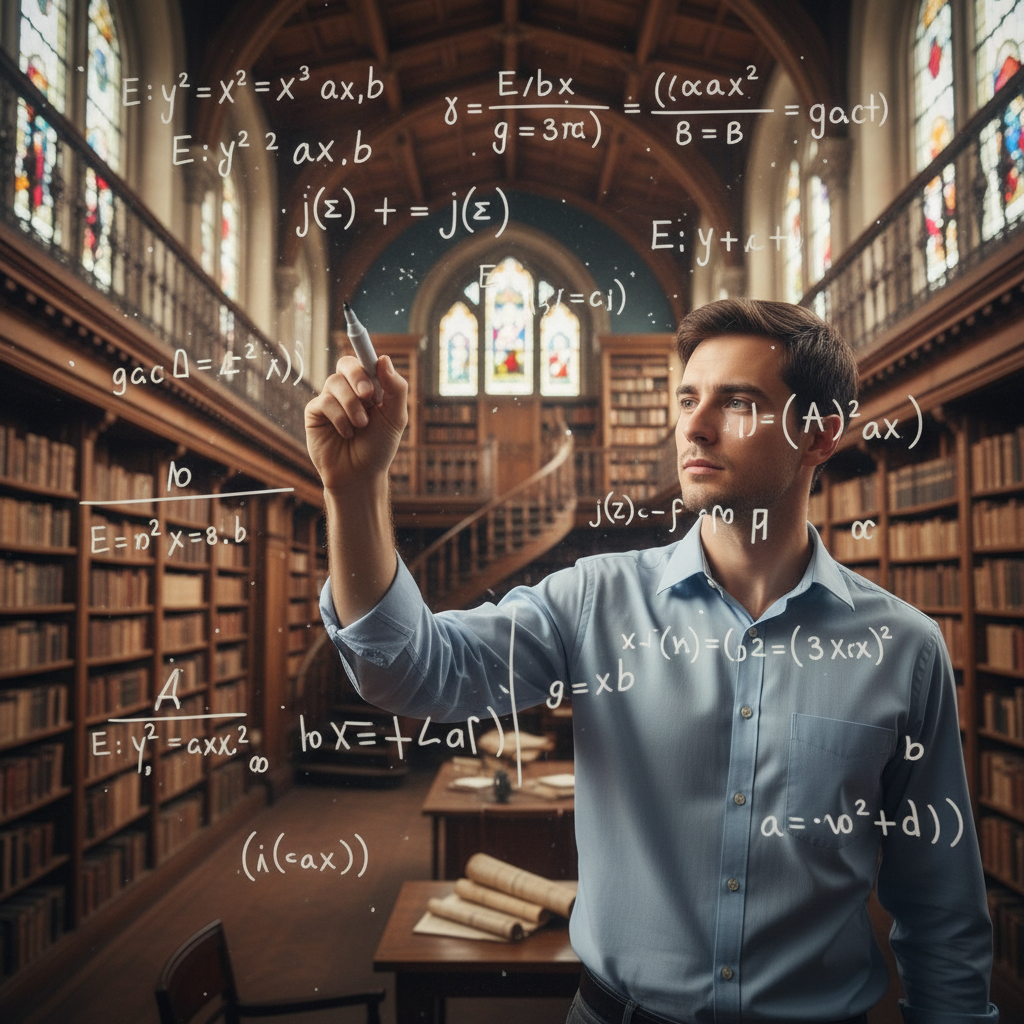
The SASTRA Ramanujan Award 2025 has been officially conferred upon Dr. Alexander Smith of Northwestern University, marking a significant milestone in the evolution of modern number theory and analytic geometry. This prestigious honor, presented in the historic town of Kumbakonam, recognizes Dr. Smith’s monumental contributions to our understanding of congruent number problems and the statistical distribution of class groups. By bridging the gap between century-old intuitive conjectures and rigorous modern proofs, Dr. Smith has solidified his position as one of the most formidable mathematicians of his generation.
On This Page
- The Legacy of Srinivasa Ramanujan in the 21st Century
- The Significance of the SASTRA Ramanujan Award 2025
- Understanding the Congruent Number Problem
- Technical Breakthroughs in Class Group Distributions
- Elliptic Curves and the Goldfeld Conjecture
- Mathematics as the Bedrock of Viksit Bharat 2047
- Future Directions and the Global Mathematical Community
We Also Published
The Legacy of Srinivasa Ramanujan in the 21st Century
The presentation of the SASTRA Ramanujan Award 2025 in Kumbakonam is not merely symbolic; it is a tribute to the "Man Who Knew Infinity." Srinivasa Ramanujan’s work in the early 20th century provided the seeds for many of the branches of mathematics that researchers like Dr. Alexander Smith explore today. Ramanujan’s insights into modular forms, mock theta functions, and partition theory continue to serve as the foundation for complex proofs in arithmetic geometry.
The award committee, which comprises international experts in the field, seeks to identify young mathematicians who embody the spirit of Ramanujan—someone who tackles deep, fundamental problems that have resisted solution for decades. By focusing on mathematicians under the age of 32, the award mirrors Ramanujan's own short but explosive career. Historically, the correlation between this award and the Fields Medal is high, with nearly seven previous winners moving on to receive the highest honor in mathematics. This trajectory underscores the rigorous selection process and the high caliber of research expected from recipients.
The Significance of the SASTRA Ramanujan Award 2025
At the ceremony, the discourse extended beyond pure abstraction. Dr. N. Kalaiselvi, Director-General of the Council of Scientific and Industrial Research (CSIR), highlighted how mathematics serves as the cornerstone of the Viksit Bharat 2047 vision. As India aims to become a developed nation by its centenary of independence, the role of advanced number theory in technological sovereignty cannot be overstated. From the development of post-quantum cryptography to the optimization of complex data systems, the mathematical breakthroughs of today are the engineering solutions of tomorrow.
Dr. Alexander Smith's work on the distribution of class numbers is particularly relevant in this context. Class groups are fundamental objects in algebraic number theory that measure the extent to which unique factorization fails in the ring of integers of a number field. Understanding their structure is essential for modern cryptography, specifically in systems that rely on the difficulty of the discrete logarithm problem in certain groups.
Understanding the Congruent Number Problem
One of the primary reasons for Dr. Smith’s selection for the SASTRA Ramanujan Award 2025 is his work on the congruent number problem. This is one of the oldest unsolved problems in mathematics, dating back over a thousand years to the work of Arab mathematicians and later popularized by Diophantus. A positive integer ##n## is called a "congruent number" if it represents the area of a right-angled triangle with rational sides.
Algebraically, this means finding rational numbers ##a, b, c## such that:
### a^2 + b^2 = c^2 ###### \frac{1}{2}ab = n ###This problem can be transformed into the study of elliptic curves. Specifically, the integer ##n## is a congruent number if and only if the elliptic curve defined by the equation:
### E_n: y^2 = x^3 - n^2x ###has a rational point ##(x, y)## where ##y \neq 0##. Such a point is a point of infinite order in the group of rational points ##E_n(\mathbb{Q})##. The challenge lies in determining the rank of this elliptic curve. Dr. Smith’s research has provided groundbreaking methods to calculate the 2-primary part of the Shafarevich-Tate group, which is a critical step in verifying the Birch and Swinnerton-Dyer (BSD) Conjecture for these specific curves.
Technical Breakthroughs in Class Group Distributions
Dr. Smith’s research extends into the Cohen-Lenstra Heuristics, which predict the frequency with which certain types of class groups occur. For a quadratic field ##\mathbb{Q}(\sqrt{D})##, the class group ##Cl(D)## is a finite abelian group. The Cohen-Lenstra heuristics suggest that the probability of a specific group appearing is inversely proportional to the size of its automorphism group.
In his landmark papers, Dr. Smith proved the heuristics for the 2-part of the class groups of imaginary quadratic fields. This was a problem that had remained stagnant for decades. His approach involved using high-order governing fields and analyzing the distribution of the 2-Sylow subgroups. By applying the techniques of Northwestern University’s advanced algebraic research, Smith demonstrated that for a given prime ##p = 2##, the distribution follows the predicted statistical model as the discriminant ##D## approaches infinity.
This work has profound implications for the congruent number problems mentioned earlier. The relationship between the class group of a quadratic field and the Selmer groups of elliptic curves allows mathematicians to estimate the rank of these curves with much greater precision. Smith’s results provided the first rigorous proof that a significant percentage of integers ##n## satisfy the conditions to be congruent numbers, assuming the parity conjecture.
Elliptic Curves and the Goldfeld Conjecture
The SASTRA Ramanujan Award 2025 also recognizes Smith’s contribution to Goldfeld’s Conjecture. Proposed by Dorian Goldfeld in 1979, the conjecture posits that the average rank of a family of quadratic twists of an elliptic curve is ##1/2##. More specifically, it suggests that 50% of such curves have rank 0 and 50% have rank 1, with higher ranks occurring with 0% frequency in the limit.
Dr. Smith’s work on the 2-Selmer groups of elliptic curves has brought us closer to a complete proof of this conjecture. By using the method of "moments," he was able to show that the distribution of ranks in certain families of elliptic curves aligns with the predictions of the BSD Conjecture. The mathematical community, including researchers at SASTRA University, views this as one of the most significant advancements in the field since the proof of Fermat’s Last Theorem.
To visualize the complexity, consider the L-function associated with an elliptic curve ##E##:
### L(E, s) = \sum_{k=1}^{\infty} \frac{a_k}{k^s} ###The BSD Conjecture relates the behavior of ##L(E, s)## at ##s=1## to the rank of the curve. Smith’s ability to manipulate the algebraic structures surrounding these L-functions has paved the way for new algorithms in computational number theory.
Mathematics as the Bedrock of Viksit Bharat 2047
The integration of advanced mathematics into national policy is a key theme of the Viksit Bharat 2047 mathematics initiative. As emphasized by Dr. Kalaiselvi, the transition to a high-tech economy requires a robust mathematical foundation. Number theory, once thought to be the "purest" and perhaps least "useful" branch of mathematics, is now the primary tool for securing the digital world.
Cryptographic protocols such as RSA and Elliptic Curve Cryptography (ECC) depend on the difficulty of problems in number theory. As quantum computers threaten current encryption standards, the work of mathematicians like Dr. Alexander Smith becomes vital. His insights into the distribution of primes and the structure of class groups are essential for developing "isogeny-based cryptography," which is theorized to be resistant to quantum attacks. This alignment between abstract research and national security illustrates why the SASTRA Ramanujan Award 2025 is of such paramount importance to the global scientific community.
Future Directions and the Global Mathematical Community
Looking forward, the techniques introduced by Dr. Smith are expected to influence a wide array of sub-disciplines, including arithmetic statistics and the theory of motives. The Alexander Smith mathematician profile is one of a scholar who is not afraid to utilize "heavy machinery" from different areas of math—combining analytic techniques with deep algebraic geometry.
For young scholars in India and across the globe, the path to innovation lies in mastering these fundamental structures. The legacy of Ramanujan, bolstered by the recognition of modern geniuses like Smith, ensures that the quest to understand the "secrets of numbers" remains a vibrant and essential human endeavor. As we move toward 2047, the mathematical breakthroughs of today will continue to define the boundaries of what is possible in science and technology.
In conclusion, the SASTRA Ramanujan Award 2025 serves as both a reward for past excellence and an investment in future discovery. Dr. Smith’s work on congruent number problems and the distribution of class groups has answered questions that have puzzled mathematicians for centuries, yet it also opens new doors for the next generation of researchers to explore. The historic streets of Kumbakonam have once again witnessed a celebration of the infinite potential of the human mind.
From our network :
- 98% of Global MBA Programs Now Prefer GRE Over GMAT Focus Edition
- AI-Powered 'Precision Diagnostic' Replaces Standard GRE Score Reports
- https://www.themagpost.com/post/analyzing-trump-deportation-numbers-insights-into-the-2026-immigration-crackdown
- EV 2.0: The Solid-State Battery Breakthrough and Global Factory Expansion
- https://www.themagpost.com/post/trump-political-strategy-how-geopolitical-stunts-serve-as-media-diversions
- Mastering DB2 LUW v12 Tables: A Comprehensive Technical Guide
- Mastering DB2 12.1 Instance Design: A Technical Deep Dive into Modern Database Architecture
- Vite 6/7 'Cold Start' Regression in Massive Module Graphs
- 10 Physics Numerical Problems with Solutions for IIT JEE
RESOURCES
- Alexander Smith
- Alexander Smith - Clay Mathematics Institute
- Alexander Smith's papers
- Alexander Smith - The Mathematics Genealogy Project
- Alexander Smith to receive 2025 SASTRA Ramanujan Prize - The ...
- 2025 SASTRA Ramanujan Prize - Department of Mathematics
- Alexander Smith to receive 2025 SASTRA Ramanujan Prize ## The ...
- Alexander Smith Awarded Clay Research Fellowship - Harvard Math
- Alexander Smith
- $2^infty $-Selmer groups, $2^infty $-class groups, and Goldfeld's ...
- Department of Mathematics - Northwestern University
- The Birch and Swinnerton-Dyer conjecture implies Goldfeld's ...
- Alex Smith | UW-Eau Claire
- New Proof Shows Infinite Curves Come in Two Types | Quanta ...
- Alex Smith (@ninja_maths) / Posts / X




9 Comments