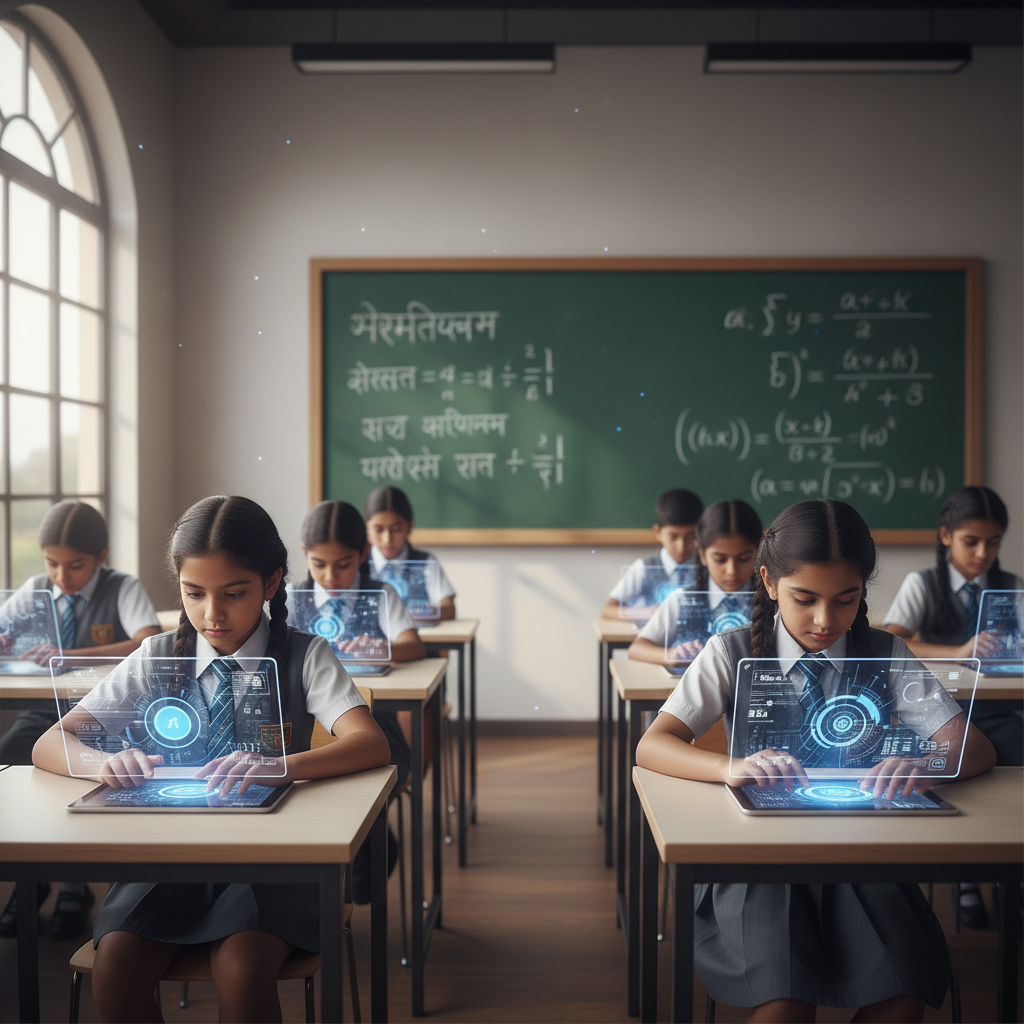
The NEP 2020 math curriculum marks a pivotal departure from traditional pedagogical norms in the Indian subcontinent, ushering in a synthesized approach that bridges classical computational heritage with the algorithmic requirements of the twenty-first century. As the 2025 academic session commences, the 5+3+3+4 structural framework has transitioned from a theoretical policy document into a functional classroom reality. This transformation is not merely administrative; it is a rigorous realignment of mathematical objectives, prioritizing deep conceptual frameworks over the mechanical derivation of results. By integrating Artificial Intelligence (AI) and the epistemological foundations of ancient Indian mathematics, the policy aims to cultivate a generation capable of navigating a data-centric global economy.
On This Page
- The Structural Transition: 5+3+3+4 and Mathematical Scaffolding
- Integrating Artificial Intelligence: The Algorithmic Shift
- Reclaiming the Heritage: Ancient Indian Mathematics as Logic
- Foundational Numeracy and the Science of Experiential Learning
- Advanced Mathematics: Transitioning to Calculus and Linear Algebra
- The Multidisciplinary Approach: Breaking the Silos
- Technological Integration and the Future of Math Labs
- Conclusion: The Path Toward an Innovation-Oriented Economy
We Also Published
Historically, Indian mathematics has been characterized by its early mastery of abstractions. The NEP 2020 math curriculum seeks to reclaim this legacy by reintroducing students to the foundational logic of scholars such as Aryabhata and Brahmagupta. However, this is not a regressive step. Instead, it serves as a scaffold for modern computational thinking. When a student in Class 3 explores the concept of zero, they are not just learning a placeholder; they are engaging with a mathematical revolution that enabled the development of calculus and binary logic. This historical context provides the "why" behind the "how," fostering an environment where foundational numeracy 2025 becomes an experiential journey rather than a chore of memorization.
One can find detailed resources on the evolution of these policies at the Ministry of Education portal. The transition to this new model requires a granular understanding of how various mathematical disciplines—from arithmetic to advanced linear algebra—interact with emerging technologies. In this technical deep-dive, we examine the structural, pedagogical, and technological components of this curriculum shift.
The Structural Transition: 5+3+3+4 and Mathematical Scaffolding
The NEP 2020 math curriculum replaces the decades-old 10+2 system with a 5+3+3+4 structure, which aligns more closely with the cognitive development stages of children. This new structure facilitates a more nuanced introduction to mathematical logic. In the Foundational Stage (ages 3–8), the focus is on "Number Sense." Rather than teaching formal arithmetic operations, the curriculum emphasizes the visualization of quantities. For instance, the concept of a "set" is introduced through physical objects, leading to the informal understanding of the additive identity: ## a + 0 = a ##.
As students move into the Preparatory Stage (ages 8–11), the curriculum introduces formal operations with a focus on "Experiential Learning." This is where foundational numeracy 2025 takes a technical turn. Students are introduced to the decimal system, not just as a rule, but as a power-series representation. A number like 452 is understood as: ### 4 \times 10^2 + 5 \times 10^1 + 2 \times 10^0 ### This clarity in base-10 logic is crucial for later transitions into other bases, such as binary (Base-2) or hexadecimal (Base-16), which are foundational to computer science and AI.
The Middle Stage (ages 11–14) introduces algebraic thinking and coding. Here, the curriculum begins to incorporate the "Indian Way" of problem-solving. Methods from the Sulba Sutras for geometric constructions are compared with Euclidean methods, showing multiple pathways to the same truth. This multidisciplinary approach ensures that mathematics is perceived as a universal language with diverse cultural dialects.
Integrating Artificial Intelligence: The Algorithmic Shift
Perhaps the most radical aspect of the NEP 2020 math curriculum is the mandatory introduction of AI literacy. In 2025, AI is no longer treated as an elective but as a core component of mathematical literacy. This is because modern AI is essentially "Applied Mathematics." To understand how a machine "learns," a student must eventually grasp concepts of probability, statistics, and calculus. Even at the early stages, students are taught the logic of algorithms—step-by-step instructions to solve a problem.
The curriculum introduces "Computational Thinking" by teaching students how to decompose complex problems into smaller, solvable units. This is the same logic used in designing a Neural Network. Consider a simple linear regression model used in AI to predict a value ## y ## based on an input ## x ##: ### y = mx + c ### In the new curriculum, students don't just solve for ## y ##; they are taught to understand how changing the "weight" ## m ## or the "bias" ## c ## affects the outcome. This is the precursor to understanding Gradient Descent, a fundamental optimization algorithm in AI, defined by the update rule: ### w_{new} = w_{old} - \eta \cdot \nabla Q(w) ### Where ## \eta ## is the learning rate and ## \nabla Q(w) ## is the gradient of the loss function. By exposing students to these concepts early, the NEP 2020 ensures they are not just consumers of AI but potential architects of it.
Reclaiming the Heritage: Ancient Indian Mathematics as Logic
The inclusion of ancient Indian mathematics in the NEP 2020 math curriculum is often misunderstood as a purely cultural move. From a technical standpoint, it is a move toward "Logical Rigor." Ancient Indian mathematicians developed sophisticated methods for handling infinite series and trigonometric functions long before the European Renaissance. For example, the Madhava series for ## \pi ##, developed by the Kerala School of Astronomy and Mathematics, is a masterpiece of early calculus: ### \pi = 4 \left( 1 - \frac{1}{3} + \frac{1}{5} - \frac{1}{7} + \dots \right) ### This is formally known as the Madhava-Leibniz series. By studying these, students see that mathematics is a cumulative human achievement. It allows them to engage with "Big O Notation" and convergence theories by looking at how many terms are needed to reach a specific precision for ## \pi ##.
Furthermore, the use of "Vedic Math" techniques is encouraged for mental calculation. While critics argue these are "shortcuts," in the context of the new curriculum, they are used as exercises in "Number Flexibility." If a student can multiply ## 98 \times 97 ## by seeing them as ## (100 - 2) \times (100 - 3) ##, they are performing an early form of algebraic expansion: ### (x - a)(x - b) = x^2 - (a+b)x + ab ### This mental agility is vital in a world where quick estimation is often more valuable than slow, precise calculation which can be offloaded to machines.
Foundational Numeracy and the Science of Experiential Learning
The "National Initiative for Proficiency in Reading with Understanding and Numeracy" (NIPUN Bharat) is the engine driving foundational numeracy 2025. The technical goal is to ensure every child achieves "Numerical Fluency" by Grade 3. This is achieved through experiential learning math modules where abstract concepts are mapped to physical reality. For example, teaching fractions is no longer limited to the blackboard. Students use "Math Labs" to understand that: ### \frac{1}{2} + \frac{1}{4} = \frac{3}{4} ### through the physical partitioning of areas. This spatial reasoning is a prerequisite for advanced Geometry and Topology. To understand more about the cognitive science behind this, one might refer to research on ancient Indian mathematical systems and their pedagogical efficiency.
In the higher grades, "Experiential Learning" evolves into "Project-Based Learning." A student might be tasked with modeling the spread of a virus using differential equations or calculating the trajectory of a satellite, integrating ISRO’s mission data. This makes mathematics "Living Science." If a student models a population growth, they encounter the exponential function: ### P(t) = P_0 e^{rt} ### By manipulating the growth rate ## r ##, they witness the power of compounding—a lesson as relevant in finance as it is in biology.
Advanced Mathematics: Transitioning to Calculus and Linear Algebra
For students in the Secondary Stage (Class 9-12), the NEP 2020 math curriculum provides a bridge to high-level research. The curriculum begins to introduce the formal language of AI: Linear Algebra. AI is built on the manipulation of matrices. A simple transformation of a vector ## \vec{v} ## by a matrix ## A ## can be represented as: ### \vec{w} = A\vec{v} ### Understanding how these transformations work is essential for fields like computer graphics, robotics, and data science. The curriculum ensures that students are comfortable with matrix multiplication and determinants before they enter university.
Calculus is also taught with a focus on its application in optimization. Instead of just learning the power rule ## \frac{d}{dx}x^n = nx^{n-1} ##, students apply it to find the maximum efficiency of a solar panel or the minimum cost of a supply chain. This "Optimization Mindset" is what the global industry demands. By the time a student completes their schooling under the NEP 2020 framework, they should be able to understand the basic mechanics of a cost function: ### J(\theta) = \frac{1}{2m} \sum_{i=1}^{m} (h_\theta(x^{(i)}) - y^{(i)})^2 ### This level of technical literacy ensures that Indian students remain competitive in the global STEM landscape.
The Multidisciplinary Approach: Breaking the Silos
One of the most innovative features of the NEP 2020 math curriculum is its "Multidisciplinary" nature. Traditionally, Indian students were forced to choose between "Science" and "Commerce." Now, a student can study Mathematics alongside Music or Philosophy. This is grounded in the historical fact that many great mathematicians were also musicians or philosophers. The mathematical structure of an Indian Raga, for instance, involves complex permutations and combinations (Combinatorics).
The study of Combinatorics in the context of poetry or music involves understanding how many ways one can arrange a set of syllables. If a poet has ## n ## syllables and wants to create a meter of length ## k ##, they are essentially exploring: ### C(n, k) = \frac{n!}{k!(n-k)!} ### By recognizing the math in the arts, students develop a "Systems Thinking" approach. This is critical for AI, which is increasingly being used in creative fields like generative art and automated music composition. The NEP 2020 math curriculum fosters this holistic intelligence, ensuring that logic and creativity are viewed as two sides of the same coin.
Technological Integration and the Future of Math Labs
By 2025, the "Math Lab" has evolved into a "Computational Sandbox." Schools are encouraged to use open-source software like GeoGebra and Python for mathematical modeling. The NEP 2020 math curriculum envisions a classroom where a student can write a simple Python script to visualize a Fourier Transform or a Fibonacci sequence. For example, generating the Fibonacci sequence ## F_n = F_{n-1} + F_{n-2} ## and observing its convergence to the Golden Ratio ## \phi ##: ### \lim_{n \to \infty} \frac{F_n}{F_{n-1}} = \phi \approx 1.618 ### This hands-on interaction with code makes mathematics tangible.
The integration of "Smart Classrooms" also allows for personalized learning. AI-driven platforms can identify a student's specific weakness—perhaps in Probability or Trigonometry—and provide targeted exercises. This "Adaptive Learning" is a key component of the NEP's goal to achieve 100% literacy and numeracy. Information on these digital initiatives can be found through DIKSHA, the national platform for school education.
Conclusion: The Path Toward an Innovation-Oriented Economy
The NEP 2020 math curriculum is a strategic investment in India's human capital. By moving from a "Rote Learning" model to a "Conceptual and Experiential" model, the policy addresses the root cause of "math anxiety" and prepares students for a world of high-velocity technological change. The curriculum's dual focus—honoring the sophisticated logic of ancient Indian mathematicians while embracing the rigorous demands of Artificial Intelligence—creates a unique pedagogical synthesis.
As we move further into the decade, the success of this shift will be measured by India’s contribution to global innovation. Whether it is in developing ethical AI, advancing quantum computing, or solving complex environmental problems through mathematical modeling, the foundation is being laid in classrooms today. The NEP 2020 math curriculum ensures that every child, regardless of their background, has the tools to understand the algorithms that govern our world and the heritage that defined the language of numbers. This is not just an educational update; it is the blueprint for a mathematically proficient, AI-ready future.
From our network :
- EV 2.0: The Solid-State Battery Breakthrough and Global Factory Expansion
- 10 Physics Numerical Problems with Solutions for IIT JEE
- Mastering DB2 12.1 Instance Design: A Technical Deep Dive into Modern Database Architecture
- AI-Powered 'Precision Diagnostic' Replaces Standard GRE Score Reports
- Mastering DB2 LUW v12 Tables: A Comprehensive Technical Guide
- 98% of Global MBA Programs Now Prefer GRE Over GMAT Focus Edition
- https://www.themagpost.com/post/analyzing-trump-deportation-numbers-insights-into-the-2026-immigration-crackdown
- https://www.themagpost.com/post/trump-political-strategy-how-geopolitical-stunts-serve-as-media-diversions
- Vite 6/7 'Cold Start' Regression in Massive Module Graphs
RESOURCES
- Leadership Course with AI by ISB Online | Executive Education India
- Oregon Department of Education : American Indian/Alaska Native ...
- AI in Indian Education: Key Steps for Growth | EY - India
- Oregon Department of Education : American Indian/Alaska Native ...
- Introducing the OpenAI Learning Accelerator in India | OpenAI
- India to introduce AI curriculum in all schools by 2026
- Data on Native Students — National Indian Education Association
- American Indian Education Oversight Committee - Resources (CA ...
- India to extend AI education to students as young as 8 years old ...
- Generative Artificial Intelligence
- Hack the Classroom: AI-Powered Learning Companion for Public ...
- AI IN SCHOOL EDUCATION: TOWARDS A PREPAREDNESS ...
- AI and Human Agency — India's Role in Shaping the Future of ...
- Northeastern Student Builds AI Tool to Help Indian Students
- AN/AI Education Program
0 Comments