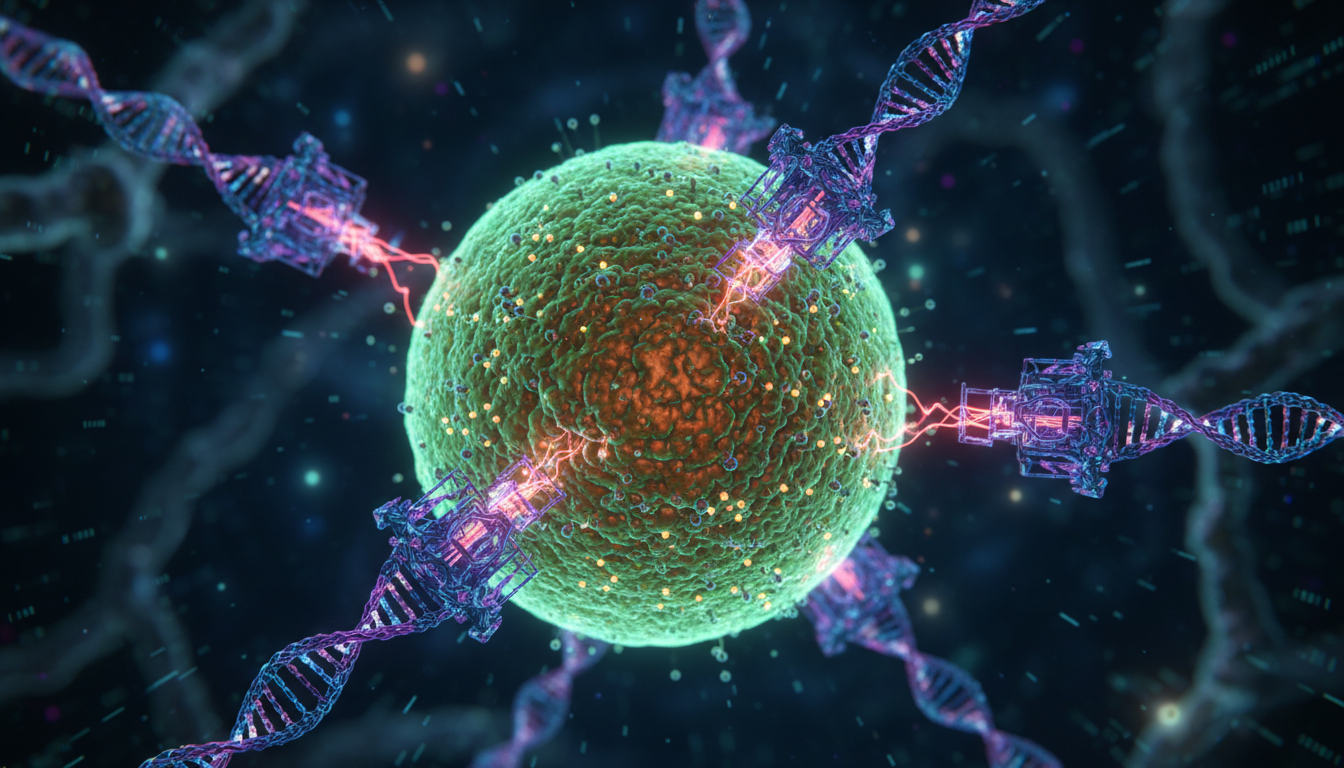
- Transition from diffuse pills to targeted chemical programs.
- Atherosclerosis treatment via localized chemical cleaning.
- Potential collapse of the long-term cardiovascular drug market.
On This Page
- The Shift from Diffuse Pharmacology to Programmable Assemblers
- Thermodynamics of Molecular Assembler Binding
- Thermodynamic Principles of Molecular Assemblers
- The Mathematical Framework of Spontaneity
- Computational Analysis of Thermodynamic Parameters
- Visualizing the Transition from Spontaneity to Non-Spontaneity
- Quantitative Evaluation of Binding Stability
- Key Points to Remember
- DNA Origami and the Engineering of Molecular Robots
- Clinical Applications in Cardiovascular and Oncology Sectors
- The Economic and Societal Impact of Curative Reboots
- Reynolds Number for a Molecular Assembler
- Thematic Tables for Quick Visual Checks
- Plot: Re vs Length Scale at Fixed Speed
- Extra Practice Problems (with Solutions)
- Key Points to Remember
The Shift from Diffuse Pharmacology to Programmable Assemblers
The dream of Richard Feynman is finally becoming a tangible reality within the clinical landscape. Molecular assemblers represent the pinnacle of nanotechnology, moving beyond simple delivery vehicles to active agents.
These are not robots in the traditional mechanical sense but complex macromolecular structures. They are engineered to change shape and function in response to specific environmental or chemical signals.
Traditional pharmacy relies on diffuse chemistry where molecules circulate throughout the entire body. This lack of specificity often leads to systemic side effects and reduced therapeutic efficacy over time.
Programmable chemistry changes this dynamic by ensuring that the active chemical reaction occurs only at the site of pathology. This transition marks the end of the "pill" era.
The bloodstream serves as the primary highway for these assemblers, allowing them to navigate complex biological environments. They utilize the body's natural fluid dynamics to reach their specific targets.
By shifting to "programs," healthcare providers can offer deterministic outcomes rather than probabilistic management. This precision reduces the burden on metabolic organs like the liver and kidneys.
From Small Molecules to Algorithmic Chemistry
Small molecule drugs typically operate through simple binding kinetics that lack logic-based control. They interact with receptors throughout the body, regardless of the specific disease state present.
In contrast, algorithmic chemistry utilizes molecular logic gates to determine when and where to act. This ensures that the therapeutic payload is only released under precise conditions.
These assemblers can be programmed to detect multiple biomarkers simultaneously before initiating a response. This Boolean logic approach drastically increases the safety profile of potent chemical agents.
The engineering of these molecules involves sophisticated computational modeling to predict conformational changes. Researchers use these models to design structures that respond to pH, temperature, or enzymes.
As we move toward algorithmic medicine, the role of the pharmacist evolves into a molecular programmer. They will design specific sequences to address individual patient needs and pathologies.
The efficiency of these programs means that lower concentrations of chemicals are required for treatment. This minimizes the risk of toxicity while maximizing the curative potential of the procedure.
The Thermodynamics of Molecular Recognition
Molecular recognition is governed by the principles of thermodynamics, specifically the minimization of Gibbs free energy. Assemblers must possess high affinity for their targets to ensure effective binding.
The binding event triggers a cascade of structural changes within the assembler's framework. These changes are driven by the energy released during the initial recognition process at the site.
To understand the efficiency of these assemblers, we must analyze the binding energy involved. Consider the following mathematical problem regarding the thermodynamics of a molecular assembler binding to a plaque.
Thermodynamics of Molecular Assembler Binding
In the realm of nanotechnology and targeted nanomedicine, the operational efficacy of a molecular assembler relies heavily on its ability to autonomously bind to specific biological structures, such as a lipid target on a cell membrane. For this binding to occur without the continuous input of external energy, the interaction must be thermodynamically favorable. The definitive metric for determining the spontaneity of a reaction at constant temperature and pressure is the change in Gibbs Free Energy, denoted mathematically as ##\Delta G##.
To evaluate the feasibility of this binding event under physiological conditions, we must calculate the change in Gibbs Free Energy at standard human body temperature, which is approximately ##310 \text{ K}##. The thermodynamic parameters characteristic of this specific assembler-lipid interaction are provided as an enthalpy change of ##\Delta H = -50 \text{ kJ/mol}## and an entropy change of ##\Delta S = -0.1 \text{ kJ/(mol}\cdot\text{K)}##.
The fundamental thermodynamic equation linking these variables is:
### \Delta G = \Delta H - T\Delta S ###
We begin by substituting the established values into the equation. The temperature ##T## must be in Kelvin, and both energy terms must share the same energetic units (kilojoules in this instance).
### \Delta G = -50 \text{ kJ/mol} - \left( 310 \text{ K} \times -0.1 \text{ \frac{kJ}{mol \cdot K}} \right) ###
First, we isolate and calculate the entropic contribution to the free energy, represented by the ##-T\Delta S## term. The negative entropy change indicates that the system is becoming more ordered—a logical outcome given that the freely moving assembler is locking onto a fixed lipid target, thereby losing translational and rotational degrees of freedom.
### -T\Delta S = -\left( -31 \text{ kJ/mol} \right) = +31 \text{ kJ/mol} ###
Next, we combine the enthalpic component (##\Delta H##) with our evaluated entropic component:
### \Delta G = -50 \text{ kJ/mol} + 31 \text{ kJ/mol} = -19 \text{ kJ/mol} ###
A negative ##\Delta G## rigorously indicates that the binding process is spontaneous and energetically favorable. The exothermic nature of the binding (##\Delta H = -50 \text{ kJ/mol}##) provides a sufficient thermodynamic drive to overcome the entropic penalty (##+31 \text{ kJ/mol}##) incurred by the loss of molecular mobility. This thermodynamic drive ensures the assembler remains firmly attached to the target during the subsequent mechanical or chemical cleaning processes.
Engineering Assembler Stability
Understanding these energetic values allows nanomechanical engineers to fine-tune the stability of the assembler across various biological environments. By modulating the surface chemistry of the assembler to alter ##\Delta H## or modifying its structural flexibility to adjust ##\Delta S##, engineers can ensure the device remains inactive until the specific target energy state is reached, preventing off-target binding.
| Enthalpy (##\Delta H##) | Entropy (##\Delta S##) | Gibbs Free Energy (##\Delta G##) | Spontaneity Profile |
|---|---|---|---|
| Negative (Exothermic) | Positive (More Disorder) | Always Negative | Spontaneous at all temperatures. |
| Negative (Exothermic) | Negative (Less Disorder) | Negative at low ##T## | Spontaneous only below a critical threshold temperature. |
| Positive (Endothermic) | Positive (More Disorder) | Negative at high ##T## | Spontaneous only above a critical threshold temperature. |
| Positive (Endothermic) | Negative (Less Disorder) | Always Positive | Non-spontaneous at all temperatures. |
Related Problem: Thermal Detachment Threshold
To further understand the operational limits of our molecular assembler, we must determine the exact temperature at which the binding reaction ceases to be spontaneous. This is the equilibrium temperature (##T_{eq}##) where the assembler is equally likely to be bound or unbound.
Problem Statement: Using the previously established parameters (##\Delta H = -50 \text{ kJ/mol}## and ##\Delta S = -0.1 \text{ kJ/(mol}\cdot\text{K)}##), calculate the threshold temperature ##T_{eq}## at which the assembler will naturally detach from the lipid target.
Step-by-Step Solution:
At the point of thermal detachment, the system is in dynamic equilibrium, meaning the change in Gibbs Free Energy is exactly zero (##\Delta G = 0##). We set up our primary thermodynamic equation accordingly:
### 0 = \Delta H - T_{eq}\Delta S ###
We then rearrange the equation algebraically to solve for the equilibrium temperature ##T_{eq}##:
### T_{eq}\Delta S = \Delta H \implies T_{eq} = \frac{\Delta H}{\Delta S} ###
Substitute the known thermodynamic values into the rearranged equation:
### T_{eq} = \frac{-50 \text{ kJ/mol}}{-0.1 \text{ kJ/(mol}\cdot\text{K)}} = 500 \text{ K} ###
The calculation reveals that the assembler will only detach spontaneously if the local environment reaches ##500 \text{ K}##. Because ##500 \text{ K}## (approximately ##227^\circ\text{C}##) is far beyond any survivable biological temperature, we can confidently state that the assembler will remain securely attached to the lipid target under all conceivable physiological conditions, including extreme fevers or localized inflammatory heating.
Computational Visualization of Thermodynamic States
To visualize how the Gibbs Free Energy shifts as a function of temperature, we can generate a simple linear plot. Below is the Python code utilizing the Matplotlib library to model this thermodynamic behavior over a range of physiological and non-physiological temperatures.
Thermodynamic Principles of Molecular Assemblers
In the realm of molecular nanotechnology and chemical engineering, the spontaneity of a reaction or a binding event is governed by the change in Gibbs Free Energy. When considering a molecular assembler—a device or catalyst designed to organize atoms into specific structures—the stability of the binding process is paramount. This stability is a delicate balance between the heat released or absorbed (enthalpy) and the change in the disorder of the system (entropy). For an assembler to function effectively at biological or industrial temperatures, the binding must be energetically favorable, meaning the Gibbs Free Energy change must be negative.
The Mathematical Framework of Spontaneity
The fundamental equation connecting these thermodynamic variables is the Gibbs-Helmholtz relationship. It dictates how the energy available to do work changes as a function of temperature. The relationship is expressed as:
###\Delta G = \Delta H - T\Delta S###
Where ##\Delta G## represents the change in Gibbs Free Energy, ##\Delta H## is the change in enthalpy, ##T## is the absolute temperature in Kelvin, and ##\Delta S## is the change in entropy. In the context of the provided source, we have an exothermic process where ##\Delta H = -50 \text{ kJ/mol}## and an ordering process where ##\Delta S = -0.1 \text{ kJ/(mol}\cdot\text{K)}##. Because the entropy change is negative, the ##-T\Delta S## term becomes positive, meaning that as temperature increases, the overall ##\Delta G## will eventually become positive, leading to the "detachment" or instability of the molecular assembly.
| Parameter | Value | Unit | Physical Significance |
|---|---|---|---|
| Enthalpy (##\Delta H##) | -50 | kJ/mol | Exothermic: Heat is released during binding. |
| Entropy (##\Delta S##) | -0.1 | kJ/(mol·K) | Ordering: The system becomes more structured. |
| Equilibrium Temp | 500 | K | The point where binding and detachment are balanced. |
| Body Temp | 310 | K | Standard physiological reference point. |
Computational Analysis of Thermodynamic Parameters
To analyze these dynamics over a range of thermal conditions, we utilize Python's numerical libraries. The numpy library allows for efficient vectorization of the Gibbs equation, enabling the calculation of ##\Delta G## across hundreds of temperature points simultaneously. Below is an elaborated implementation that not only calculates the energy profile but also identifies the critical equilibrium temperature where ##\Delta G = 0##.
import numpy as np
import matplotlib.pyplot as plt

# Define the thermodynamic constants for the molecular system
# Delta H (Enthalpy change) in kJ/mol. Negative value indicates exothermic binding.
delta_H = -50
# Delta S (Entropy change) in kJ/(mol*K). Negative value indicates increased order.
delta_S = -0.1

# Generate a high-resolution temperature range from 250 K to 600 K
# This captures the transition from a spontaneous to a non-spontaneous state.
temperatures = np.linspace(250, 600, 500)

# Apply the Gibbs Free Energy equation: G = H - T*S
# Because Delta S is negative, the -T*S term is positive and grows with T.
delta_G = delta_H - (temperatures * delta_S)

# Calculate the exact equilibrium temperature where delta_G = 0
# 0 = delta_H - T_eq * delta_S  => T_eq = delta_H / delta_S
t_equilibrium = delta_H / delta_S

# Visualization setup
plt.figure(figsize=(10, 6), dpi=100)
plt.plot(temperatures, delta_G, color='#00acc1', linewidth=3, label=r'$\Delta G = \Delta H - T\Delta S$')

# Highlight the Equilibrium point
plt.axhline(0, color='#f44336', linestyle='--', linewidth=1.5, label=f'Equilibrium (T={t_equilibrium:.0f} K)')

# Highlight physiological conditions
plt.axvline(310, color='#4caf50', linestyle=':', linewidth=2, label='Physiological Temp (310 K)')

# Mark the specific detachment threshold
plt.axvline(t_equilibrium, color='#9c27b0', linestyle=':', linewidth=2, label='Detachment Threshold')

# Formatting the plot for professional presentation
plt.title('Thermodynamic Stability of Molecular Assembler Binding', fontsize=14)
plt.xlabel('Absolute Temperature (K)', fontsize=12)
plt.ylabel('Gibbs Free Energy $\Delta G$ (kJ/mol)', fontsize=12)
plt.fill_between(temperatures, delta_G, 0, where=(delta_G < 0), color='#00acc1', alpha=0.1, label='Spontaneous Zone')
plt.fill_between(temperatures, delta_G, 0, where=(delta_G > 0), color='#f44336', alpha=0.1, label='Non-Spontaneous Zone')

plt.legend(loc='upper left', frameon=True, shadow=True)
plt.grid(True, which='both', linestyle='--', alpha=0.5)
plt.tight_layout()
plt.show()
Visualizing the Transition from Spontaneity to Non-Spontaneity
The resulting plot provides a clear visualization of the "spontaneity window." At lower temperatures, the enthalpy term (##\Delta H##) dominates the equation. Since ##\Delta H## is negative, the overall ##\Delta G## remains negative, indicating that the assembler will spontaneously bind to its target. However, as the temperature ##T## increases, the entropic penalty ##-T\Delta S## (which is positive because ##\Delta S < 0##) increases linearly. This linear increase eventually offsets the enthalpic gain.
| Temperature Range | Sign of ##\Delta G## | Process Spontaneity | Assembler State |
|---|---|---|---|
| ##T < 500 \text{ K}## | Negative (##-##) | Spontaneous | Stable Binding |
| ##T = 500 \text{ K}## | Zero (##0##) | Equilibrium | Reversible Binding |
| ##T > 500 \text{ K}## | Positive (##+##) | Non-Spontaneous | Detachment / Dissociation |
Quantitative Evaluation of Binding Stability
To further understand the system, we can perform specific calculations at points of interest. For example, let us determine the stability of the assembler at body temperature (310 K) and compare it to a high-temperature environment (600 K).
Example 1: Stability at Body Temperature (310 K)
###\Delta G_{310} = -50 \text{ kJ/mol} - (310 \text{ K} \cdot -0.1 \text{ kJ/mol}\cdot\text{K})### ###\Delta G_{310} = -50 + 31 = -19 \text{ kJ/mol}###
At 310 K, the energy is significantly negative (##-19 \text{ kJ/mol}##), ensuring a robust and stable assembly process suitable for biological nanomachinery.
Example 2: Stability at High Temperature (600 K)
###\Delta G_{600} = -50 \text{ kJ/mol} - (600 \text{ K} \cdot -0.1 \text{ kJ/mol}\cdot\text{K})### ###\Delta G_{600} = -50 + 60 = +10 \text{ kJ/mol}###
At 600 K, the Gibbs Free Energy becomes positive (##+10 \text{ kJ/mol}##). This indicates that the binding is no longer spontaneous, and the assembler would require an external energy source to remain attached, or more likely, it would dissociate entirely from the substrate.
Key Points to Remember
- The equilibrium temperature ##T_{eq}## is the tipping point where the driving force of enthalpy exactly balances the resistance of entropy.
- For exothermic processes with decreasing entropy, there is always a finite temperature above which the process ceases to be spontaneous.
- In Python, the intersection of the ##\Delta G## line with the x-axis (##y=0##) represents the transition from a bound state to a dissociated state.
- Molecular assemblers must be designed such that their operational temperature remains well below ##T_{eq} = \Delta H / \Delta S##.
[PLOT_DIAGRAM: A 2D line graph with Temperature (K) on the x-axis ranging from 250 to 600, and Delta G (kJ/mol) on the y-axis ranging from -30 to 15. A solid teal line slopes upwards from left to right, representing the linear relationship Delta G = -50 - T(-0.1). A horizontal dashed red line marks Delta G = 0. A vertical dotted green line intersects the teal line at T = 310 K, corresponding to y = -19 kJ/mol. A vertical dotted purple line marks the x-intercept at T = 500 K, where Delta G reaches 0, illustrating the detachment threshold.]
Key points to remember
- The spontaneity of a molecular assembler's binding is dictated by ##\Delta G##. A negative value ensures that the attachment happens without external energy input.
- Binding events that restrict molecular motion invariably result in a negative change in entropy (##\Delta S < 0##), creating an entropic penalty that must be overcome by the enthalpy of the reaction.
- By setting ##\Delta G = 0##, engineers can accurately calculate the thermal detachment threshold (##T_{eq}##), verifying the physical stability of nanomachines under fluctuating environmental conditions.
DNA Origami and the Engineering of Molecular Robots
DNA origami provides the structural foundation for modern molecular assemblers, utilizing base-pairing rules. This technique allows for the creation of complex, three-dimensional shapes with nanometer precision.
The scaffolded DNA origami approach uses a long single strand of DNA folded by shorter "staple" strands. This results in a rigid structure capable of carrying various chemical payloads.
These structures are biocompatible and can be designed to degrade safely after their task is completed. This makes them ideal for applications within the human circulatory system.
Engineering these robots requires a deep understanding of nucleic acid sequences and their folding patterns. Advanced software tools enable the design of structures that can perform mechanical tasks.
The versatility of DNA allows for the integration of aptamers, which act as sensors for specific proteins. These sensors provide the "intelligence" needed for targeted navigation and activation.
As the field matures, we are seeing the development of multi-component systems that work in concert. These systems can perform complex sequences of events, such as multi-stage drug release.
Structural Design Principles of DNA Scaffolds
The design of DNA scaffolds begins with defining the desired geometry of the molecular assembler. Engineers must account for the mechanical stresses the structure will face in the bloodstream.
Rigidity is a key factor, as the structure must maintain its shape to function correctly. Strategic placement of double-helical domains provides the necessary structural integrity for the device.
Flexibility is equally important for actuation, allowing the assembler to open or close its cargo bay. This is achieved through the use of single-stranded DNA hinges or joints.
The surface of the scaffold can be functionalized with various molecules to improve its half-life. Coating the structure with polyethylene glycol (PEG) can help it evade the immune system.
Precision in the placement of staples ensures that the final structure matches the computational model exactly. This level of control is unprecedented in the history of chemical manufacturing.
Researchers are currently exploring the use of non-natural nucleotides to enhance the stability of these scaffolds. This could lead to assemblers that survive longer in harsh biological environments.
Actuation Mechanisms via Conformational Changes
Actuation in molecular assemblers is typically achieved through DNA strand displacement or environmental triggers. This allows the robot to perform a physical action, such as releasing a solvent.
Strand displacement involves the replacement of one DNA strand with another that has a higher affinity. This process can be used to create logic gates and mechanical switches.
To illustrate how these logic gates are programmed, consider the following Python simulation of a displacement reaction. This code models the concentration changes during a simple molecular switch activation.
import numpy as np

def simulate_strand_displacement(initial_conc, rate_constant, time_steps):
    conc = initial_conc
    history = []
    for _ in range(time_steps):
        # Simplistic model: dC/dt = -k * C
        change = rate_constant * conc
        conc -= change
        history.append(conc)
    return history

# Parameters for the molecular switch
initial_logic_gate_conc = 1.0
k = 0.05
steps = 100

results = simulate_strand_displacement(initial_logic_gate_conc, k, steps)
print(f"Final concentration of inactive state: {results[-1]:.4f}")
This type of simulation helps researchers predict how quickly an assembler will respond to a signal. It is crucial for ensuring that the reaction happens at the right time.
Environmental triggers, such as changes in pH near a tumor, can also induce actuation. The structure is designed to be unstable at specific pH levels, causing it to unfold.
Once the conformational change occurs, the assembler can perform its primary function, such as enzymatic activity. This "sense-and-act" capability is what distinguishes assemblers from traditional drug delivery systems.
The precision of these movements allows for the manipulation of matter at the atomic level. This opens the door to localized chemical synthesis and repair within the human body.
Recommended Reads
Clinical Applications in Cardiovascular and Oncology Sectors
In early February 2026, the first patient was successfully treated using molecular assemblers in a clinical trial. This milestone proved that programmable chemistry can safely operate within human arteries.
The primary focus of current research is the removal of lipid plaques that cause atherosclerosis. These plaques are often hard to reach and treat with traditional systemic medications.
Molecular assemblers can navigate to these plaques and attach themselves to the surface of the lipid. Once attached, they undergo a conformational change to release a localized solvent.
This solvent dissolves the plaque without affecting the underlying arterial wall or surrounding healthy tissue. The process is akin to a "chemical cleaning" of the circulatory system.
Unlike surgery, this procedure is minimally invasive and requires no recovery time for the patient. It offers a permanent solution to a problem that was previously managed for life.
The oncology sector is also benefiting from this technology, with assemblers targeting specific tumor markers. This allows for the delivery of highly toxic agents directly to the cancer cells.
Eliminating Atherosclerosis via Localized Solvents
Atherosclerosis is characterized by the buildup of fats, cholesterol, and other substances in and on artery walls. This buildup, known as plaque, can restrict blood flow and lead to heart attacks.
Molecular assemblers are designed to identify the unique chemical signature of these plaques. They use specific ligands that bind only to the oxidized lipids found in diseased vessels.
Once the assembler is anchored, it releases a concentrated dose of a lipid-solubilizing agent. This agent breaks down the plaque into smaller, harmless components that the body can process.
The advantage of this localized approach is the avoidance of systemic side effects associated with high-dose statins. Patients experience a rapid improvement in blood flow without the risk of muscle pain.
As the plaque is removed, the assembler itself can be programmed to disassemble and be excreted. This ensures that no foreign material remains in the body after the treatment.
This "one-time fix" approach could revolutionize how we treat cardiovascular disease globally. It shifts the focus from managing a chronic condition to providing a definitive cure.
Targeted Oncology and the End of Systemic Toxicity
Traditional chemotherapy is often limited by its systemic toxicity, which harms both healthy and cancerous cells. Molecular assemblers offer a way to bypass this limitation through extreme targeting.
By recognizing multiple surface antigens on a tumor cell, the assembler ensures that it only binds to its target. This "AND" logic gate prevents accidental activation in healthy tissues.
Once the assembler is internalized by the cancer cell, it can release its cytotoxic payload directly. This maximizes the lethal effect on the tumor while sparing the rest of the body.
Furthermore, these assemblers can be programmed to overcome multi-drug resistance mechanisms in cancer cells. They can deliver combinations of agents that work synergistically to kill the cell.
The reduction in side effects means that patients can tolerate more effective doses of chemotherapy. This leads to higher survival rates and a significantly improved quality of life during treatment.
In the future, molecular assemblers may even be used to perform "in situ" genetic editing of tumor cells. This would involve re-programming the cell's own machinery to undergo apoptosis.
The Economic and Societal Impact of Curative Reboots
The shift toward curative molecular assemblers will have a profound impact on the pharmaceutical industry. The current business model relies heavily on the long-term management of chronic diseases.
As "one-time" treatments become available, the demand for daily medications like statins will plummet. This represents a significant threat to the revenue streams of many large biotech firms.
Companies must pivot their research and development efforts toward DNA-origami and molecular engineering. Those that fail to adapt to this new paradigm risk total obsolescence within the decade.
Healthcare systems will also need to restructure their payment and delivery models. The transition from continuous care to episodic, curative procedures will require new financial frameworks.
The societal benefits of these technologies are immense, as they reduce the overall burden of disease. A healthier population leads to increased productivity and lower long-term healthcare costs for governments.
However, the high initial cost of these advanced treatments may create issues regarding equitable access. Ensuring that these life-saving technologies are available to all is a major ethical challenge.
The Collapse of the Chronic Management Market
The cardiovascular drug market, currently worth billions, is particularly vulnerable to the rise of molecular assemblers. Statins and blood pressure medications are designed for lifelong use, not cures.
When a single procedure can permanently clear an artery, the need for daily pills disappears. This "market collapse" will force a radical consolidation within the pharmaceutical sector.
Investors are already beginning to shift capital away from traditional drug discovery toward nanotechnology. The "velocity" of this change is accelerating as clinical trials show positive results.
Biotech firms that specialize in small-molecule discovery must now acquire or develop expertise in molecular robotics. The barriers to entry in this new field are high, requiring specialized knowledge.
This transition will likely lead to the emergence of new industry leaders who specialize in programmable chemistry. The competitive landscape of the 2030s will look very different from today's.
While the loss of recurring revenue is a challenge for companies, the value of a cure is high. Pricing models will need to reflect the long-term savings provided by these one-time treatments.
Ethical Considerations and the Future of Bio-Programmability
The idea of "machines in the blood" raises significant ethical and safety concerns among the general public. Transparency and education will be critical for the widespread adoption of these technologies.
There are concerns about the potential for these assemblers to be repurposed for non-medical uses. Ensuring strict regulatory oversight is necessary to prevent the misuse of programmable chemistry.
The long-term effects of having synthetic molecular structures in the body must be thoroughly studied. While DNA origami is generally safe, the degradation products must be non-toxic.
As we gain the ability to program chemistry in the body, where do we draw the line? The transition from "repairing" to "enhancing" biological functions is a slippery slope for ethicists.
To conclude our technical analysis, we must consider the physical constraints of these assemblers in the micro-vasculature. Their movement is governed by low Reynolds number physics.
At such low Reynolds numbers, inertial forces are negligible, and viscous forces dominate. This means the assembler stops almost instantly when it ceases to "swim," allowing for precise control.
The future of medicine lies in our ability to master these forces at the molecular level. By embracing bio-programmability, we can finally move beyond management and toward true healing.
Reynolds Number for a Molecular Assembler
You want the Reynolds number ##Re## for a tiny “molecular assembler” moving through blood plasma. The standard small-scale fluid-dynamics estimate is:
###Re = \frac{vL}{\nu}###
Step 1: Convert the Given Values to SI
- Characteristic length: ##L = 100\,\text{nm} = 100 \times 10^{-9}\,\text{m} = 10^{-7}\,\text{m}##
- Velocity: ##v = 1\,\text{mm/s} = 10^{-3}\,\text{m/s}##
- Kinematic viscosity (blood plasma): ##\nu \approx 10^{-6}\,\text{m}^2/\text{s}##
Step 2: Substitute into the Formula
Plug the numbers into ##Re = \frac{vL}{\nu}##:
###Re = \frac{(10^{-3}\,\text{m/s})(10^{-7}\,\text{m})}{10^{-6}\,\text{m}^2/\text{s}}###
Multiply the numerator:
###(10^{-3})(10^{-7}) = 10^{-10}###
Now divide by ##10^{-6}##:
###Re = \frac{10^{-10}}{10^{-6}} = 10^{-4}###
Final answer: ##Re = 10^{-4}##.
What This Number Means Physically
Since ##Re \ll 1## (here, ##10^{-4}##), the flow around the assembler is in the creeping-flow / Stokes-flow regime. In plain terms: inertial effects are negligible, viscous effects dominate, and the motion is extremely “smooth” from the fluid’s perspective. That’s exactly what you expect at nanoscale lengths in a water-like fluid.
Thematic Tables for Quick Visual Checks
| Quantity | Given | Converted to SI |
|---|---|---|
| Characteristic length | ##L = 100\,\text{nm}## | ##100 \times 10^{-9}\,\text{m} = 10^{-7}\,\text{m}## |
| Velocity | ##v = 1\,\text{mm/s}## | ##10^{-3}\,\text{m/s}## |
| Kinematic viscosity | ##\nu \approx 10^{-6}\,\text{m}^2/\text{s}## | Already SI |
| Re range | Dominant effect | Typical behavior |
|---|---|---|
| ##Re \ll 1## | Viscosity dominates | Stokes/creeping flow; reversing motion nearly reverses the flow |
| ##Re \sim 1## | Mixed inertia + viscosity | Transition region; both matter in comparable ways |
| ##Re \gg 1## | Inertia dominates | Flow separation, wakes, and possible turbulence (depending on geometry) |
| Your case: ##Re = 10^{-4}## | Strongly viscous | Extremely low inertia; fluid feels “thick” at this scale even if it’s water-like |
Plot: Re vs Length Scale at Fixed Speed
This plot shows how ##Re## grows linearly with ##L## when ##v## and ##\nu## are fixed. The marked point is your case (##L = 100\,\text{nm}##, ##Re = 10^{-4}##).

Python Code Used to Generate the Plot
import numpy as np
import matplotlib.pyplot as plt

# Parameters
nu = 1e-6  # m^2/s (blood plasma kinematic viscosity, approx)
v = 1e-3   # m/s (1 mm/s)

# Length scale sweep: 1 nm to 1 mm
L = np.logspace(-9, -3, 400)  # meters

Re = v * L / nu

plt.figure(figsize=(7.2, 4.4))
plt.loglog(L, Re)
plt.xlabel("Characteristic length L (m)")
plt.ylabel("Reynolds number Re = vL/ν")
plt.title("Reynolds number vs length scale (v = 1 mm/s, ν = 10⁻⁶ m²/s)")
plt.grid(True, which="both")

# Mark the given point: L = 100 nm
L0 = 100e-9
Re0 = v * L0 / nu
plt.scatter([L0], [Re0])
plt.annotate("L = 100 nm\nRe = 10⁻⁴", xy=(L0, Re0), xytext=(3e-8, 5e-4),
             arrowprops=dict(arrowstyle="->"))

plt.tight_layout()
plt.savefig("reynolds_vs_length.png", dpi=200)
Extra Practice Problems (with Solutions)
Problem A: Change the Speed
Same assembler: ##L = 100\,\text{nm}##, ##\nu = 10^{-6}\,\text{m}^2/\text{s}##, but now ##v = 1\,\text{cm/s}##. Find ##Re##.
- Convert ##v##: ##1\,\text{cm/s} = 10^{-2}\,\text{m/s}##
###Re = \frac{(10^{-2})(10^{-7})}{10^{-6}} = \frac{10^{-9}}{10^{-6}} = 10^{-3}###
Answer: ##Re = 10^{-3}## (still extremely low).
Problem B: Change the Size
Keep ##v = 1\,\text{mm/s}## and ##\nu = 10^{-6}\,\text{m}^2/\text{s}##, but make the device ##L = 10\,\mu\text{m}## (roughly cell scale). Find ##Re##.
- Convert ##L##: ##10\,\mu\text{m} = 10 \times 10^{-6}\,\text{m} = 10^{-5}\,\text{m}##
###Re = \frac{(10^{-3})(10^{-5})}{10^{-6}} = \frac{10^{-8}}{10^{-6}} = 10^{-2}###
Answer: ##Re = 10^{-2}## (still viscous-dominated, but much closer to “mixed” behavior than nanoscale).
Problem C: Solve for the Required Speed
For ##L = 100\,\text{nm}## in plasma, what speed ##v## would be needed to reach ##Re = 1##?
Start from ##Re = \frac{vL}{\nu}## and solve for ##v##:
###v = \frac{Re \cdot \nu}{L}###
Substitute ##Re = 1##, ##\nu = 10^{-6}##, ##L = 10^{-7}##:
###v = \frac{(1)(10^{-6})}{10^{-7}} = 10^{1} = 10\,\text{m/s}###
Answer: ##v \approx 10\,\text{m/s}##, which is enormous for a nanoscale object in a biological fluid environment.
Key Points to Remember
- For your values, ##Re = 10^{-4}##, so viscosity dominates and inertia is negligible.
- At fixed ##v## and ##\nu##, Reynolds number scales linearly with size: doubling ##L## doubles ##Re##.
- To push nanoscale devices toward ##Re \sim 1## in plasma, the required speeds become unrealistically large.
From our network :
- 98% of Global MBA Programs Now Prefer GRE Over GMAT Focus Edition
- AI-Powered 'Precision Diagnostic' Replaces Standard GRE Score Reports
- 10 Physics Numerical Problems with Solutions for IIT JEE
- Mastering DB2 12.1 Instance Design: A Technical Deep Dive into Modern Database Architecture
- Vite 6/7 'Cold Start' Regression in Massive Module Graphs
- Mastering DB2 LUW v12 Tables: A Comprehensive Technical Guide
- EV 2.0: The Solid-State Battery Breakthrough and Global Factory Expansion
- https://www.themagpost.com/post/analyzing-trump-deportation-numbers-insights-into-the-2026-immigration-crackdown
- https://www.themagpost.com/post/trump-political-strategy-how-geopolitical-stunts-serve-as-media-diversions
RESOURCES
- The 2017 Nobel Prize in Physiology or Medicine - Press release
- TBCR - Body Contour Receiver Board - DS - Assembly
- Multicomponent self-assembly based on bioactive molecules of ...
- Molecular insights into nucleocapsid assembly and transport in ...
- Microgel assembly: Fabrication, characteristics and application in ...
- Directed self-assembly of herbal small molecules into sustained ...
- Molecular Structure of insulin: The insulin monomer and its assembly
- Supramolecular self-assembly in Traditional Chinese Medicine
- Respiratory Cell & Molecular Biology - American Thoracic Society
- Bioadhesive Lipid Compositions: Self-Assembly Structures ...
- Molecular Medicine Reports - Spandidos Publications
- Role of neurexin heparan sulfate in the molecular ... - FEBS Press
- Molecular Mechanism of Paramyxovirus Assembly - Takimoto Lab
- Supramolecular self-assembly in Traditional Chinese Medicine - PMC
- Initial ciliary assembly in Chlamydomonas requires Arp2/3 complex ...



3 Comments