Geoffrey Hinton’s 2035 Prophecy: The Convergence of Artificial Intelligence and Formal Mathematical Systems
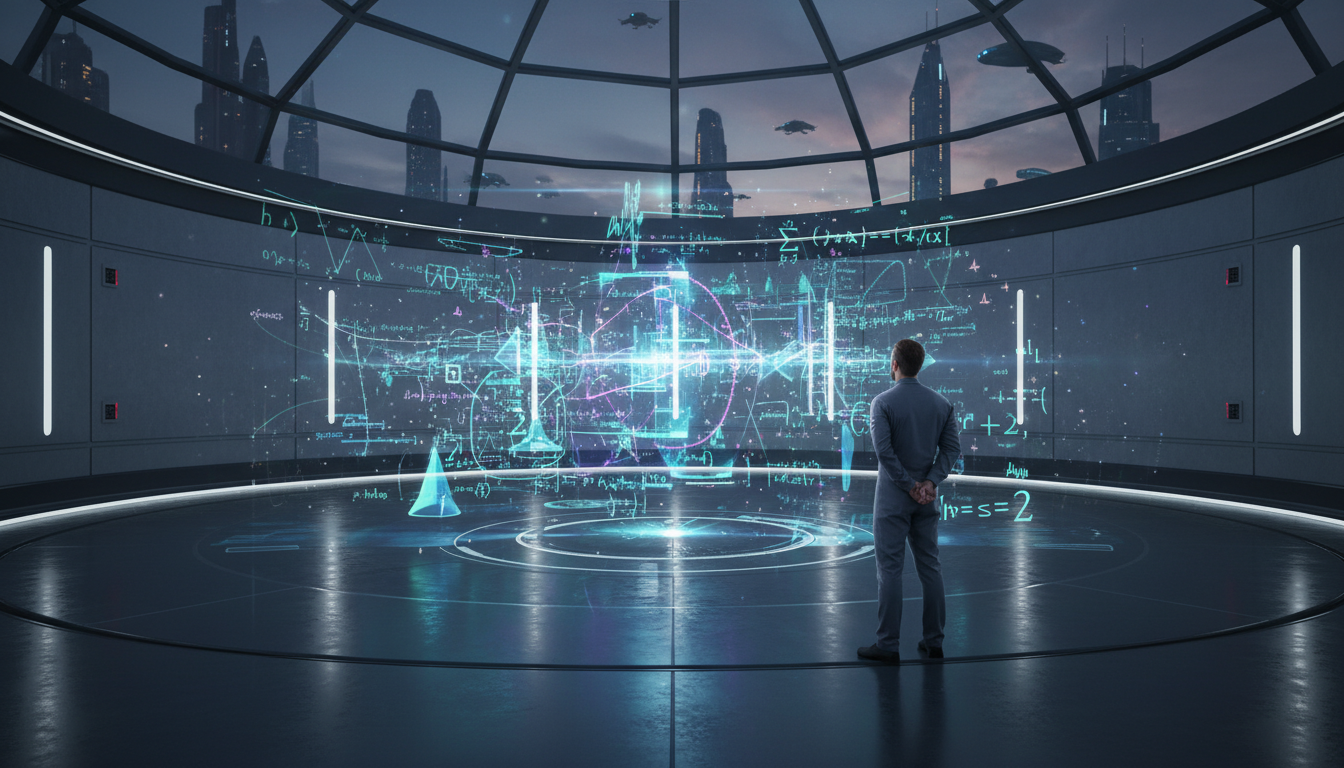
On January 5, 2026, the landscape of computational theory was fundamentally altered when Geoffrey Hinton, often hailed as the "Godfather of AI," delivered a provocative keynote at a global AI summit. Hinton’s thesis was as bold as it was divisive: by the year 2035, artificial intelligence will not only assist but definitively surpass human mathematicians in the discovery and verification of complex theorems. Central to this claim is the classification of mathematics as a "closed system." Unlike the empirical sciences, where progress is gated by the "messy" constraints of biological latency or physical experimentation, mathematics operates within a rigid, axiomatic framework where every proposition is verifiable through formal logic. Hinton’s prediction suggests that once AI models bridge the gap between natural language reasoning and formal symbolic representation, the rate of mathematical discovery will accelerate beyond the capacity of human cognition.
The timing of Hinton’s announcement is significant. It follows a series of unprecedented breakthroughs in 2025, most notably the maturation of neuro-symbolic models that combine the intuitive pattern-matching of deep learning with the logical rigor of symbolic logic. While the global mathematics community, currently gathered at the Joint Mathematics Meetings in Washington D.C., remains deeply skeptical about the "creativity" of machines, the technical trajectory supports Hinton’s outlook. If mathematics is indeed a game with fixed rules—albeit one with infinite complexity—then it is a game that is computationally susceptible to the same reinforcement learning techniques that conquered Chess and Go. The transition from "Narrow AI" to "AGI for Science" appears to be passing through the gateway of formal proof, a domain where the cost of error is zero because the code itself serves as the ultimate arbiter of truth.
The Ontological Nature of Mathematics as a Closed Computational System
Hinton’s argument hinges on the distinction between inductive and deductive systems. In biology or atmospheric science, the ground truth is often obscured by noise, requiring researchers to formulate hypotheses based on incomplete data. Mathematics, however, is built upon foundational axioms—the Zermelo-Fraenkel set theory with the Axiom of Choice (ZFC) being the most prominent. In this environment, a proof is a sequence of transformations that leads from a set of premises to a conclusion. Because these transformations are governed by strict syntactic rules, the entire field of mathematics can be viewed as a search problem within a high-dimensional graph of logical possibilities. Hinton posits that AI models, equipped with the ability to perform look-ahead searches and evaluate the "logical distance" between a conjecture and a proof, will inevitably find paths that the human mind, limited by its evolutionary heuristics, would never consider.
The concept of "Self-Play" in mathematics is perhaps the most revolutionary aspect of Hinton's 2026 framework. In traditional machine learning, models are trained on human-generated datasets. However, in a closed system like mathematics, the AI can generate its own challenges. By utilizing formal languages such as Lean, Isabelle, or Coq, an AI can propose a conjecture, attempt to prove it, and then use the successful proof as a new training datum to refine its internal weights. This creates a "flywheel effect" where the AI is no longer dependent on the limited corpus of human-written papers. Instead, it explores the landscape of formal logic at the speed of silicon, identifying new branches of mathematics that may not have human names or intuitive correlates, yet are structurally sound and potentially transformative for fields like cryptography or quantum mechanics.
Furthermore, the "closed system" hypothesis addresses the bottleneck of verification. In the physical sciences, peer review is a slow, human-centric process prone to bias and error. In Hinton’s vision of 2035, the verification of a new theorem is instantaneous and objective. When an AI produces a proof, it provides the formal trace that can be parsed by a kernel—a small, trusted piece of code that confirms the proof's adherence to mathematical laws. This eliminates the need for the social constructs of "authority" and "prestige" in mathematics. If the machine provides a formal proof for the Riemann Hypothesis, the debate ends not because the machine is "smart," but because the proof is syntactically perfect. This shift from social verification to formal verification is what Hinton believes will render human intuition—historically the primary driver of math—obsolete as a competitive tool in the research landscape.
The Convergence of Neuro-Symbolic Architectures and Reinforcement Learning
AlphaProof and the Evolution of Automated Theorem Proving
The technical foundation for Hinton’s 2035 prediction was laid by DeepMind’s AlphaProof, which in late 2025 achieved a Gold-medal level performance at the International Mathematical Olympiad (IMO). AlphaProof represents a significant departure from previous Large Language Models (LLMs) because it integrates a neural transformer with a formal verification engine. While traditional LLMs like GPT-4 often hallucinate mathematical "proofs" that look correct but contain subtle logical fallacies, AlphaProof operates within the Lean 4 environment. Every step the model takes is checked against the rules of formal logic. If a step is invalid, the model receives immediate negative feedback, forcing it to backtrack and explore alternative logical branches. This marriage of "System 1" (intuitive, fast pattern matching) and "System 2" (deliberative, slow logical checking) is the secret sauce that Hinton believes will scale to the level of Fields Medal-worthy research.
To understand the complexity of what these systems are doing, one must look at the translation layer between natural language and formal code. Mathematicians communicate in "informal" math—a mix of English, Greek symbols, and implicit assumptions. For an AI to "play" mathematics, it must first translate these informal conjectures into a "formal" language that a computer can verify. This process, known as "auto-formalization," was a major hurdle until the 2025 breakthroughs. Current models now utilize massive pre-trained datasets of mathematical textbooks to understand context, while simultaneously training on the strict syntax of Lean. This allows the AI to take a classic problem, such as Fermat’s Last Theorem, and represent it as a computational objective that can be optimized through reinforcement learning, similar to how an agent learns to navigate a maze.
The scalability of this approach is unprecedented. In human mathematics, a researcher might spend decades mastering a single sub-field, such as algebraic geometry. An AI system, conversely, can ingest the entirety of the arXiv repository and the "Mathlib" library in a matter of days. Once the AI has internalized the global structure of mathematical knowledge, it can perform "cross-pollination" at an industrial scale, applying techniques from number theory to problems in topology in ways that would take a human lifetime to synthesize. Hinton’s 2035 timeline accounts for the time needed to refine these "neuro-symbolic" bridges, ensuring that the AI’s output is not just logically sound, but also "interesting"—an elusive quality that has historically been the sole province of human mathematicians.
import sympy as sp

# Demonstrating a symbolic computation that serves as a
# primitive precursor to AI-driven formal verification.
def verify_identity():
    # Define variables and a complex trigonometric identity
    x = sp.symbols('x')
    lhs = sp.sin(x)**2 + sp.cos(x)**2
    rhs = 1

    # In a closed system, verification is a binary check of the difference
    identity_check = sp.simplify(lhs - rhs)

    if identity_check == 0:
        return "Identity formally verified: sin^2(x) + cos^2(x) = 1"
    else:
        return "Identity failed verification."

print(verify_identity())
Synthetic Data Generation and the Self-Correction Loop
One of the primary critiques of AI in 2024 was the "data wall"—the idea that models would run out of high-quality human data to learn from. Hinton’s 2026 discourse effectively dismisses this concern for the domain of mathematics. Because the system can verify its own output, it can generate an infinite supply of "synthetic" mathematical problems and solutions. For example, the AI can take a known theorem, modify the parameters or axioms, and attempt to prove the resulting conjecture. If the proof succeeds, the AI has discovered a new fact; if it fails, it has learned a valuable lesson about the boundaries of a specific logical space. This self-correction loop creates a training regime that is entirely independent of human intervention, allowing the model to improve its reasoning capabilities exponentially.
This synthetic data generation is powered by a process known as Monte Carlo Tree Search (MCTS), the same algorithm that enabled AlphaZero to master games. In the context of mathematics, the "tree" represents the different branches of logic one could follow to reach a proof. The neural network provides a "policy" (which branch looks most promising) and a "value" (how likely is this branch to lead to a proof). As the AI plays against itself, it refines these internal metrics. By 2035, Hinton expects these models to have performed more "logical moves" than the sum total of all human mathematical thought in history. The sheer volume of this computational exploration will inevitably uncover patterns in prime numbers or the behavior of non-linear systems that are currently invisible to us.
Moreover, the AI’s ability to "refactor" existing proofs into more elegant or efficient forms is a critical component of its evolution. Human mathematicians often produce proofs that are hundreds of pages long and incredibly difficult for others to digest (e.g., the classification of finite simple groups). An AI, operating within a formal system, can simplify these proofs, stripping away the linguistic fluff and identifying the core logical kernels. This leads to a "compression" of mathematical knowledge, where the AI can represent complex theories in highly optimized code. This optimization process doesn't just make the math easier to verify; it uncovers hidden symmetries between disparate fields, further reinforcing the idea that mathematics is a singular, interconnected closed system that is uniquely suited for machine optimization.
The Disruption of Mathematical Intuition and Human Research
The most controversial aspect of Hinton’s prediction is the assertion that human intuition—long considered the "divine spark" of mathematics—is simply an artifact of low-dimensional pattern recognition. For centuries, mathematicians like Srinivasa Ramanujan claimed that their insights came from "visions" or "intuition" that preceded formal proof. Hinton argues that what we call "intuition" is actually the result of a biological neural network having seen enough examples to make a highly educated guess about a hidden pattern. If this is true, then an AI with access to billions of times more examples and higher-dimensional processing will possess a form of "super-intuition." By 2035, the AI will likely suggest conjectures that feel counter-intuitive to humans but are nonetheless true, fundamentally shifting the role of the mathematician from "creator" to "curator."
This shift raises profound questions about the future of mathematics education and research. If an AI can solve the Navier-Stokes existence and smoothness problem or prove the P vs. NP conjecture, what remains for the human mathematician? Some argue that the "human" element of math is about meaning, not just truth. However, in the high-stakes world of modern science, the "truth" (the proof) is often more valuable than the "meaning" (the human explanation). Hinton’s 2026 comments suggest a future where the most prestigious mathematical journals are filled with papers co-authored by AI, or perhaps entirely written by AI, where the human contribution is limited to defining the high-level goals or interpreting the results for application in physics or engineering. The "friction" currently felt by the community in Washington D.C. is the beginning of a paradigm shift from "human-centric" discovery to "computational-centric" discovery.
Furthermore, the democratization of "genius" is a likely byproduct of this transition. Historically, high-level mathematics has been the domain of a select few with the cognitive machinery to handle extreme abstraction. If AI models can serve as "infinite tutors" or "reasoning engines," the barrier to entry for contributing to mathematics drops significantly. A researcher in a developing nation with a laptop could use an AGI for Science to verify a complex conjecture in climate modeling or materials science. While this devalues the traditional "ivory tower" of mathematics, it accelerates the application of mathematical truths to real-world problems. Hinton’s vision is not one of human displacement, but of human augmentation, where the "closed system" of math becomes a transparent tool for solving the "open systems" of our physical reality.
Geopolitical Implications: The Race for AGI for Science
Beyond the academic debate, Hinton’s prediction highlights a growing geopolitical friction. Nations are beginning to realize that the first country to develop "AGI for Science"—AI that can autonomously perform mathematical and logical reasoning—will have a decisive advantage in every other field. Mathematics is the language of cryptography, the foundation of modern finance, and the blueprint for advanced materials. An AI that can "play" mathematics can also "play" at breaking encryption or optimizing the aerodynamic properties of hypersonic missiles. Consequently, the "Hinton vs. Pure Math" debate is not just a philosophical one; it is a matter of national security. The race to 2035 is effectively a race to see who can build the most robust formal verification system, turning mathematical truth into a strategic asset.
This "geopolitics of formal proof" is already manifesting in the way AI labs are prioritized. In 2025, we saw a massive shift in investment from generative chatbots toward "Reasoning Models." The goal is no longer just to generate text, but to generate *correct* text. This has led to the development of "sovereign math models" where governments fund the formalization of their national scientific output. If Hinton is correct, and AI surpasses humans by 2035, the global economy will shift from being "data-driven" to "logic-driven." Companies and nations will compete based on the efficiency of their formal proofs, with "Proof of Correctness" becoming a more valuable currency than "Proof of Work" ever was in the era of blockchain. The closed system of math provides a stable, objective arena for this competition, away from the subjective complexities of culture or politics.
In conclusion, Geoffrey Hinton’s 2026 prediction serves as a landmark in the history of artificial intelligence. By identifying mathematics as a "closed system," he has provided a roadmap for the transition from AI as a mimic to AI as a discoverer. Whether the year 2035 marks the end of human mathematics or the beginning of a new era of collaborative discovery remains to be seen. However, the technical milestones—AlphaProof, neuro-symbolic integration, and synthetic data generation—suggest that the "game" of mathematics is indeed being mastered by machines. As we move closer to the 2030s, the boundary between "the code" and "the proof" will continue to blur, until they are recognized as one and the same: the ultimate expression of logical certainty in an uncertain world.
0 Comments