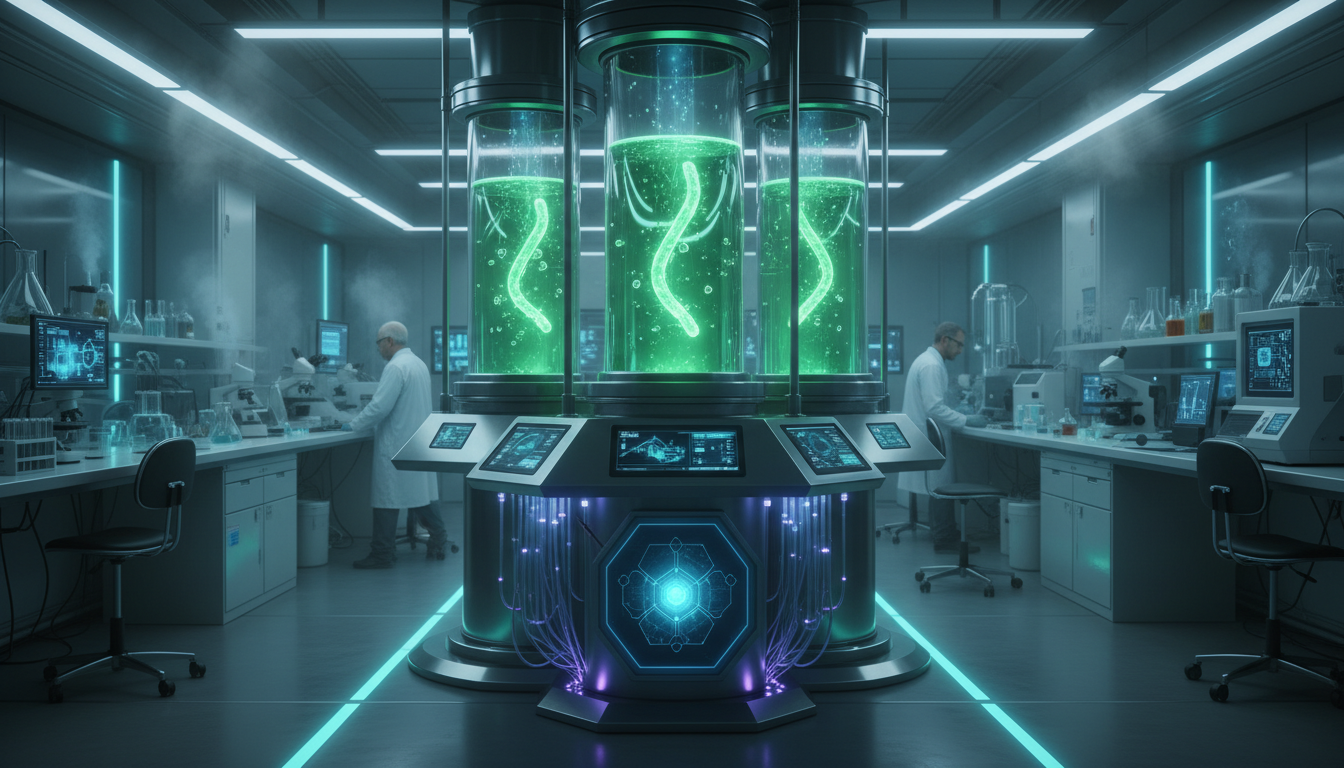
- Overcomes the degradation issues inherent in traditional mechanical recycling methods.
- Utilizes highly specific hydrolases to target PET and other polymers in mixed waste.
- Disrupts the petrochemical industry by providing a viable alternative to virgin plastic production.
On This Page
The Biochemistry of Enzymatic Depolymerization
Enzymatic depolymerization represents a paradigm shift in waste management, moving beyond the physical shredding of materials toward precise chemical disassembly. This process utilizes biological catalysts to target specific bonds within polymers.
Traditional mechanical recycling often results in polymer chain scission, which significantly reduces the structural integrity of the plastic. This degradation limits the number of times material can be reused effectively.
In contrast, enzymatic methods focus on the hydrolysis of ester or amide bonds within the polymer backbone. This restores the material to its original monomeric state with high purity levels.
The specificity of these biological catalysts allows for the selective processing of complex waste streams. This means that mixed plastics can be treated without the need for intensive pre-sorting.
By operating at lower temperatures and pressures compared to thermochemical recycling, enzymes offer a more energy-efficient pathway. This reduces the overall carbon footprint of the entire recycling lifecycle.
Current industrial applications are focusing on Polyethylene Terephthalate (PET) due to its ubiquity and the availability of highly efficient PETase enzymes discovered in recent biological research.
Molecular Scissors and Substrate Specificity
Enzymes function as molecular scissors, possessing active sites that are evolutionarily or synthetically tuned to recognize specific polymer sequences. This recognition is governed by complex non-covalent interactions within the site.
The interaction between the enzyme and the polymer substrate involves a lock-and-key mechanism. This ensures that only the intended polymer is cleaved, leaving contaminants and other plastics entirely untouched.
Substrate specificity is crucial when dealing with multi-layer packaging where different polymers are bonded together. Enzymes can selectively strip away one layer while leaving the structural integrity of others.
The catalytic triad within the enzyme's active site facilitates the nucleophilic attack on the carbonyl carbon of the ester bond. This reaction is the fundamental step in polymer breakdown.
Engineered variants of natural enzymes have shown significantly higher affinity for synthetic substrates. These modifications often involve adjusting the volume of the binding pocket to accommodate larger polymer chains.
Understanding the steric hindrance at the polymer-enzyme interface is essential for optimizing reaction rates. Researchers use computational modeling to predict how different enzyme mutations affect the binding energy.
Thermodynamic Efficiency of Enzyme Catalysis
Enzymatic reactions occur under mild aqueous conditions, which contrasts sharply with the high-energy requirements of pyrolysis or gasification. This thermodynamic advantage is key to the process's economic viability.
The activation energy required for the hydrolysis of PET is significantly lowered by the presence of a catalyst. This allows the reaction to proceed at temperatures as low as sixty degrees.
Lowering the thermal energy input prevents the formation of unwanted side products often found in thermal recycling. This leads to a higher yield of pure monomers that require less refining.
The Gibbs free energy change for enzymatic hydrolysis is typically negative, indicating a spontaneous reaction under standard biological conditions. This favorability drives the process toward completion efficiently.
Efficiency is also measured by the turnover frequency of the enzyme, which dictates how many polymer bonds one molecule can break per second. Higher frequencies reduce the necessary enzyme loading.
Integrating enzymatic steps into existing wastewater treatment or waste processing facilities is feasible due to these mild conditions. This reduces the capital expenditure required for new infrastructure.
Engineering High-Performance Hydrolases
The success of enzymatic upcycling depends heavily on the performance of the enzymes used. Natural enzymes are rarely optimized for the harsh conditions of industrial-scale chemical reactors.
Hydrolases, the class of enzymes responsible for breaking chemical bonds with water, are the primary focus of engineering efforts. These proteins must be robust enough to withstand high concentrations.
Engineering involves modifying the amino acid sequence to enhance stability, activity, and selectivity. Even single-point mutations can lead to dramatic improvements in the enzyme's overall catalytic efficiency.
Directed evolution is a powerful technique used to "breed" better enzymes by simulating natural selection in a laboratory. This process identifies variants that perform best under specific industrial stresses.
The goal is to create a "super-enzyme" that can operate continuously for days without losing its structural integrity. This longevity is vital for maintaining a steady flow in monomer refineries.
Recent breakthroughs have led to the creation of dual-enzyme systems where two different proteins work synergistically. One enzyme breaks the large polymer while the second processes the resulting oligomers.
Recommended Reads
Directed Evolution and AI-Driven Protein Design
Directed evolution involves creating a library of enzyme mutants and screening them for desired traits. This iterative process allows researchers to explore a vast landscape of protein configurations.
Artificial intelligence and machine learning are now accelerating this search by predicting which mutations are likely to succeed. This reduces the number of physical experiments needed to find winners.
AI models analyze the relationship between protein structure and function to suggest novel designs. These designs often include modifications that a human researcher might not have intuitively considered.
By combining AI with high-throughput screening, the timeline for developing a new industrial enzyme has shrunk from years to months. This rapid iteration is crucial for tackling diverse plastics.
The resulting enzymes often feature reinforced disulfide bridges or improved hydrophobic cores. These structural changes prevent the protein from unfolding when exposed to heat or varying pH levels.
As the database of known enzyme-polymer interactions grows, AI models become increasingly accurate. This creates a virtuous cycle of innovation in the field of synthetic biology and chemistry.
Thermal Stability in Industrial Bioreactors
Industrial bioreactors often operate at temperatures higher than the natural environment of most enzymes. Thermal stability is therefore a primary engineering target to ensure consistent catalytic performance.
When an enzyme loses its three-dimensional shape due to heat, it becomes inactive. Stabilizing the protein structure allows it to function effectively at the glass transition temperature of plastics.
Operating near the glass transition temperature increases the mobility of the polymer chains. This makes the chemical bonds more accessible to the enzyme's active site, speeding up depolymerization.
Techniques such as immobilization on solid supports can also enhance thermal stability. This involves tethering the enzyme to a surface, which prevents it from denaturing or being washed away.
Researchers are also exploring thermophilic organisms that naturally thrive in extreme heat. The enzymes from these organisms provide a robust template for further engineering and industrial application.
Maintaining a stable temperature within large-scale reactors requires sophisticated control systems. However, the energy saved by using enzymes still far outweighs the cost of thermal regulation.
Kinetic Modeling and Process Optimization
To scale enzymatic upcycling, engineers must develop precise kinetic models that describe the rate of polymer breakdown. These models help in designing reactors that maximize monomer yield.
Kinetic studies involve measuring how the concentration of substrate and enzyme affects the reaction velocity. This data is essential for calculating the residence time required in a bioreactor.
Mathematical modeling also accounts for factors like product inhibition, where the monomers produced slow down the enzyme. Strategies must be developed to continuously remove these products from the system.
Optimization involves balancing the cost of enzyme production against the value of the recovered monomers. A highly efficient process minimizes waste and maximizes the purity of the output.
The following math problems illustrate the fundamental calculations required to understand and optimize the enzymatic depolymerization of plastic polymers in a controlled industrial environment.
These calculations are the foundation for engineering teams tasked with scaling laboratory successes to pilot plants. Precise mathematics ensures that the chemical processes remain both safe and profitable.
Michaelis-Menten Kinetics in Polymer Breakdown
The Michaelis-Menten equation is the standard model for enzyme kinetics. It relates the initial reaction rate to the substrate concentration, providing insights into the enzyme's efficiency and affinity.
**Problem 1:** Calculate the reaction velocity ##[v]## for an engineered PETase enzyme where the maximum velocity ##[V_{max}]## is 500 μmol/min and the Michaelis constant ##[K_m]## is 20 mM, given a substrate concentration ##[[S]]## of 80 mM.
**Solution:** Using the formula ##[v = \frac{V_{max} [S]}{K_m + [S]}]##, we substitute the values: ##[v = \frac{500 \times 80}{20 + 80}]##. This simplifies to ##[v = \frac{40000}{100} = 400]## μmol/min.
This result indicates how quickly the plastic is being converted at a specific concentration. Understanding this relationship allows engineers to maintain optimal substrate levels within the industrial bioreactor.
If the substrate concentration is much higher than the ##[K_m]##, the enzyme is saturated. In this state, the reaction proceeds at a rate very close to its maximum capacity.
Monitoring these kinetic parameters ensures that the enzyme is utilized to its full potential. Any deviation from the model may indicate enzyme degradation or the presence of inhibitory substances.
Mass Balance in Monomer Recovery Systems
Maintaining a mass balance is critical for any chemical refinery to ensure that all inputs are accounted for. In enzymatic upcycling, this tracks the conversion of solid waste to liquid monomers.
**Problem 2:** A monomer refinery processes 1,000 kg of PET waste. After enzymatic treatment, 850 kg of pure terephthalic acid (TPA) is recovered. Calculate the percentage yield of the process.
**Solution:** The yield is calculated using the formula ###[Y_{monomer} = \frac{m_{recovered}}{m_{initial}} \times 100\%]###. Substituting the values: ###[Y = \frac{850}{1000} \times 100\% = 85\%]###.
An 85% yield is quite high for chemical recycling, demonstrating the efficiency of enzymatic pathways. The remaining 15% might consist of impurities, additives, or unreacted polymer fragments.
Improving the yield involves optimizing the contact time between the enzyme and the plastic. Finer grinding of the plastic waste can increase the surface area available for the reaction.
**Problem 3:** Determine the rate constant ##[k]## at 333 K (60°C) using the Arrhenius equation, given a frequency factor ##[A]## of ##[10^{12} s^{-1}]## and an activation energy ##[E_a]## of 70 kJ/mol.
**Solution:** Using ##[k = A e^{-\frac{E_a}{RT}}]## with ##[R = 8.314 J/(mol \cdot K)]##: ##[k = 10^{12} \times e^{-\frac{70000}{8.314 \times 333}}]##. This yields ##[k \approx 10^{12} \times e^{-25.3} \approx 10.2 s^{-1}]##.
Economic and Environmental Lifecycle Impact
The transition to enzymatic upcycling has profound implications for the global economy and the environment. It offers a path to decouple plastic production from fossil fuel extraction.
By creating a high-value output from waste, enzymatic processes provide a strong economic incentive for collection. This turns "trash" into a valuable feedstock for the next generation of materials.
The environmental benefits include reduced greenhouse gas emissions and less plastic leakage into the oceans. A circular system keeps carbon within the loop rather than releasing it.
Life cycle assessments (LCA) show that enzymatic recycling can have a significantly lower environmental impact than virgin plastic production. This is especially true as the energy grid decarbonizes.
Waste management companies are poised to evolve into "Monomer Refineries," specializing in chemical recovery. This shift creates new jobs in the biotechnology and green chemistry sectors.
Consumer goods companies are increasingly demanding recycled content to meet sustainability goals. Enzymatic upcycling provides the high-quality material needed to meet these ambitious targets without compromise.
Decoupling Growth from Virgin Petrochemical Feedstocks
The petrochemical industry has long relied on the continuous production of virgin plastics for growth. Enzymatic upcycling threatens this model by providing a sustainable and infinite alternative.
When monomers can be recovered indefinitely, the need for new oil and gas inputs diminishes. This shifts the balance of power from resource-rich nations to technology-rich nations.
Strategic investments in enzymatic infrastructure allow countries to manage their own plastic waste domestically. This reduces the need for exporting waste to developing nations with poor infrastructure.
The economic disruption is significant, as the cost of recovered monomers begins to compete with virgin prices. As technology scales, the efficiency gains will further drive down these costs.
Policy changes, such as plastic taxes or mandated recycled content, are accelerating this transition. Companies that adopt enzymatic upcycling early will have a significant competitive advantage in the market.
Ultimately, the goal is a closed-loop system where the concept of "waste" no longer exists. Every piece of plastic produced becomes a permanent resource for future manufacturing.
Transitioning to Monomer Refineries and Circular Hubs
The infrastructure of the future will feature localized circular hubs where waste is processed and reused. These hubs will integrate enzymatic reactors with traditional manufacturing plants for maximum efficiency.
Monomer refineries will replace traditional recycling centers, using advanced biotechnology to process mixed streams. These facilities will be cleaner and quieter than traditional chemical plants.
The integration of digital tracking, such as blockchain, can ensure the provenance of recycled materials. This provides transparency for consumers and regulators regarding the circularity of products.
Designers are already being encouraged to create packaging that is "enzymatically friendly." This means avoiding materials or glues that could interfere with the enzymatic depolymerization process.
The shift toward enzymatic upcycling also encourages the development of new, bio-based polymers. These materials can be designed from the ground up to be easily disassembled by enzymes.
As we move toward 2050, the widespread adoption of these technologies will be a cornerstone of the circular economy. The "recycling is a lie" narrative will finally be put to rest.
From our network :
- Mastering DB2 LUW v12 Tables: A Comprehensive Technical Guide
- https://www.themagpost.com/post/analyzing-trump-deportation-numbers-insights-into-the-2026-immigration-crackdown
- 10 Physics Numerical Problems with Solutions for IIT JEE
- Mastering DB2 12.1 Instance Design: A Technical Deep Dive into Modern Database Architecture
- EV 2.0: The Solid-State Battery Breakthrough and Global Factory Expansion
- AI-Powered 'Precision Diagnostic' Replaces Standard GRE Score Reports
- Vite 6/7 'Cold Start' Regression in Massive Module Graphs
- 98% of Global MBA Programs Now Prefer GRE Over GMAT Focus Edition
- https://www.themagpost.com/post/trump-political-strategy-how-geopolitical-stunts-serve-as-media-diversions
RESOURCES
- No query provided.



0 Comments