In earlier discussions, we learned that limits describe how a function behaves as its input gets closer and closer to a particular value. So far, this idea has been mostly intuitive: we look at a table of values or a graph and say that the function values “approach” a number. To build calculus on a solid foundation, we now need a clear and precise definition of what it means for a limit to exist.
This lesson develops the formal definition of a limit in an intuition-friendly way. we will unpack each part of the definition, interpret it in simple language, and then see many examples, from very basic ones to more challenging problems involving piecewise functions and situations where limits do not exist.
1. The Idea Of Getting Arbitrarily Close
When we say
###\lim_{x \to a} f(x) = L,###
we mean: as ##x## gets closer and closer to ##a## (but not necessarily equal to ##a##), the values of ##f(x)## get closer and closer to ##L##. The phrase “closer and closer” is vague. The formal definition replaces this phrase with a precise way to measure closeness using distances on the number line.
Distance On The Number Line
To say that ##x## is close to ##a##, we require ##|x – a|## to be small. To say that ##f(x)## is close to ##L##, we require ##|f(x) – L|## to be small.
2. The Formal (Epsilon–Delta) Definition
The standard definition of a limit uses two Greek letters: epsilon (##\varepsilon##) and delta (##\delta##).
Definition (intuitive wording). we say
###\lim_{x \to a} f(x) = L###
if we can make ##f(x)## as close to ##L## as we wish (within any small distance ##\varepsilon > 0##) by choosing ##x## sufficiently close to ##a## (within some distance ##\delta > 0##), while keeping ##x \neq a##.
Definition (symbolic form). For every ##\varepsilon > 0##, there exists a ##\delta > 0## such that whenever
###0 < |x – a| < \delta,###
it follows that
###|f(x) – L| < \varepsilon.###
Breaking Down The Definition
The key idea is: no matter how strict a closeness we demand around ##L##, the function can meet that demand by restricting ##x## to be sufficiently close to ##a##.
3. Simple Examples To Build Intuition
Example 1: A Constant Function
Consider
###f(x) = 5.###
What is ##\lim_{x \to 2} f(x)##?
Solution. For every value of ##x##, we have ##f(x) = 5##. So, as ##x## approaches 2, ##f(x)## simply stays at 5. Therefore,
###\lim_{x \to 2} f(x) = 5.###
In epsilon–delta language, given any ##\varepsilon > 0##, we can choose any ##\delta > 0##, because ##|f(x) – 5| = 0 < \varepsilon## automatically. Constant functions are the easiest examples.
Example 2: A Linear Function
Let
###f(x) = 2x + 1.###
Find ##\lim_{x \to 3} f(x)##.
Solution. By direct substitution,
###f(3) = 2 \cdot 3 + 1 = 7,###
so we expect
###\lim_{x \to 3} (2x + 1) = 7.###
To see how the formal definition works here, compute
###|f(x) – 7| = |2x + 1 – 7| = |2x – 6| = 2|x – 3|.###
we want ##|f(x) – 7| < \varepsilon##. This becomes
###2|x – 3| < \varepsilon \quad \Rightarrow \quad |x – 3| < \frac{\varepsilon}{2}.###
So if we choose
###\delta = \frac{\varepsilon}{2},###
then whenever ##0 < |x – 3| < \delta##, we automatically get ##|f(x) – 7| < \varepsilon##. This matches the formal definition.
Example 3: Quadratic Function With Direct Substitution
Let
###f(x) = x^2.###
Find ##\lim_{x \to 4} f(x)##.
Solution. Direct substitution gives
###f(4) = 16,###
so we expect
###\lim_{x \to 4} x^2 = 16.###
Near ##x = 4##, we have
###|f(x) – 16| = |x^2 – 16| = |x – 4||x + 4|.###
If we restrict ourselves to values of ##x## near 4, for example by insisting that ##|x – 4| < 1##, then ##x## lies between 3 and 5, so ##|x + 4| \leq 9##. Therefore,
###|x^2 – 16| = |x – 4||x + 4| \leq 9|x – 4|.###
To make ##|x^2 – 16| < \varepsilon##, it is enough to require
###9|x – 4| < \varepsilon \quad \Rightarrow \quad |x – 4| < \frac{\varepsilon}{9}.###
So one possible choice is
###\delta = \min\!\left\{1, \frac{\varepsilon}{9}\right\}.###
This satisfies the formal definition, but the algebra is more involved than linear functions. The main intuition remains the same: if ##x## is close enough to 4, then ##x^2## is close to 16.
4. Limits When The Function Is Not Defined At The Point
One of the strengths of the limit concept is that it does not require ##f(a)## to be defined. The limit depends only on the behaviour of ##f(x)## near ##a##, not at ##a## itself.
Example 4: A Hole In The Graph
Consider
###f(x) = \begin{cases}\displaystyle \frac{x^2 – 1}{x – 1}, & x \neq 1, \\[6pt]\text{undefined}, & x = 1.\end{cases}###
For ##x \neq 1##, we can simplify:
###\frac{x^2 – 1}{x – 1} = \frac{(x – 1)(x + 1)}{x – 1} = x + 1.###
So for any ##x## close to 1 (but not equal to 1),
###f(x) = x + 1.###
As ##x \to 1##, the expression ##x + 1## approaches 2. Hence,
###\lim_{x \to 1} \frac{x^2 – 1}{x – 1} = 2.###
Even though ##f(1)## is not defined, the limit exists and equals 2. Formally, we can use the same epsilon–delta reasoning as for the linear function ##x + 1##.
Example 5: Limit Versus Function Value
Define
###f(x) = \begin{cases}x^2, & x \neq 2, \\5, & x = 2.\end{cases}###
Compute ##\lim_{x \to 2} f(x)##.
Solution. For ##x \neq 2##, ##f(x) = x^2##, so as ##x \to 2##, we have ##f(x) \to 4##. Therefore,
###\lim_{x \to 2} f(x) = 4,###
even though ##f(2) = 5##. This example shows that the limit depends only on nearby values, not on the actual value at the point.
5. Graphical View Of The Definition
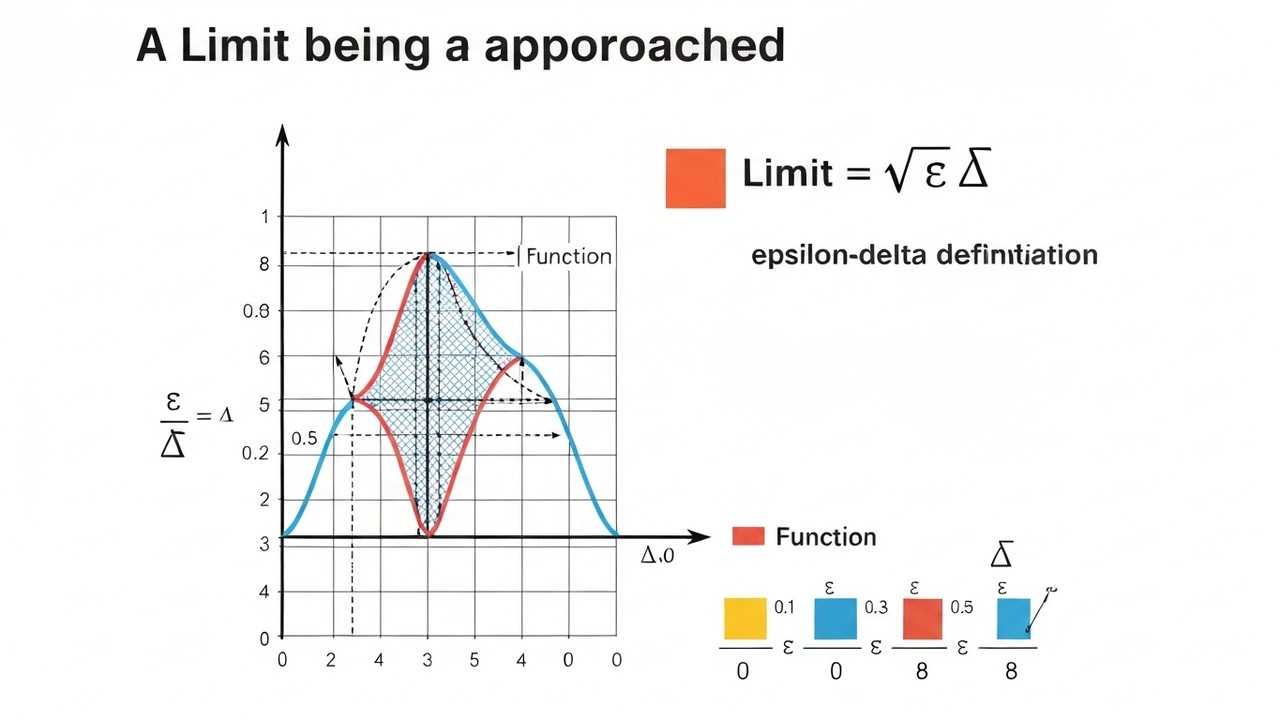
The epsilon–delta definition can be visualised on the graph of ##y = f(x)##.
If such a strip can be found for every chosen ##\varepsilon##, the limit exists and equals ##L##.
Example 6: Reading A Limit From A Graph
Suppose the graph of ##f(x)## has a “hole” at ##x = 1## but the curve approaches the point ##(1, 3)## from both sides. Then we conclude:
###\lim_{x \to 1} f(x) = 3.###
Whenever the left-hand and right-hand sides of the graph approach the same height, the limit equals that common value.
Example 7: A Jump Discontinuity
Consider a function whose graph has a jump at ##x = 0##: as ##x## approaches 0 from the left, ##f(x)## approaches 1, and as ##x## approaches 0 from the right, ##f(x)## approaches 3.
Because these two one-sided limits are not equal, the two-sided limit does not exist:
###\lim_{x \to 0} f(x) \text{ does not exist}.###
6. One-Sided Limits And Piecewise Functions
Many real-world situations are described by piecewise functions, where different formulas apply on different intervals. In such cases, one-sided limits are very important.
Definition: One-Sided Limits
The two-sided limit exists and equals ##L## if and only if both one-sided limits exist and are equal to ##L##.
Example 8: A Simple Piecewise Function
Let
###f(x) = \begin{cases}2x + 1, & x < 1, \\x^2, & x \geq 1.\end{cases}###
Find ##\lim_{x \to 1^-} f(x)##, ##\lim_{x \to 1^+} f(x)##, and ##\lim_{x \to 1} f(x)##.
Solution.
###\lim_{x \to 1^-} f(x) = 2 \cdot 1 + 1 = 3.###
###\lim_{x \to 1^+} f(x) = 1^2 = 1.###
Because the left-hand limit (3) and right-hand limit (1) are not equal, the two-sided limit does not exist:
###\lim_{x \to 1} f(x) \text{ does not exist}.###
Example 9: Piecewise Function With Matching Limits
Consider
###f(x) = \begin{cases}3x – 1, & x < 2, \\x^2 – 1, & x \geq 2.\end{cases}###
Find ##\lim_{x \to 2} f(x)##.
Solution.
###\lim_{x \to 2^-} f(x) = 3 \cdot 2 – 1 = 5.###
###\lim_{x \to 2^+} f(x) = 2^2 – 1 = 3.###
Since 5 ##\neq## 3, the two-sided limit does not exist. If we instead had defined the pieces so that both sides meet at the same value, the two-sided limit would exist and equal that common value.
7. When A Limit Does Not Exist
There are several common patterns where limits fail to exist:
Example 10: Infinite Limit
Consider
###f(x) = \frac{1}{x^2}.###
What happens as ##x \to 0##?
Solution. As ##x## gets closer to 0 (from either side), ##x^2## gets very small and positive, so ##1/x^2## becomes very large. we write
###\lim_{x \to 0} \frac{1}{x^2} = \infty,###
which means the function grows without bound near 0. In this situation, we say the limit is infinite, and the usual finite limit “does not exist” in the strict sense.
Example 11: Oscillating Function
Consider
###f(x) = \sin\left(\frac{1}{x}\right), \quad x \neq 0.###
As ##x \to 0##, the quantity ##1/x## becomes very large in magnitude, and ##\sin(1/x)## oscillates rapidly between −1 and 1. It never settles near a single value. Hence,
###\lim_{x \to 0} \sin\left(\frac{1}{x}\right) \text{ does not exist}.###
8. Epsilon–Delta Proofs For Simple Functions
To get comfortable with the formal definition, we now practise with some simple epsilon–delta proofs.
Example 12: Proving A Limit For A Linear Function
Show using the epsilon–delta definition that
###\lim_{x \to 2} (3x + 1) = 7.###
Solution. we start with
###|f(x) – 7| = |3x + 1 – 7| = |3x – 6| = 3|x – 2|.###
we want ##|f(x) – 7| < \varepsilon##. This will happen if we ensure
###3|x – 2| < \varepsilon \quad \Rightarrow \quad |x – 2| < \frac{\varepsilon}{3}.###
So we choose
###\delta = \frac{\varepsilon}{3}.###
Then, whenever ##0 < |x – 2| < \delta##, we get
###|f(x) – 7| = 3|x – 2| < 3 \cdot \frac{\varepsilon}{3} = \varepsilon.###
This completes the epsilon–delta proof.
Example 13: Another Linear Example
Show that
###\lim_{x \to -1} (2x – 5) = -7.###
Solution. Compute
###|f(x) – (-7)| = |2x – 5 + 7| = |2x + 2| = 2|x + 1|.###
we want ##2|x + 1| < \varepsilon##, which holds if
###|x + 1| < \frac{\varepsilon}{2}.###
So we can take
###\delta = \frac{\varepsilon}{2}.###
Then ##0 < |x + 1| < \delta## implies ##|f(x) + 7| < \varepsilon##, as required.
Example 14: Quadratic Function At A Point
Prove that
###\lim_{x \to 1} x^2 = 1.###
Solution. we start with
###|x^2 – 1| = |x – 1||x + 1|.###
To control this, we first force ##x## to stay close to 1. Suppose we require ##|x – 1| < 1##. Then ##x## lies between 0 and 2, so ##|x + 1| \leq 3##. Hence,
###|x^2 – 1| = |x – 1||x + 1| \leq 3|x – 1|.###
we want ##|x^2 – 1| < \varepsilon##. It is enough to ensure
###3|x – 1| < \varepsilon \quad \Rightarrow \quad |x – 1| < \frac{\varepsilon}{3}.###
So we choose
###\delta = \min\!\left\{1, \frac{\varepsilon}{3}\right\}.###
Then ##0 < |x – 1| < \delta## implies ##|x^2 – 1| < \varepsilon##, which proves the limit.
Example 15: Limit For A Function With A Hole
Prove that
###\lim_{x \to 1} \frac{x^2 – 1}{x – 1} = 2.###
Solution. For ##x \neq 1##, we simplify
###\frac{x^2 – 1}{x – 1} = x + 1.###
So the problem is equivalent to proving
###\lim_{x \to 1} (x + 1) = 2.###
Now
###| (x + 1) – 2 | = |x – 1|.###
To have ##|x – 1| < \varepsilon##, we can directly choose
###\delta = \varepsilon.###
Then ##0 < |x – 1| < \delta## implies ##| (x + 1) – 2 | < \varepsilon##. This proves the desired limit formally.
Example 16: Limit Of A Constant Times A Function
Let ##f(x) = x##. Show that
###\lim_{x \to 0} 5x = 0.###
Solution. Here
###|5x – 0| = 5|x|.###
To make this less than ##\varepsilon##, we require
###5|x| < \varepsilon \quad \Rightarrow \quad |x| < \frac{\varepsilon}{5}.###
So taking
###\delta = \frac{\varepsilon}{5}###
works. Whenever ##0 < |x| < \delta##, we have ##|5x| < \varepsilon##, and the formal definition is satisfied.
9. Summary And References
In this lesson, we moved from an intuitive idea of limits to a precise mathematical definition. The epsilon–delta language allows me to express “getting arbitrarily close” in an exact way:
Along the way, we saw many examples: constant and linear functions, quadratics, functions with holes, piecewise functions with jumps, and functions whose limits fail to exist due to infinite growth or oscillation. These examples show how the formal definition matches my geometric and numerical intuition.
For further study and more rigorous treatments, we can consult reliable references such as:
With this formal definition in hand, we are now ready to explore limit rules, continuity, and the rigorous definition of the derivative in later lessons.



0 Comments