Limits give a precise way to describe how a function behaves as its input approaches a particular value. To use them efficiently in algebra and calculus, we need a clear notation and a collection of basic rules (properties). These rules allow me to break complicated limits into simpler pieces and evaluate them step by step.
In this text, we review standard limit notation, introduce one-sided and infinite limits, and then develop fundamental algebraic properties of limits. Each property is illustrated with worked examples, ranging from straightforward direct substitutions to more involved expressions where factorisation and limit rules work together.
1. Core Limit Notation
The central notation is
###\lim_{x \to a} f(x) = L.###
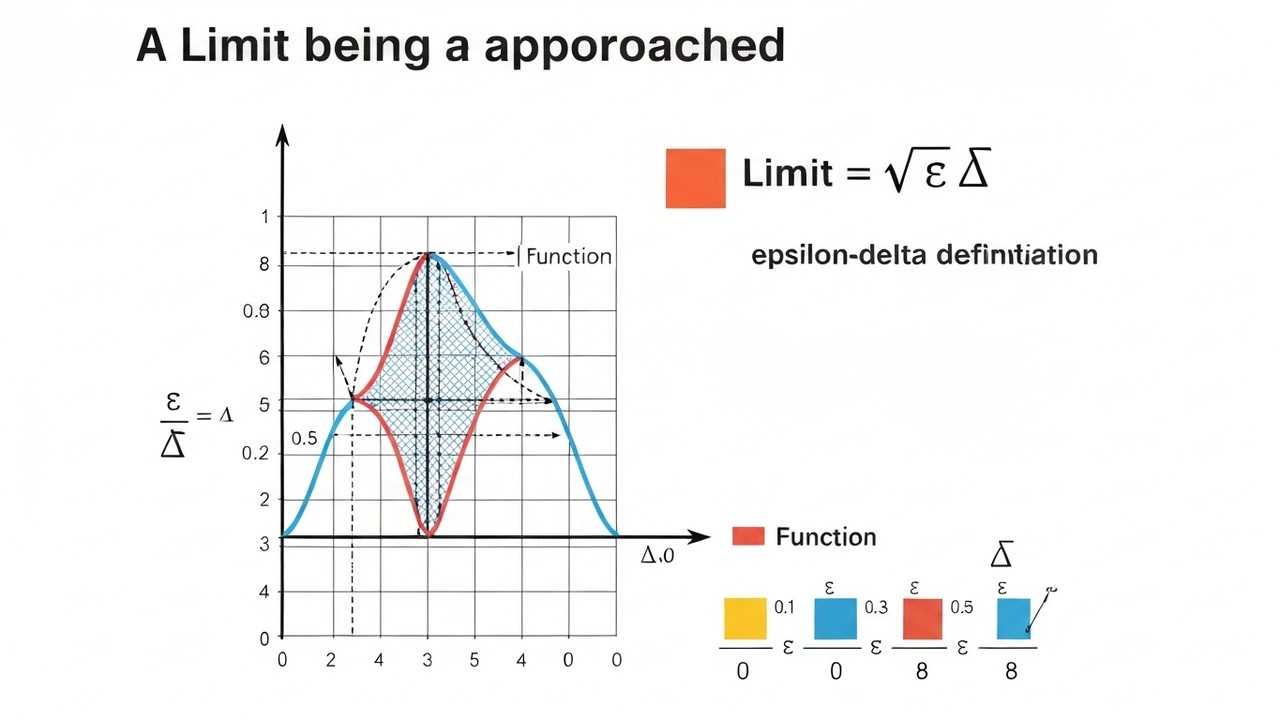
This is read as “the limit of ##f(x)## as ##x## approaches ##a## is ##L##.” It has a specific meaning:
Approach Versus Equality
When we write ##x \to a##, we are talking about values of ##x## that are close to ##a## but not necessarily equal to ##a##. The behaviour of ##f(x)## near ##a## can be well-behaved even if ##f(a)## is undefined or different from the limit.
2. One-Sided Limits
Sometimes it is important to consider what happens as ##x## approaches a point only from the left or only from the right. This leads to one-sided limits.
The two-sided limit exists and equals ##L## if and only if both one-sided limits exist and are equal to ##L##:
###\lim_{x \to a} f(x) = L \quad \Longleftrightarrow \quad\lim_{x \to a^-} f(x) = L \text{ and } \lim_{x \to a^+} f(x) = L.###
Example 1: One-Sided Limits For A Step Function
Define
###f(x) = \begin{cases}1, & x < 0, \\[4pt]3, & x \ge 0.\end{cases}###
Find ##\lim_{x \to 0^-} f(x)##, ##\lim_{x \to 0^+} f(x)##, and ##\lim_{x \to 0} f(x)##.
Solution.
Because the left-hand and right-hand limits are not equal, the two-sided limit does not exist:
###\lim_{x \to 0} f(x) \text{ does not exist}.###
Example 2: One-Sided Limits That Agree
Let
###f(x) = \begin{cases}x^2, & x \le 1, \\[4pt]2x – 1, & x > 1.\end{cases}###
Find ##\lim_{x \to 1} f(x)##.
Solution.
Because both one-sided limits equal 1, the two-sided limit exists and equals 1:
###\lim_{x \to 1} f(x) = 1.###
3. Infinite Limits And Limits At Infinity
Sometimes the values of a function grow without bound as ##x## approaches some finite number. In such cases we say the limit is infinite.
These expressions indicate unbounded behaviour, not a finite limit.
Example 3: Infinite Limit
Consider
###f(x) = \frac{1}{(x – 2)^2}.###
As ##x \to 2##, the denominator ##(x – 2)^2## becomes very small and positive, so ##1/(x – 2)^2## becomes very large and positive. we write
###\lim_{x \to 2} \frac{1}{(x – 2)^2} = \infty.###
Limits At Infinity
When ##x## itself becomes very large (positively or negatively), we write limits such as
###\lim_{x \to \infty} f(x), \quad \lim_{x \to -\infty} f(x).###
These describe long-term behaviour of the function, often related to horizontal asymptotes.
Example 4: Limit At Infinity
Consider
###f(x) = \frac{3x^2 + 1}{x^2 + 2}.###
Divide numerator and denominator by ##x^2##:
###f(x) = \frac{3 + \frac{1}{x^2}}{1 + \frac{2}{x^2}}.###
As ##x \to \infty##, the fractions ##1/x^2## and ##2/x^2## go to 0, so
###\lim_{x \to \infty} \frac{3x^2 + 1}{x^2 + 2} = \frac{3 + 0}{1 + 0} = 3.###
4. Fundamental Limit Properties
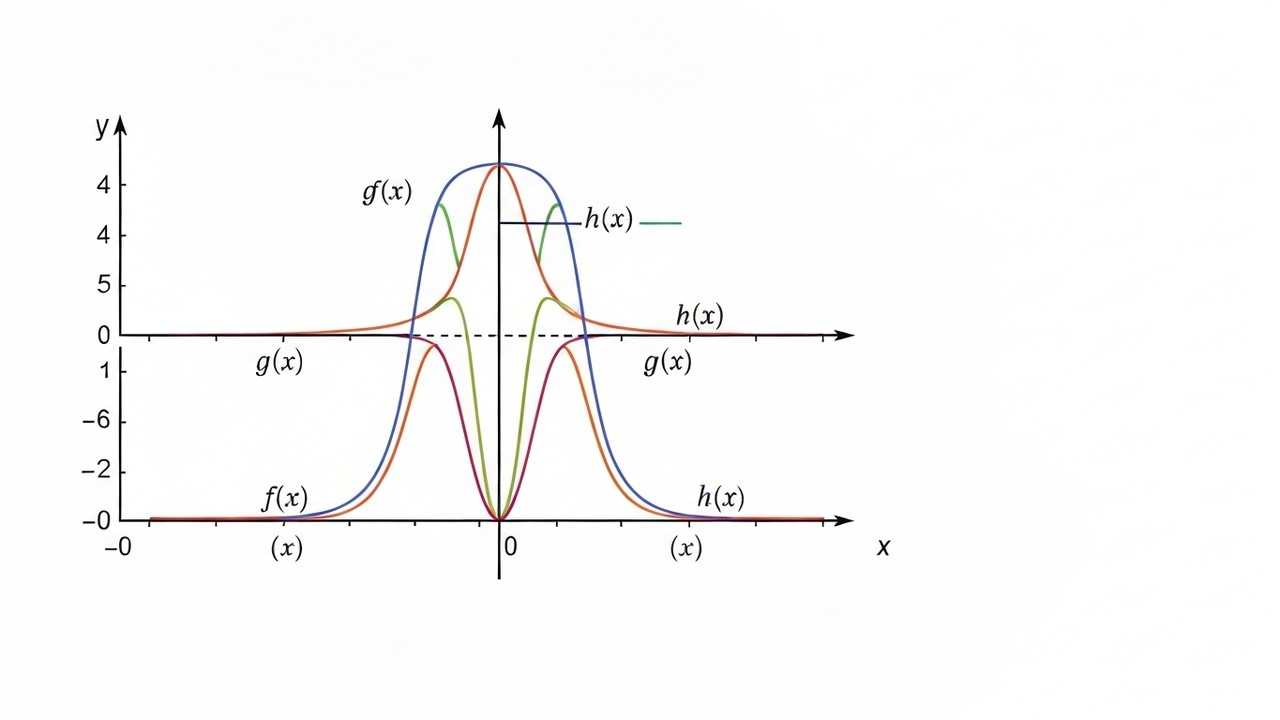
The following properties are valid when the individual limits involved exist and are finite. Suppose
###\lim_{x \to a} f(x) = L \quad \text{and} \quad \lim_{x \to a} g(x) = M.###
Then:
These properties allow me to break a limit into simpler parts, evaluate those parts, and then reassemble the result.
5. Basic Examples Using Properties
Example 5: Using Sum And Constant Multiple
Evaluate
###\lim_{x \to 2} (3x^2 – 4x + 1).###
Solution.
Write the function as a sum of simpler parts:
###3x^2 – 4x + 1 = 3x^2 + (-4x) + 1.###
Using the properties and known limits of powers of ##x##:
Then:
###\lim_{x \to 2} (3x^2 – 4x + 1)= 3 \cdot \lim_{x \to 2} x^2 – 4 \cdot \lim_{x \to 2} x + \lim_{x \to 2} 1= 3 \cdot 4 – 4 \cdot 2 + 1= 12 – 8 + 1= 5.###
Example 6: Quotient Of Polynomials
Evaluate
###\lim_{x \to 1} \frac{x^2 + x – 2}{x – 1}.###
Solution.
First factor the numerator:
###x^2 + x – 2 = (x + 2)(x – 1).###
So
###\frac{x^2 + x – 2}{x – 1} = \frac{(x + 2)(x – 1)}{x – 1} = x + 2, \quad x \neq 1.###
Now the limit is
###\lim_{x \to 1} (x + 2) = 1 + 2 = 3.###
Example 7: Combining Sum, Difference, And Quotient
Evaluate
###\lim_{x \to 0} \frac{3x^2 – 2x}{x}.###
Solution.
For ##x \neq 0##, simplify:
###\frac{3x^2 – 2x}{x} = 3x – 2.###
Now
###\lim_{x \to 0} (3x – 2) = 3 \cdot 0 – 2 = -2.###
Example 8: Limit Of A Product
Evaluate
###\lim_{x \to 2} (x – 2)(x^2 + 1).###
Solution.
Use the product rule:
Thus
###\lim_{x \to 2} (x – 2)(x^2 + 1) = 0 \cdot 5 = 0.###
6. Using Properties With Roots And Powers
Example 9: Square Root Function
Evaluate
###\lim_{x \to 9} \sqrt{x}.###
Solution.
As ##x \to 9##, the number inside the root approaches 9. By the root property:
###\lim_{x \to 9} \sqrt{x} = \sqrt{9} = 3.###
Example 10: Higher Powers
Evaluate
###\lim_{x \to 1} (2x – 1)^4.###
Solution.
7. Worked Examples Combining Multiple Rules
Example 11: Polynomial Over Polynomial
Evaluate
###\lim_{x \to 3} \frac{x^3 – 27}{x – 3}.###
Solution.
Factor the numerator using the difference of cubes:
###x^3 – 27 = (x – 3)(x^2 + 3x + 9).###
Thus
###\frac{x^3 – 27}{x – 3} = x^2 + 3x + 9, \quad x \neq 3.###
Therefore,
###\lim_{x \to 3} \frac{x^3 – 27}{x – 3} = \lim_{x \to 3} (x^2 + 3x + 9)= 3^2 + 3 \cdot 3 + 9= 9 + 9 + 9= 27.###
Example 12: Rational Expression With Root
Evaluate
###\lim_{x \to 4} \frac{\sqrt{x} – 2}{x – 4}.###
Solution.
Direct substitution gives ##0/0##, an indeterminate form. we can multiply numerator and denominator by the conjugate of the numerator:
###\frac{\sqrt{x} – 2}{x – 4} \cdot \frac{\sqrt{x} + 2}{\sqrt{x} + 2}= \frac{x – 4}{(x – 4)(\sqrt{x} + 2)}= \frac{1}{\sqrt{x} + 2}, \quad x \neq 4.###
Now the limit becomes
###\lim_{x \to 4} \frac{1}{\sqrt{x} + 2}= \frac{1}{\sqrt{4} + 2}= \frac{1}{2 + 2}= \frac{1}{4}.###
Example 13: Limit Using Sum And Quotient Rules
Evaluate
###\lim_{x \to 1} \left( \frac{2x + 3}{x + 1} – x \right).###
Solution.
First combine the terms into a single fraction:
###\frac{2x + 3}{x + 1} – x= \frac{2x + 3 – x(x + 1)}{x + 1}= \frac{2x + 3 – (x^2 + x)}{x + 1}= \frac{-x^2 + x + 3}{x + 1}.###
Evaluate the limit by substitution:
So
###\lim_{x \to 1} \left( \frac{2x + 3}{x + 1} – x \right)= \frac{3}{2}.###
Example 14: Function With A Removable Discontinuity
Define
###f(x) = \begin{cases}\displaystyle \frac{x^2 – 9}{x – 3}, & x \neq 3, \\[6pt]0, & x = 3.\end{cases}###
Find ##\lim_{x \to 3} f(x)## and compare it with ##f(3)##.
Solution.
For ##x \neq 3##,
###\frac{x^2 – 9}{x – 3} = \frac{(x – 3)(x + 3)}{x – 3} = x + 3.###
Therefore, for values close to 3, ##f(x) = x + 3##, and
###\lim_{x \to 3} f(x) = \lim_{x \to 3} (x + 3) = 6.###
However, by definition ##f(3) = 0##. So the limit exists and equals 6, but the function value at 3 is 0. This expresses a removable discontinuity.
Example 15: Limit Involving An Absolute Value
Evaluate
###\lim_{x \to 0} |x|.###
Solution.
Both one-sided limits equal 0, so
###\lim_{x \to 0} |x| = 0.###
Example 16: Combining Root And Polynomial
Evaluate
###\lim_{x \to 1} \left( \sqrt{x + 3} – x \right).###
Solution.
Here direct substitution is straightforward:
Hence,
###\lim_{x \to 1} \left( \sqrt{x + 3} – x \right) = 1.###
Example 17: Rational Function With Nonzero Denominator
Evaluate
###\lim_{x \to -2} \frac{2x^2 – 3x + 1}{x^2 + 1}.###
Solution.
Since the denominator is never zero (##x^2 + 1 > 0## for all real ##x##), we can directly substitute:
Therefore,
###\lim_{x \to -2} \frac{2x^2 – 3x + 1}{x^2 + 1} = \frac{15}{5} = 3.###
Example 18: Limit Using Factorisation And Quotient Rule
Evaluate
###\lim_{x \to 2} \frac{x^2 – 4x + 4}{x – 2}.###
Solution.
Factor the numerator:
###x^2 – 4x + 4 = (x – 2)^2.###
Then
###\frac{x^2 – 4x + 4}{x – 2} = \frac{(x – 2)^2}{x – 2} = x – 2, \quad x \neq 2.###
Thus,
###\lim_{x \to 2} \frac{x^2 – 4x + 4}{x – 2} = \lim_{x \to 2} (x – 2) = 0.###
Example 19: Limit Involving A Sum Of Fractions
Evaluate
###\lim_{x \to 1} \left( \frac{1}{x} + \frac{1}{x^2} \right).###
Solution.
Using the sum property:
###\lim_{x \to 1} \left( \frac{1}{x} + \frac{1}{x^2} \right) = 1 + 1 = 2.###
Example 20: Limit Of A Difference Involving A Square
Evaluate
###\lim_{x \to 3} \left( x^2 – \frac{1}{x} \right).###
Solution.
Therefore, by the difference rule,
###\lim_{x \to 3} \left( x^2 – \frac{1}{x} \right)= 9 – \frac{1}{3}= \frac{27}{3} – \frac{1}{3}= \frac{26}{3}.###
8. Summary Of Notation And Properties
In this text, we have:
These ideas form the computational toolkit for limits. In more advanced topics, such as continuity and derivatives, the same notation and properties continue to play a central role.
9. References For Further Study
For additional reading, examples, and historical context, we can consult trusted resources such as:


0 Comments