PHYSICS
Resources & Insights

Understanding Relative and Absolute Motion
Understanding the concepts of Relative and Absolute Motion forms a crucial part of mastering the principles of kinematics. When we delve into the complex worlds of physics, these two notions significantly influence how we perceive and analyse movement. In essence, motion can appear differently depending on the frame of reference. By deciphering these concepts through real-world examples and mathematical demonstrations, we'll gain a deeper understanding of their applications in various technological and scientific domains. Defining Relative Motion Relative motion refers to the movement of a body as observed from a specific frame of reference. This means that movement isn't absolute but depends on the observer's point of view. Consider two trains moving parallel to each other: to a passenger in […] READ MORE...

Physics: Motion in One Dimension
Motion in One Dimension forms the foundational block in understanding the Physics of movement. This topic delves into the specifics of how objects move in a straight line under the influence of various forces. By exploring the key concepts of displacement, velocity, and acceleration, one can grasp how these parameters interrelate to describe the kinematic motion of particles or bodies in a single-dimensional plane. Understanding Motion in One Dimension Motion in One Dimension, also known as Rectilinear Motion, focuses on the movement of objects along a straight path. This type of motion simplifies the analysis of movement as it restricts the scenario to a single axis, usually the x-axis. To comprehend this, we examine three primary components: displacement, velocity, and […] READ MORE...
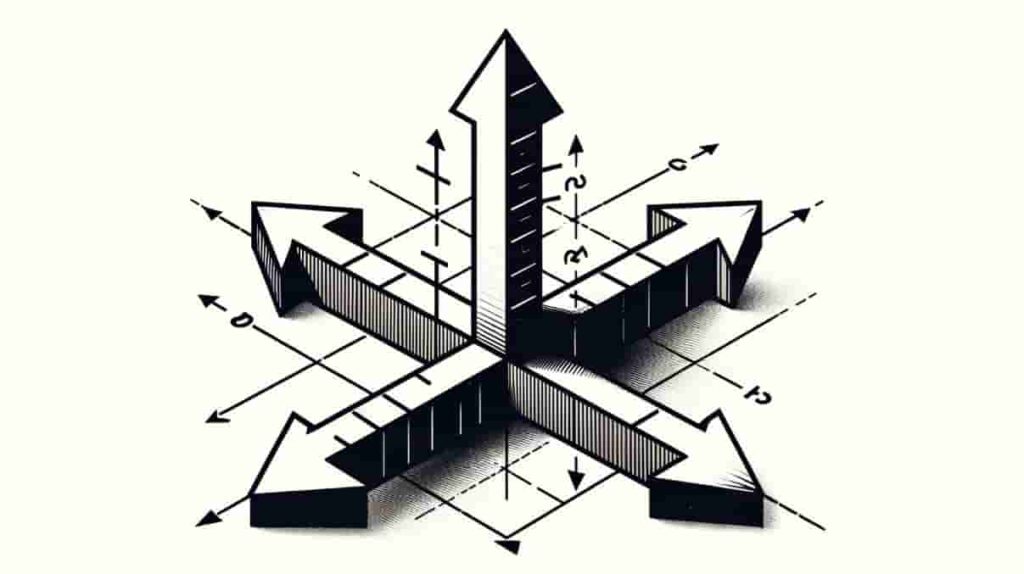
The Three Dimensions
In physics and geometry, the concept of "three dimensions" refers to a spatial framework necessary to describe the position or location of an object fully. Each dimension provides a unique axis that, together with the others, can describe any point in space. Here’s a breakdown of the three dimensions typically used: We also published: Scientific Notations 1. X-Axis (First Dimension) This is often thought of as the horizontal dimension. In a Cartesian coordinate system, it typically defines width or length. 2. Y-Axis (Second Dimension) This axis is perpendicular to the x-axis. In a Cartesian coordinate system, it typically defines height or breadth when considered in a two-dimensional plane along with the x-axis. 3. Z-Axis (Third Dimension) The z-axis is perpendicular […] READ MORE...

The Pivotal Role of Supernova Explosions in Shaping Our Universe
Supernova Explosions: A Cosmic Transformation The study of supernova explosions has significantly expanded our understanding of the intricate workings of the universe. These cataclysmic events have provided invaluable insights into the life cycles of stars, the formation of essential elements, and the accelerating expansion of the cosmos. Seeding the Cosmos with Stardust The remnants of supernova explosions, rich in heavy elements, disperse into the vast reaches of space, seeding future generations of stars and planets. In fact, a substantial portion of the material that composes the Earth and our own bodies was forged in the heart of these stellar giants and scattered throughout the universe by supernova events. This cyclical process of stellar birth, death, and rebirth is a fundamental […] READ MORE...

Scientific Notations
Scientific notation is a way to express very large or very small numbers in a compact form. It's especially useful in fields like science, engineering, and mathematics where such numbers frequently occur. The notation is based on powers of 10. Here's the general form: \( a \times 10^b \) a is known as the coefficient or significand. It is a number greater than or equal to 1 but less than 10. b is the exponent, which is an integer. It tells us how many times to multiply the coefficient by 10. If b is positive, the number is greater than 1. If b is negative, the number is a fraction, less than 1. Examples Large Number: The distance from the […] READ MORE...

Drive, Walk, Refuel: Find Displacement, Time & Velocity
You drive a car on a straight road at a constant speed of 70 km/h for a distance of 8.4 km, after which the car runs out of fuel. You then walk a further distance of 2 km for 30 minutes to reach the gas station. a) What is the total displacement from the beginning of your drive to your arrival at the gas station? b) What is the total time interval from the beginning of your drive to your arrival at the gas station? c) What is the average velocity from the beginning of your drive to your arrival at the gas station? READ MORE...

Numerical Examples in Motion in One Dimension - Kinematics
These problems encompass a variety of scenarios involving motion in one dimension, designed to reinforce the understanding of key concepts such as constant velocity, acceleration, deceleration, and the equations of motion. READ MORE...

Top 20 Questions on Motion
These questions and answers provide a basic yet comprehensive overview of the fundamental concepts of motion, tailored for educational purposes, especially for students at a 9th and 10th-grade level. READ MORE...