MATHEMATICS
Resources & Insights
Explore mathematics, the foundational science of numbers, patterns, and logical reasoning. Learn key topics including algebra, geometry, calculus, statistics, and number theory. Ideal for students, educators, and enthusiasts seeking to develop problem-solving skills and apply mathematical concepts in science, technology, finance, and everyday life.

Comprehending the Additive Inverse of an element: An Essential Mathematical Principle
The additive inverse of an element, a fundamental concept in mathematics. Learn how to determine it and why it matters. READ MORE...

Understanding Additive Identity in Mathematics
Explore the concept of Additive Identity in Mathematics and its importance in algebra and number theory. READ MORE...

An Introduction to Probability for Beginners (Lecture Class Presentation Notes Nov 2023)
What is probability? Probability is a fundamental concept in mathematics and statistics that deals with the likelihood of an event occurring. It is a way to quantify uncertainty and make predictions based on available information. In simple terms, probability is a measure of how likely it is for a specific outcome to happen. It is expressed as a number between 0 and 1, where 0 represents impossibility and 1 represents certainty. Understanding probability is essential in various fields, including science, finance, and even everyday decision-making. It helps us analyze and interpret data, assess risks, and make informed choices. Whether you are a student, a professional, or simply curious about the world around you, having a solid understanding of probability can […] READ MORE...
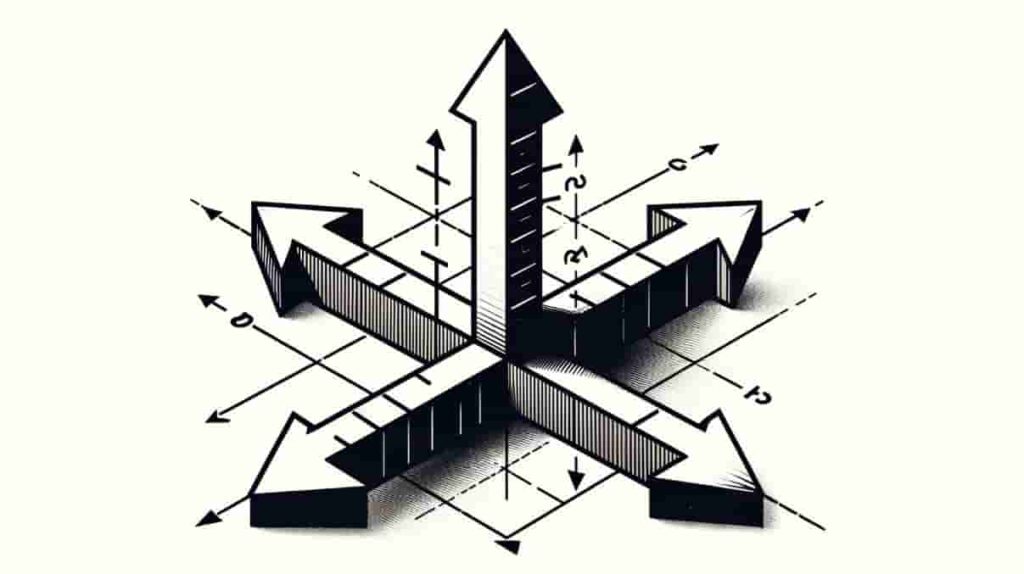
The Three Dimensions
In physics and geometry, the concept of "three dimensions" refers to a spatial framework necessary to describe the position or location of an object fully. Each dimension provides a unique axis that, together with the others, can describe any point in space. Here’s a breakdown of the three dimensions typically used: We also published: Scientific Notations 1. X-Axis (First Dimension) This is often thought of as the horizontal dimension. In a Cartesian coordinate system, it typically defines width or length. 2. Y-Axis (Second Dimension) This axis is perpendicular to the x-axis. In a Cartesian coordinate system, it typically defines height or breadth when considered in a two-dimensional plane along with the x-axis. 3. Z-Axis (Third Dimension) The z-axis is perpendicular […] READ MORE...

Scientific Notations
Scientific notation is a way to express very large or very small numbers in a compact form. It's especially useful in fields like science, engineering, and mathematics where such numbers frequently occur. The notation is based on powers of 10. Here's the general form: \( a \times 10^b \) a is known as the coefficient or significand. It is a number greater than or equal to 1 but less than 10. b is the exponent, which is an integer. It tells us how many times to multiply the coefficient by 10. If b is positive, the number is greater than 1. If b is negative, the number is a fraction, less than 1. Examples Large Number: The distance from the […] READ MORE...

Multiplication Rule in Probability
The multiplication rule in probability is used to find the probability of the intersection of two or more independent event READ MORE...

Addition Rule in Probability
Addition Rule calculates the probability of one or more events occurring. For mutually exclusive events, add individual probabilities. For non-mutually exclusive events, add individual probabilities and subtract the probability of both events occurring. READ MORE...
Derive the Mean or Expected Value of Random Variable that has Poisson Distribution
Finding the Expected Value μ (mean) of Random Variable that has Poisson Distribution READ MORE...