CBSE CLASS 10 CHEMISTRY
Resources & Insights
Navigating the CBSE Board Exams 2025: A Comprehensive Guide
Conquer the CBSE Board Exams 2025 with our guide! Learn effective study strategies, time management tips, and overcome exam anxiety for success. READ MORE...

Metal compound A reacts with dilute hydrochloric acid to produce effervescence. The gas evolved extinguishes a burning candle. Write a balanced chemical equation for the reaction if one of the compounds formed is calcium chloride. Also, determine the Metal Compound A.
Based on the information provided, the metal compound A reacts with dilute hydrochloric acid to produce effervescence, and the gas evolved extinguishes a burning candle. Additionally, one of the compounds formed in the reaction is calcium chloride. Let's write the balanced chemical equation for this reaction: Metal Compound A + Hydrochloric Acid → Calcium Chloride + Gas + Water Since calcium chloride is formed, we can represent it as CaCl2. The gas evolved that extinguishes a burning candle is hydrogen gas (H2). The balanced chemical equation for the reaction is as follows: Metal Compound A + 2HCl → CaCl2 + H2 + H2O In this reaction, the metal compound A reacts with hydrochloric acid (HCl) to produce calcium chloride (CaCl2) […] READ MORE...

Which gas is usually liberated when an acid reacts with a metal? Illustrate with an example. How will you test for the presence of this gas?
When an acid reacts with a metal, hydrogen gas (H2) is usually liberated. The reaction between an acid and a metal is a type of single-displacement or single-replacement reaction, where the more reactive metal displaces hydrogen from the acid, forming a metal salt and releasing hydrogen gas. Here's an example of the reaction between hydrochloric acid (HCl) and zinc (Zn): Hydrochloric Acid + Zinc → Zinc Chloride + Hydrogen Gas 2HCl + Zn → ZnCl2 + H2 Testing for the Presence of Hydrogen Gas: To test for the presence of hydrogen gas, you can perform the "pop" test. This test is a simple way to detect the presence of hydrogen gas, as hydrogen is highly flammable. When hydrogen gas is […] READ MORE...
Why should curd and sour substances not be kept in brass and copper vessels?
Curd and sour substances should not be kept in brass and copper vessels because these metals can react with acidic foods, leading to potential health hazards. The main concern is the leaching of toxic metals into the food or liquid being stored, which can contaminate the food and make it unsafe for consumption. Here are the reasons why: Acidic Reactions: Curd and sour substances contain acids (such as lactic acid in curd) that can react with the copper and zinc present in brass or copper vessels. This reaction can cause the release of these metals into the food, leading to metal poisoning. Copper Toxicity: Copper is an essential mineral needed by the body in small amounts, but excessive intake of […] READ MORE...
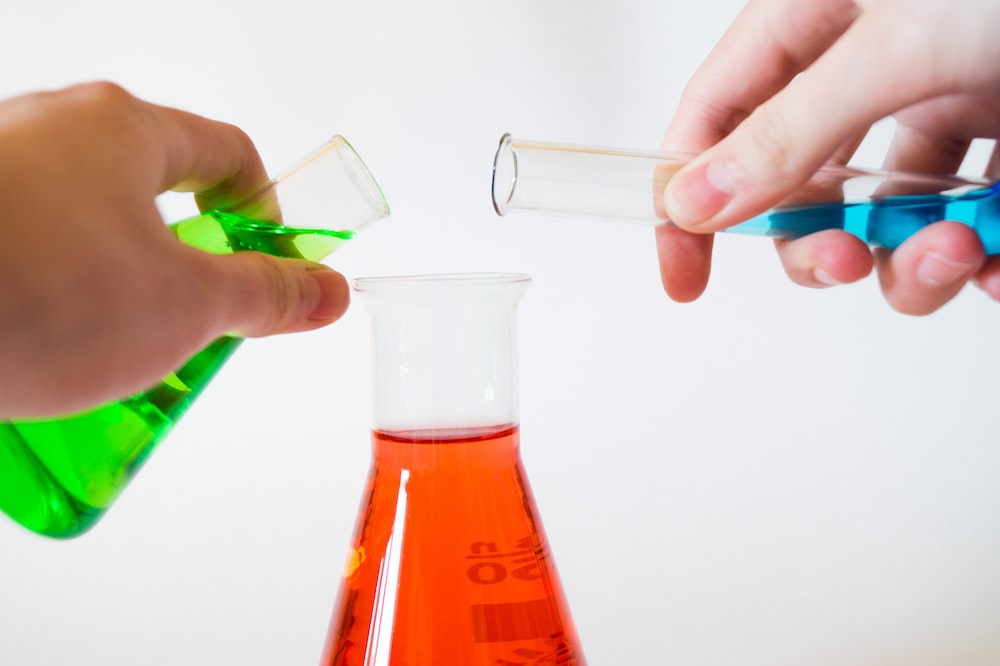
Understanding Chemical Reactions and Equations
Get ready to embark on a journey through the fascinating realm of chemical reactions and equations, where every reaction is a symphony of atoms dancing to the tunes of nature. READ MORE...

10 Examples of combination reactions
1. The reaction between hydrogen gas and oxygen gas to form water: 2H2 + O2 → 2H2O 2. The reaction between iron and sulfur to form iron sulfide: Fe + S → FeS 3. The reaction between magnesium and oxygen to form magnesium oxide: 2Mg + O2 → 2MgO 4. The reaction between nitrogen gas and hydrogen gas to form ammonia: N2 + 3H2 → 2NH3 5. The reaction between sodium and chlorine gas to form sodium chloride: 2Na + Cl2 → 2NaCl 6. The reaction between carbon and oxygen gas to form carbon dioxide: C + O2 → CO2 7. The reaction between lithium and oxygen to form lithium oxide: 4Li + O2 → 2Li2O 8. The reaction between […] READ MORE...
Characteristics of a chemical reaction.
A chemical reaction generally has one or more of the below-mentioned characteristics. Change in state Change in colour Evolution of gas Change in temperature Appearance of light Formation of Precipitate 1> Change in stateCertain chemical reactions are featured with a change in the state of matter(solid, liquid, gases) of the substances involved. When the wax is burned, the combustion process produces both water and gas (Carbon Dioxide). There is a transformation from a solid state to a liquid and gaseous state. 2> Change in colourA change in colour is another sign that a chemical reaction has occurred. A good example of this is when something rusts. Pure iron is naturally silver in colour. We don’t usually observe it this way […] READ MORE...
What is a Chemical Reaction?
A process in which one or more substances get transformed to produce new substance or substances is called a Chemical Reaction. A chemical reaction involves changes in the position of electrons of atoms by restructuring chemical bonds, with no changes to the nuclei of atoms, thus preserving the elements of participating substances. The occurrence of a chemical reaction is generally supported by the following observations. Change in state Change in colour Evolution of gas Change in temperature Appearance of light Formation of Precipitate READ MORE...