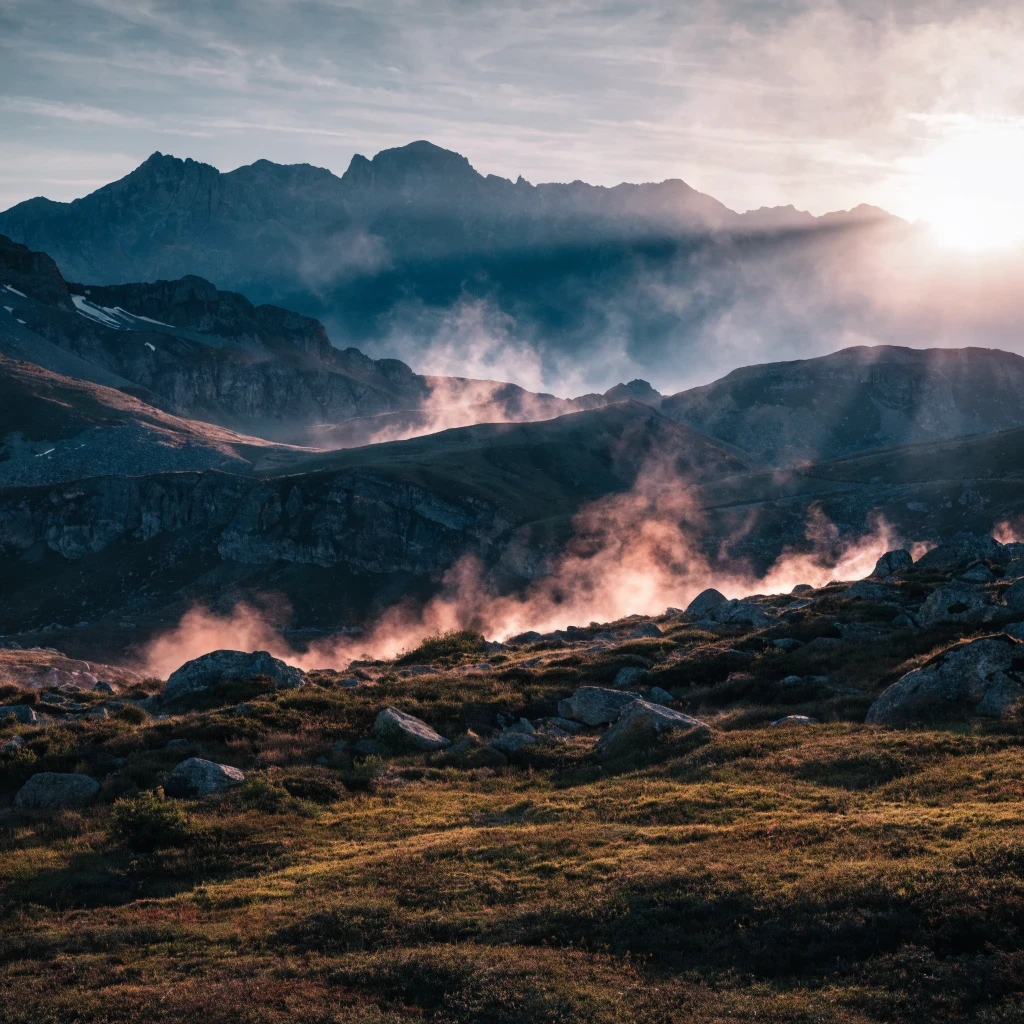
Thermal Radiation: The Invisible Language of Heat
Thermal radiation is the transfer of energy through electromagnetic waves emitted by matter because of its temperature. Unlike conduction and convection, it does not require physical contact or a moving fluid. Every object above absolute zero radiates energy, whether it is a human body, a heated furnace, Earth’s surface, or a distant star. Temperature determines both the intensity and character of this emission.
The central principle is uncompromising: matter is never completely radiatively silent while its temperature remains above absolute zero. Atoms, molecules, and charged particles are in continual motion, and their microscopic activity produces electromagnetic emission. At ordinary temperatures this radiation is predominantly infrared and invisible. As temperature rises, the emitted energy increases dramatically and may eventually become visible as red, orange, yellow, or white light.
Thermal radiation should not be confused with heat itself. Heat is energy transferred because of a temperature difference, whereas radiation is one mechanism by which that transfer occurs. A hot object can radiate toward a colder object across a vacuum, allowing energy to cross empty space. This is why the Sun warms Earth despite the enormous, nearly airless distance between them.
Why Radiation Is Different from Conduction and Convection
Conduction transfers energy through microscopic collisions within a material, and convection transports energy through the bulk movement of fluids. Both mechanisms depend strongly on matter occupying the region between two locations. Radiation operates under a different rule. Electromagnetic waves can travel through vacuum, transparent gases, and many other media, making radiative transfer the dominant mechanism in astronomy and a major factor in engineering.
In a solid wall, heat may move by conduction while its surfaces simultaneously exchange radiation with surrounding objects. In a room, air currents create convection, but walls, floors, people, and furniture continuously emit and absorb infrared energy. A realistic thermal analysis therefore treats conduction, convection, and radiation as interacting processes rather than isolated textbook categories.
Radiation travels at the speed of light in vacuum and is not carried by a substance. Its propagation may involve visible light, infrared wavelengths, ultraviolet radiation, microwaves, or other portions of the electromagnetic spectrum. Thermal radiation, however, is distinguished by its origin: it arises from the thermal state of matter rather than from a purely engineered communication signal or a deliberately stimulated optical source.
The Electromagnetic Spectrum of Thermal Emission
The wavelength distribution of thermal radiation depends chiefly on temperature. Cool objects emit most strongly at relatively long infrared wavelengths. Hotter objects radiate more intensely and shift their strongest emission toward shorter wavelengths. This shift explains why an electric heating element first glows dull red and later becomes orange or nearly white as its temperature increases.
At room temperature, the human body emits strongly in the infrared region near wavelengths that specialized thermal cameras can detect. Visible light is only a narrow segment of the electromagnetic spectrum, so ordinary vision gives an incomplete account of thermal behavior. An object may be radiating substantial energy even when it appears perfectly dark to the eye.
The wavelength distribution of an ideal emitter is described by Planck’s law. In spectral form, the energy emitted at a particular wavelength depends on wavelength and absolute temperature. The equation is not merely a mathematical ornament; it explains the complete shape of a thermal spectrum and provides the foundation for infrared sensing, astrophysical temperature estimation, and radiation-based manufacturing control.
In this relation, ##B_{\lambda}(T)## represents spectral radiance, ##\lambda## is wavelength, ##T## is absolute temperature, ##h## is Planck’s constant, ##c## is the speed of light, and ##k_{\mathrm{B}}## is Boltzmann’s constant. The law predicts that emission is distributed across a continuous range of wavelengths, not concentrated at a single color or frequency.
Blackbody Radiation and the Ideal Standard
A blackbody is an idealized object that absorbs all incident radiation, regardless of wavelength or direction. Because it reflects nothing and transmits nothing, it is also the most efficient possible emitter at a given temperature. No practical surface behaves as a perfect blackbody, but the model is so powerful that it serves as the benchmark against which real materials are measured.
Blackbody behavior does not mean the object must look black to the eye. A blackbody at low temperature emits invisible infrared radiation and may appear dark. At sufficiently high temperature, the same ideal object would glow visibly. “Black” describes absorption and emission properties across the spectrum, not simply the visual appearance of a surface.
The total power radiated by an ideal blackbody is governed by the Stefan–Boltzmann law. It rises with the fourth power of absolute temperature, making thermal emission exceptionally sensitive to temperature. A modest increase in temperature can therefore produce a substantial increase in radiative output, especially at high operating temperatures.
Here, ##E_{\mathrm{b}}## is the total blackbody emissive power per unit area, ##T## is temperature in kelvin, and ##\sigma## is the Stefan–Boltzmann constant. For a real surface, the emitted power is reduced by its emissivity. The corresponding net exchange between a small object and large surroundings at temperature ##T_{\mathrm{s}}## is often represented by ##q=\varepsilon\sigma A(T^{4}-T_{\mathrm{s}}^{4})##.
Wien’s Displacement Law: Temperature Revealed by Color
Wien’s displacement law identifies the wavelength at which blackbody emission reaches its maximum. As temperature increases, the peak moves toward shorter wavelengths. This relationship allows scientists to estimate the temperatures of stars, flames, planets, and industrial surfaces from their spectral or infrared signatures, often without touching them or placing a sensor directly inside a dangerous environment.
The constant ##b## is Wien’s displacement constant. The law has an important practical consequence: a cooler body emits most strongly at longer infrared wavelengths, while a hotter body peaks closer to the visible range. The familiar progression from dark red to bright white is therefore a physical temperature signal, although visual color alone is not a precise thermometer.
Thermal cameras exploit this principle but do not simply “see heat” in an unrestricted sense. They detect infrared radiation within selected wavelength bands and convert measured radiance into an estimated temperature. Accuracy depends on emissivity, reflected radiation, atmospheric absorption, viewing angle, calibration, and the difference between the object’s true temperature and the apparent temperature inferred by the instrument.
Emissivity: The Property That Makes Real Surfaces Complicated
Emissivity is the ratio of radiation emitted by a real surface to radiation emitted by a blackbody at the same temperature and under comparable conditions. Its value ranges from zero to one. Highly polished metals often have low emissivity in the infrared, whereas oxidized metals, painted surfaces, ceramics, water, and many nonmetallic materials commonly exhibit much higher emissivity.
A low-emissivity surface is not necessarily cold. It may simply be a poor emitter and a strong reflector of surrounding radiation. This distinction is critical in thermal imaging. A shiny metal pipe can produce a misleading temperature reading because the camera may detect reflected infrared energy from nearby heaters, walls, or people rather than radiation emitted solely by the pipe itself.
Emissivity can depend on wavelength, direction, surface roughness, oxidation, coating, temperature, and material composition. Treating it as a universal fixed number is convenient for elementary problems but dangerous in precision work. Engineers compensate by applying known coatings, using reference surfaces, measuring at favorable angles, or selecting instruments designed for spectral and material-specific analysis.
Kirchhoff’s Law and the Logic of Absorption
Kirchhoff’s law of thermal radiation states that, at thermal equilibrium, a surface’s ability to emit radiation at a particular wavelength and direction is linked to its ability to absorb radiation under the same conditions. A surface that absorbs efficiently at a given wavelength must also emit efficiently there. This principle unifies absorption and emission rather than treating them as unrelated properties.
The law explains why black, rough, and matte surfaces are commonly effective radiators, while polished reflective surfaces are often poor radiators. The statement must be applied spectrally: a material may absorb strongly in one wavelength band and weakly in another. Consequently, color in visible light does not automatically determine emissivity in the infrared.
Selective emitters are engineered to radiate strongly within desired wavelength bands and suppress emission elsewhere. Such control matters in thermal camouflage, infrared signaling, high-temperature furnaces, thermophotovoltaic energy conversion, and spacecraft design. Modern coatings can be designed to reflect solar wavelengths while emitting thermal infrared energy, a strategy used in passive cooling surfaces.
Radiative Exchange Between Surfaces
Two objects at different temperatures exchange radiation in both directions. The hotter object emits more energy toward the colder object, while the colder object emits less energy toward the hotter one. Net heat transfer is the difference between these opposing exchanges. This is why a person near a cold window may feel chilled even when the surrounding air temperature seems comfortable.
Radiative exchange depends not only on temperature and emissivity but also on geometry. A surface sees another surface through a quantity called the view factor, which describes the fraction of radiation leaving one surface that reaches another. Large facing surfaces exchange more energy than small, oblique, or partially shielded surfaces. Geometry can therefore be as important as material choice.
Radiation shields reduce heat transfer by inserting low-emissivity surfaces between hot and cold regions. Multiple shields are especially effective in vacuum systems because conduction through the remaining gas is minimized. Polished metallic foils, multilayer insulation, and carefully designed enclosures protect cryogenic tanks, spacecraft instruments, and sensitive detectors from unwanted radiative loading.
Radiation in Earth’s Climate System
Earth’s climate is governed by a continuing balance between incoming solar radiation and outgoing terrestrial radiation. The Sun, with an effective temperature far higher than Earth’s, emits primarily at shorter wavelengths. Earth absorbs part of this solar energy and re-emits energy at longer infrared wavelengths because its surface and atmosphere are much cooler.
Atmospheric gases influence the escape of infrared radiation. Water vapor, carbon dioxide, methane, nitrous oxide, and other gases absorb and re-emit radiation within particular wavelength bands. This process does not violate conservation of energy or require a literal solid “glass” roof. It changes the pathways and timescales by which energy leaves the surface-atmosphere system.
The greenhouse effect is therefore a radiative phenomenon. The atmosphere is comparatively transparent to much incoming visible sunlight but more absorptive at selected infrared wavelengths emitted by Earth. Clouds also alter radiation by reflecting sunlight and absorbing or emitting infrared energy. Climate analysis must consider both shortwave solar gains and longwave terrestrial losses.
Radiative equilibrium does not mean that every location has the same temperature. Local conditions vary because of latitude, seasons, clouds, land cover, oceans, atmospheric circulation, and surface properties. The global energy budget is an aggregate balance, while regional weather reflects the redistribution of energy through radiation, convection, evaporation, and atmospheric and oceanic transport.
Radiation in Space and Astronomy
Stars are among the most important natural laboratories for thermal radiation. Their spectra approximate blackbody distributions, although absorption lines and atmospheric effects modify the ideal pattern. Astronomers use spectral shape, peak wavelength, luminosity, and radius to infer stellar temperatures and classify stars. Blue-white stars are generally hotter than red stars, though color must be interpreted quantitatively.
Planets, moons, dust clouds, and interstellar matter also emit thermal radiation. Infrared astronomy reveals objects obscured by visible dust, maps cool molecular clouds, and detects the heat signatures of planets and smaller bodies. A planet’s thermal emission can provide evidence about its atmosphere, surface composition, internal heat, cloud structure, and energy balance.
Cosmic microwave background radiation is not ordinary heat from a nearby object, yet it is a remnant electromagnetic field with a near-blackbody spectrum. Its extremely low temperature reflects the expansion and cooling of the universe. The blackbody framework thus extends from industrial furnaces to observations of cosmic history, demonstrating the remarkable reach of thermal physics.
Engineering Applications
Thermal radiation is central to furnace design, glass production, metal processing, combustion systems, and high-temperature manufacturing. At elevated temperatures, radiation can dominate heat transfer, especially across open spaces or gases that do not conduct efficiently. Engineers calculate surface temperatures, view factors, gas absorption, and emissivity to ensure reliable heating without damaging components.
Infrared thermography provides rapid, non-contact temperature mapping. It is used to inspect electrical panels, motors, bearings, pipelines, roofs, buildings, circuit boards, and industrial machinery. Abnormal hot spots can reveal excessive electrical resistance, poor lubrication, insulation failure, blocked flow, or mechanical friction before visible damage occurs.
Thermal radiation also supports energy conversion. Thermophotovoltaic systems absorb carefully selected radiation and convert it into electricity. Solar thermal collectors concentrate sunlight to produce high temperatures, while radiative cooling surfaces emit infrared energy toward the cold sky. Spacecraft use surface coatings and radiators to reject waste heat where convection is impossible.
In building science, windows and insulation are designed to control radiative exchange as well as conduction and air leakage. Low-emissivity window coatings reduce infrared transfer, improving indoor comfort and lowering heating or cooling demand. Reflective roofs limit solar absorption, while dark absorptive surfaces can be advantageous when passive solar heating is the objective.
Radiation, Human Health, and Safety
Most thermal radiation encountered in daily life is non-ionizing. Infrared radiation can warm tissue, but it does not possess enough photon energy to ionize atoms in the manner associated with X-rays or gamma rays. The main hazard from intense thermal radiation is heating: skin burns, eye injury, ignition of materials, and dangerous heat stress.
Fire safety depends heavily on radiative transfer. A nearby flame can ignite combustible material without direct contact because radiant energy crosses the intervening air. Wildfire spread, industrial fire protection, and building separation distances therefore require estimates of flame temperature, emitting area, atmospheric attenuation, and the radiation absorbed by neighboring surfaces.
Thermal radiation is also useful in medicine. Infrared imaging can assist in monitoring surface temperature patterns, circulation changes, inflammation, and wound conditions. It is not a substitute for clinical diagnosis, and temperature patterns are influenced by environmental conditions and emissivity. Its strength lies in safe, rapid observation rather than in producing definitive conclusions by itself.
Common Misconceptions
A frequent misconception is that only hot objects emit radiation. In reality, every object above absolute zero emits thermal radiation. The practical difference is intensity and wavelength: a cool object emits weakly and mainly in infrared, while a hot object emits much more strongly and may radiate visibly. Darkness therefore indicates limited visible emission, not an absence of radiation.
Another mistake is assuming that a good absorber must look black. Absorption is wavelength-dependent. A surface can appear white in visible light yet absorb infrared efficiently, or appear dark while reflecting strongly at certain infrared wavelengths. Correct analysis requires specifying the wavelength range, direction, temperature, and surface condition.
It is equally misleading to describe radiation as requiring a medium. Electromagnetic waves propagate through vacuum. The Sun’s energy reaches Earth through space precisely because radiative transfer does not depend on air, water, or a solid bridge. Media can absorb, scatter, refract, or re-emit radiation, but they are not fundamentally required for its transmission.
Finally, an infrared camera does not directly measure temperature in the simplistic sense. It measures radiation entering the detector and calculates an apparent temperature through a physical model. Emissivity settings, reflected surroundings, atmospheric distance, focus, detector calibration, and viewing geometry can all alter the result. Thermal imaging is powerful, but only disciplined interpretation makes it reliable.
How to Solve Thermal Radiation Problems
Begin by identifying whether the problem concerns total emission, peak wavelength, spectral distribution, or net exchange. Then convert every temperature to kelvin before applying a radiation law. Determine whether the surface is ideal or real, identify its emissivity, and check whether the problem includes surrounding temperature, surface area, or a geometric view factor.
For total blackbody emission, use the fourth-power temperature relationship. For a real surface, include emissivity. For net exchange with surroundings, subtract the surroundings’ fourth-power temperature from the object’s fourth-power temperature. For peak wavelength, use Wien’s displacement law. For a detailed spectrum, apply Planck’s law and preserve consistent units throughout.
Unit discipline is essential. Wavelength may be given in micrometres, nanometres, or metres, while radiative constants are normally expressed in SI units. Area must be measured in square metres, and temperature must be absolute. A calculation can appear numerically polished while being physically meaningless if Celsius is inserted directly into a fourth-power law.
Interpret the result physically rather than stopping at arithmetic. A negative net value indicates that the chosen object receives more radiation than it emits under the assumed conditions. A very large fourth-power increase signals strong temperature sensitivity. A suspiciously high camera reading may indicate reflected radiation or an incorrect emissivity setting rather than an unexpectedly hot object.
The Core Message
Thermal radiation is the universal exchange of energy between matter and electromagnetic fields. It operates without contact, carries energy across vacuum, and links microscopic motion to macroscopic temperature. Its behavior is governed by a coherent set of laws: Planck describes the spectrum, Stefan–Boltzmann describes total power, Wien identifies the peak, and Kirchhoff connects absorption with emission.
The subject becomes genuinely powerful when ideal laws are combined with real-world judgment. Surfaces are not perfect blackbodies, temperatures are not always uniform, detectors do not see without assumptions, and geometry controls how radiation travels between objects. The correct question is never merely “How hot is it?” It is “What radiation is emitted, where does it go, and how is it measured?”
From the warmth of sunlight to the diagnosis of industrial faults, from climate regulation to the temperatures of stars, thermal radiation provides a unified explanation for phenomena across vastly different scales. Mastering it means understanding not only formulas but also spectra, surfaces, surroundings, and energy balance. Radiation is invisible, but its physical consequences are everywhere.
__ZARTOM_QUIZ_ITEMS_BELOW__29FCM
course_title|lesson_title|quiz_title|question_text|question_image|option_a|option_a_image|option_b|option_b_image|option_c|option_c_image|option_d|option_d_image|correct_option|explanation|sort_order
||Thermal Radiation Laws|Which law states that the total power emitted per unit area by an ideal blackbody is proportional to the fourth power of its absolute temperature?||Planck’s law||Wien’s displacement law||Stefan–Boltzmann law||Kirchhoff’s law|C|The Stefan–Boltzmann law gives total blackbody emissive power as proportional to ##T^4##. Planck’s law describes the spectral distribution, Wien’s law gives the peak wavelength, and Kirchhoff’s law relates emission to absorption at thermal equilibrium.|1
__ZARTOM_QUIZ_ITEMS_END__29FCM
From our network :
- Analyzing Trump Deportation Numbers Insights Into The 2026 Immigration Crackdown
- Mastering DB2 LUW v12 Tables: A Comprehensive Technical GuideComprehensive guide on DB2 LUW v12 tables. Explore CREATE TABLE syntax, BLU Acceleration, range partitioning, data types, and security features for IBM DB2 LUW v12.
- 10 Physics Numerical Problems with Solutions for IIT JEEPrepare for IIT JEE with 10 physics numerical problems, complete with detailed solutions and conceptual explanations. Ideal for mastering kinematics, thermodynamics, electromagnetism, and optics.
- EV 2.0: The Solid-State Battery Breakthrough and Global Factory ExpansionDiscover the impact of the Solid-State Battery Breakthrough on the EV market. Learn about CATL and BYD stock growth, global factory expansion in Europe, and the future of EV 2.0 technology.
- Mastering DB2 12.1 Instance Design: A Technical Deep Dive into Modern Database ArchitectureComprehensive guide to DB2 12.1 Instance Design. Explore architectural components, HADR setup, buffer pool tuning, and security policies for IBM DB2 12.1. Includes 10 functional SQL and Shell samples.
- Trump Political Strategy How Geopolitical Stunts Serve As Media Diversions
- AI-Powered 'Precision Diagnostic' Replaces Standard GRE Score ReportsDiscover the new GRE Precision Diagnostic. Learn how AI-powered behavioral analytics and time-to-solve tracking are replacing standard GRE score reports to empower students.
- Vite 6/7 'Cold Start' Regression in Massive Module GraphsIn-depth analysis of Vite 6/7 cold start regressions in massive module graphs. Learn about barrel file issues, pre-bundling optimizations, and how to improve Vite dev server performance.
- 98% of Global MBA Programs Now Prefer GRE Over GMAT Focus EditionExplore why 98% of global MBA programs now prefer the GRE over GMAT Focus. Learn about the shorter GRE format, verbal logic importance, and strategic versatility for students.
RESOURCES
- Rewriting a scientific law to unlock the potential of energy, sensing ...psu.eduJun 20, 2025 ... ... thermal radiation with unprecedented strength, setting the stage for more efficient energy harvesting, heat transfer and infrared sensing.
- Violating Kirchhoff's Law of Thermal Radiation in Semitransparent ...pubs.acs.orgAug 6, 2021 ... Howell, J. R.; Mengüc, M. P.; Daun, K.; Siegel, R. Thermal Radiation Heat Transfer, 7th ed.; CRC Press, 2021; pp…
- Thermal radiation - Wikipediaen.wikipedia.orgThis visible glow is called incandescence. Thermal radiation is one of the fundamental mechanisms of heat transfer, along with conduction and convection. The ...
- Nonlinear sensitivity and optimization of heat transfer and drag in ...sciencedirect.com... law fluid flow over a permeable wedge with variable magnetic field and thermal radiation effects. Author links open overlay panel. Wajiha Waheed a…
- Effect of thermal radiation on convective heat transfer in MHD ... - PMCpmc.ncbi.nlm.nih.govMar 13, 2023 ... studied heat source/sink and generalized Fourier's law under variable thermal conductivity influence in Carreau fluid flow. Waqas et al.
- Dynamic thermal radiation regulation for thermal managementsciencedirect.com... heating and cooling is increasing. Traditional heaters or coolers (air conditioners etc.) consume lots of energy and only transfer heat to different places ...
- Thermal Radiation: Heat Transfer Without a Mediumquadco.engineeringWhat Is Thermal Radiation? Blackbody Radiation and Planck's Law; The Stefan-Boltzmann Law; Wien's Displacement Law; Radiative Heat Exchange Between Surfaces ...
- Complex Heat Transfer in a Bath under Arcs of High-Power ... - Ebscoopenurl.ebsco.comTitle. Complex Heat Transfer in a Bath under Arcs of High-Power Arc Steel-Melting Furnaces. Part I. Laws of Thermal Radiation of Gas Volumes and…
- New spin-resolved thermal radiation laws for nonreciprocal ...iopscience.iop.org... heat-transfer laws. Here, we introduce a new concept of detailed balance of angular momentum of radiative heat at thermal equilibrium. Since this concept…
- Thermal radiation at the nanoscale and applications - AIP Publishingpubs.aip.orgNov 30, 2023 ... Near-field radiative heat transfer and thermal emission in systems ... Planck's famous law of surface-to-surface radiative exchange ...
0 Comments