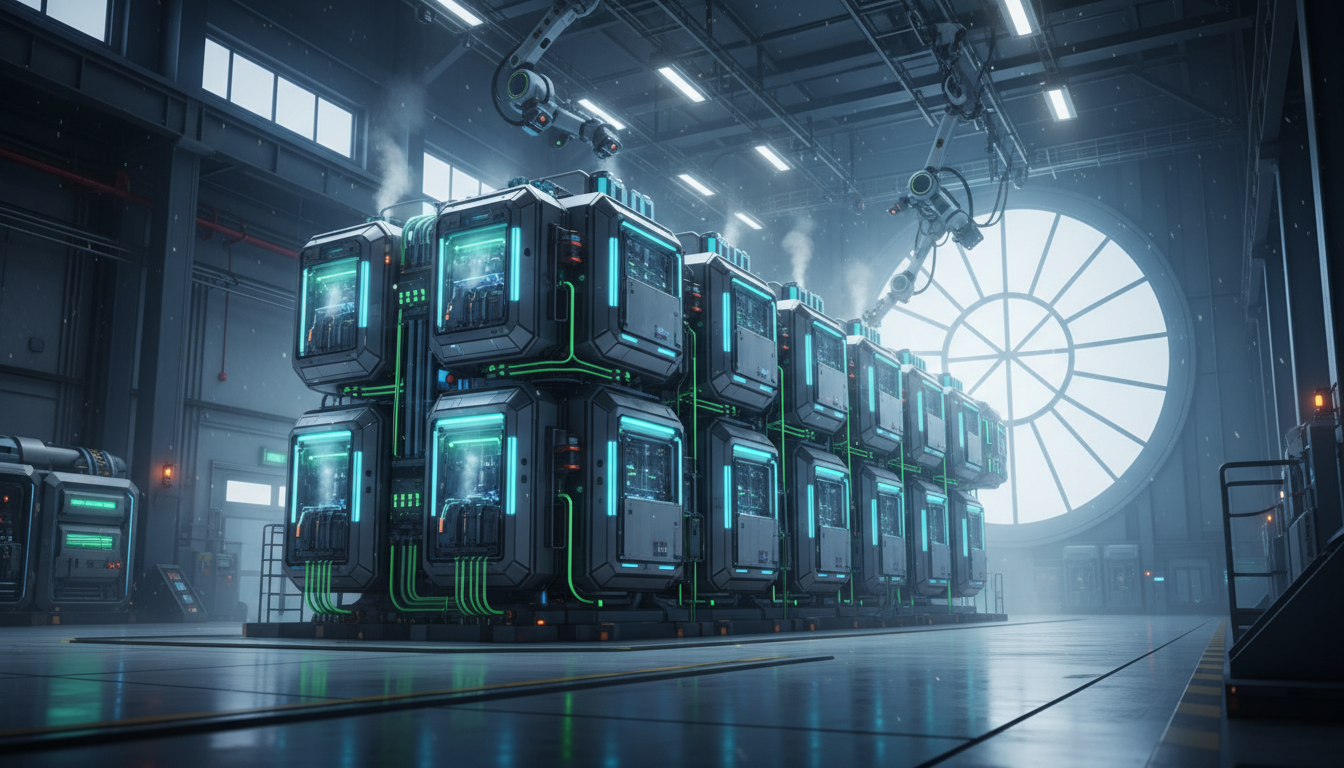
- Decentralization: Moves fertilizer production from massive industrial hubs to local, farm-scale modular units.
- Decarbonization: Eliminates the reliance on natural gas, potentially reducing global carbon emissions by 2%.
- Food Sovereignty: Empowers energy-rich but gas-poor regions to produce internal agricultural inputs independently.
On This Page
The Limitations of Haber-Bosch and the Rise of Electrochemistry
For over a century, the Haber-Bosch process has served as the backbone of global agriculture, providing the nitrogen necessary to sustain billions of people worldwide.
While revolutionary, this thermochemical method requires extreme pressures and temperatures, typically exceeding 400 degrees Celsius and 200 atmospheres, to break the strong triple bond.
The process is fundamentally tethered to fossil fuels, primarily natural gas, which serves as both the energy source and the hydrogen feedstock for the synthesis.
Consequently, the global food chain remains vulnerable to the volatility of energy markets, where spikes in gas prices directly translate into higher grocery costs.
Environmental concerns are equally pressing, as Haber-Bosch is responsible for roughly 1.4 percent of total global carbon dioxide emissions due to its massive scale.
The emergence of electrochemical nitrogen reduction offers a sustainable alternative, allowing for ambient temperature synthesis powered entirely by renewable electricity and water.
Energy Intensity and Carbon Footprint
The thermodynamic requirements of traditional ammonia synthesis are immense, consuming nearly 2 percent of the world's total energy production every single year.
Methane steam reforming, the primary method for hydrogen production in this context, releases significant amounts of greenhouse gases as a byproduct of the reaction.
This carbon footprint is no longer compatible with global net-zero targets, necessitating a shift toward "Green Ammonia" produced via electrolysis and nitrogen fixation.
Electrochemical methods bypass the carbon-intensive reforming stage, utilizing protons derived directly from water splitting to hydrogenate atmospheric nitrogen into ammonia molecules.
By operating at lower temperatures, these systems minimize the thermal energy losses inherent in high-heat industrial processes, improving overall system-wide energy efficiency.
The carbon intensity of the food supply chain could be slashed by over 90 percent if electrochemical synthesis becomes the primary method for fertilizer production.
The Centralization Bottleneck
Haber-Bosch plants are massive, centralized facilities that require billions of dollars in capital expenditure and extensive infrastructure to operate and distribute products.
This centralization creates a fragile supply chain where geopolitical instability or logistics disruptions can lead to localized fertilizer shortages and subsequent crop failures.
Farmers in remote or developing regions often pay a significant premium for fertilizer due to the high costs associated with long-distance transportation and storage.
The reliance on a few global production hubs leaves the agricultural sector exposed to systemic risks, as seen during recent global energy crises and conflicts.
Decentralization through modular electrochemical units allows for "on-demand" production, where fertilizer is synthesized exactly where and when it is needed on the farm.
This shift empowers small-scale farmers, providing them with the tools to manage their own nutrient cycles without dependency on international chemical conglomerates.
Calculate the theoretical mass of ammonia (##NH_3##) produced if a constant current of 500 Amperes is applied to an electrochemical cell for 24 hours, assuming a Faradaic efficiency (##\eta##) of 65% for the Nitrogen Reduction Reaction (NRR).
The reaction is: ###[N_2 + 6H^+ + 6e^- \rightarrow 2NH_3]###
Solution:
1. Total Charge (##Q##) = ##I \times t = 500 \, A \times (24 \times 3600) \, s = 43,200,000 \, C##.
2. Moles of electrons (##n_e##) = ##Q / F = 43,200,000 / 96485 \approx 447.74 \, mol##.
3. Moles of ##NH_3## (theoretical) = ##n_e \times (2/6) \approx 149.25 \, mol##.
4. Moles of ##NH_3## (actual) = ##149.25 \times 0.65 \approx 97.01 \, mol##.
5. Mass of ##NH_3## = ##97.01 \, mol \times 17.03 \, g/mol \approx 1652.1 \, g## or ##1.65 \, kg##.
Mechanism of Electrochemical Nitrogen Reduction
The Nitrogen Reduction Reaction (NRR) involves the multi-step transfer of six protons and six electrons to a nitrogen molecule to produce two ammonia molecules.
This process is notoriously difficult because the ##N \equiv N## triple bond has an extremely high dissociation energy of approximately 941 kilojoules per mole.
In an electrochemical cell, the nitrogen gas is reduced at the cathode, while water is oxidized at the anode to provide the necessary protons.
A major technical hurdle is the Hydrogen Evolution Reaction (HER), which competes with NRR for electrons and often dominates in aqueous environments.
Achieving high selectivity for ammonia requires specialized catalysts and electrolyte environments that suppress hydrogen gas formation while facilitating nitrogen adsorption and activation.
Recent breakthroughs in non-aqueous electrolytes and solid-state proton conductors have shown promise in improving the Faradaic efficiency of these electrochemical systems.
Ruthenium-Based Electrocatalysts
Ruthenium has emerged as a premier candidate for NRR catalysts due to its optimal d-band position, which balances nitrogen adsorption and product desorption.
Unlike iron-based catalysts used in Haber-Bosch, ruthenium-based systems can operate effectively at lower temperatures and pressures, making them ideal for modular electrochemical units.
Researchers are now engineering ruthenium nanoparticles on conductive supports like carbon nanotubes or metal-organic frameworks to maximize the available active surface area.
Doping these catalysts with alkali metals or other transition elements can further tune the electronic environment, enhancing the rate of nitrogen fixation significantly.
The stability of these catalysts remains a critical area of study, as the harsh electrochemical environment can lead to surface poisoning or structural degradation.
Advanced characterization techniques, such as in-situ spectroscopy, allow scientists to observe the reaction intermediates on the ruthenium surface in real-time during synthesis.
Overcoming the Scaling Challenges
Scaling electrochemical ammonia production requires addressing the mass transport limitations of nitrogen gas, which has low solubility in most liquid electrolytes.
Gas diffusion electrodes (GDEs) are being developed to provide a high-surface-area interface where gas, liquid, and solid catalyst phases meet for efficient reaction.
Managing the heat generated during electrolysis is also vital, as localized temperature spikes can alter catalyst selectivity and reduce the lifespan of the membranes.
The integration of these cells into stacks, similar to hydrogen fuel cells, allows for scalable power and production capacity to meet varying agricultural demands.
System-level optimizations, including electrolyte recycling and automated pH control, are necessary to ensure the long-term autonomous operation of modular fertilizer units.
Economic viability depends on reducing the cost of the catalyst materials and improving the current density to achieve commercially relevant production rates.
Determine the theoretical minimum cell potential (##E_{cell}##) required for the electrochemical synthesis of ammonia from nitrogen and water at standard conditions (##298 \, K##).
The overall reaction is: ###[N_2(g) + 3H_2O(l) \rightarrow 2NH_3(g) + 1.5O_2(g)]###
Given: ##\Delta G_f^\circ (NH_3) = -16.45 \, kJ/mol## and ##\Delta G_f^\circ (H_2O) = -237.13 \, kJ/mol##.
Solution:
1. Calculate ##\Delta G_{rxn}^\circ##: ##\Delta G_{rxn}^\circ = [2 \times (-16.45) + 1.5 \times 0] - [0 + 3 \times (-237.13)] = -32.9 + 711.39 = 678.49 \, kJ##.
2. For 2 moles of ##NH_3##, ##n = 6## electrons are transferred.
3. Use the relation ##\Delta G^\circ = -nFE_{cell}^\circ##.
4. ##E_{cell}^\circ = -\Delta G^\circ / (nF) = -678,490 / (6 \times 96485) \approx -1.17 \, V##.
The negative sign indicates that energy must be supplied; thus, the minimum voltage is ##1.17 \, V##.
Recommended Reads
The Economic Impact of Decentralized Production
Decentralized ammonia production represents a tectonic shift in the economic landscape of the chemical industry, challenging the traditional "economy of scale" model.
By moving production closer to the end-user, the industry can eliminate the massive costs associated with the storage and transport of hazardous anhydrous ammonia.
This model favors "economies of unit," where mass-produced modular reactors benefit from standardized manufacturing processes and rapid deployment across diverse geographical regions.
Small-scale farmers gain the ability to produce fertilizer as a service, potentially using excess energy from on-site solar or wind installations to lower costs.
The financial risk for farmers is reduced, as they are no longer dependent on the volatile pricing of global fertilizer markets and shipping lanes.
Investors are increasingly looking toward "Ag-Tech" platforms that integrate renewable energy generation with electrochemical synthesis as a high-growth, sustainable asset class.
Decoupling Food from Natural Gas
Historically, the price of nitrogen fertilizer has tracked the price of natural gas with high correlation, leading to food inflation during energy shortages.
Electrochemical ammonia breaks this link by substituting fossil fuel feedstocks with electricity, which is becoming increasingly cheap and abundant through renewable sources.
This decoupling provides a powerful hedge against geopolitical shocks that often disrupt gas supplies, ensuring a more stable and predictable food pricing environment.
As the cost of solar and wind energy continues to plummet, the operational expense of green ammonia synthesis will eventually underprice traditional Haber-Bosch methods.
Governments can enhance national food security by subsidizing the transition to electrochemical systems, reducing their reliance on imported energy and chemical inputs.
The shift to green ammonia also aligns with global carbon pricing mechanisms, which will increasingly penalize the high-emissions profile of traditional fertilizer production plants.
Localized Agriculture in Emerging Markets
Regions like Sub-Saharan Africa and South America possess vast renewable energy potential but often lack the natural gas reserves needed for traditional fertilizer manufacturing.
Electrochemical technology allows these regions to leapfrog centralized industrialization, moving directly to a decentralized, renewable-based agricultural economy that supports local food sovereignty.
Localized production reduces the "yield gap" in developing nations by making fertilizer accessible and affordable to smallholder farmers who were previously priced out.
By producing fertilizer locally, these nations can keep capital within their borders, stimulating economic growth and creating high-tech jobs in the rural agricultural sector.
The ability to produce ammonia on-site also facilitates the development of micro-grids, where fertilizer production acts as a flexible load for intermittent renewable energy.
This synergy between energy and agriculture creates a resilient foundation for sustainable development, empowering communities to grow their own food and generate their power.
Future Outlook and Technical Implementation
The future of ammonia production lies in the integration of smart sensors, automated control systems, and high-efficiency electrochemical cells into user-friendly modular packages.
Ongoing research into "Single Atom Catalysts" (SACs) promises to push the boundaries of Faradaic efficiency, potentially reaching levels previously thought impossible at ambient conditions.
Hybrid systems that combine electrochemical synthesis with biological nitrogen fixation are also being explored to create multi-layered, highly resilient agricultural nutrient management systems.
As the technology matures, we expect to see standardized "Ammonia-in-a-Box" units becoming as common on modern farms as tractors or irrigation systems are today.
The digital twin of these modular units will allow for remote monitoring and predictive maintenance, ensuring high uptime and optimized performance across global fleets.
Ultimately, the transition to electrochemical ammonia is not just a chemical upgrade; it is a fundamental reimagining of how we feed the world sustainably.
Modular Hardware and Ag-Tech Integration
Modular ammonia hardware is designed for rapid deployment, often housed in standard shipping containers that can be easily transported via truck, rail, or ship.
These units include integrated water purification, nitrogen separation from the air, and the electrochemical reactor stack, providing a true "plug-and-play" fertilizer solution.
Integration with precision agriculture software allows the units to adjust production based on soil sensor data, weather forecasts, and specific crop nutrient requirements.
The use of advanced materials, such as 3D-printed electrodes and high-performance membranes, is driving down the weight and cost of these modular hardware systems.
Ag-tech companies are developing financing models, such as "Fertilizer-as-a-Service," where farmers pay for the nutrients produced rather than owning the hardware itself.
This servitization model lowers the barrier to entry for small farms, accelerating the adoption of green technology across the global agricultural landscape and markets.
Long-Term Structural Shifts in Chemical Markets
The rise of green ammonia will lead to a long-term structural decline in natural gas demand, as the chemical industry is its largest industrial consumer.
Traditional chemical giants are pivotally investing in electrochemical R&D to avoid being left behind by the rapid decentralization of their core product markets.
New market entrants, from energy startups to tech firms, are disrupting the status quo with innovative business models centered around decentralized chemical manufacturing and distribution.
Ammonia itself is gaining traction as a carbon-free maritime fuel and a long-term energy storage medium, further expanding the market for electrochemical synthesis technologies.
Regulatory frameworks are evolving to support the certification of "Green Ammonia," creating premium markets for fertilizers with low carbon intensity and sustainable origins.
The convergence of energy, chemistry, and agriculture is creating a new industrial paradigm where sustainability and profitability are no longer mutually exclusive goals.
Calculate the specific energy consumption (##SEC##) in ##kWh/kg## of ammonia produced by a modular electrochemical unit operating at an average cell voltage of ##2.2 \, V## with a Faradaic efficiency of ##70\%##.
Solution:
1. The energy required to produce 1 mole of ##NH_3## is given by ##E_{mol} = (n \times F \times V_{cell}) / \eta##, where ##n=3## electrons per mole of ##NH_3##.
2. ##E_{mol} = (3 \times 96485 \, C/mol \times 2.2 \, V) / 0.70 \approx 909,715 \, J/mol##.
3. Convert Joules to ##kWh##: ##1 \, J = 2.777 \times 10^{-7} \, kWh##.
4. ##E_{mol} (kWh) = 909,715 \times 2.777 \times 10^{-7} \approx 0.2526 \, kWh/mol##.
5. Calculate ##SEC## per kg: ##SEC = E_{mol} / M_{NH_3} = 0.2526 \, kWh/mol / 0.01703 \, kg/mol \approx 14.83 \, kWh/kg##.
This value is significantly higher than Haber-Bosch (approx. ##8-12 \, kWh/kg##), highlighting the need for further efficiency improvements.
From our network :
- Analyzing Trump Deportation Numbers Insights Into The 2026 Immigration Crackdown
- Trump Political Strategy How Geopolitical Stunts Serve As Media Diversions
- 10 Physics Numerical Problems with Solutions for IIT JEEPrepare for IIT JEE with 10 physics numerical problems, complete with detailed solutions and conceptual explanations. Ideal for mastering kinematics, thermodynamics, electromagnetism, and optics.
- Vite 6/7 'Cold Start' Regression in Massive Module GraphsIn-depth analysis of Vite 6/7 cold start regressions in massive module graphs. Learn about barrel file issues, pre-bundling optimizations, and how to improve Vite dev server performance.
- EV 2.0: The Solid-State Battery Breakthrough and Global Factory ExpansionDiscover the impact of the Solid-State Battery Breakthrough on the EV market. Learn about CATL and BYD stock growth, global factory expansion in Europe, and the future of EV 2.0 technology.
- 98% of Global MBA Programs Now Prefer GRE Over GMAT Focus EditionExplore why 98% of global MBA programs now prefer the GRE over GMAT Focus. Learn about the shorter GRE format, verbal logic importance, and strategic versatility for students.
- Mastering DB2 LUW v12 Tables: A Comprehensive Technical GuideComprehensive guide on DB2 LUW v12 tables. Explore CREATE TABLE syntax, BLU Acceleration, range partitioning, data types, and security features for IBM DB2 LUW v12.
- Mastering DB2 12.1 Instance Design: A Technical Deep Dive into Modern Database ArchitectureComprehensive guide to DB2 12.1 Instance Design. Explore architectural components, HADR setup, buffer pool tuning, and security policies for IBM DB2 12.1. Includes 10 functional SQL and Shell samples.
- AI-Powered 'Precision Diagnostic' Replaces Standard GRE Score ReportsDiscover the new GRE Precision Diagnostic. Learn how AI-powered behavioral analytics and time-to-solve tracking are replacing standard GRE score reports to empower students.
RESOURCES
- No query provided.

0 Comments