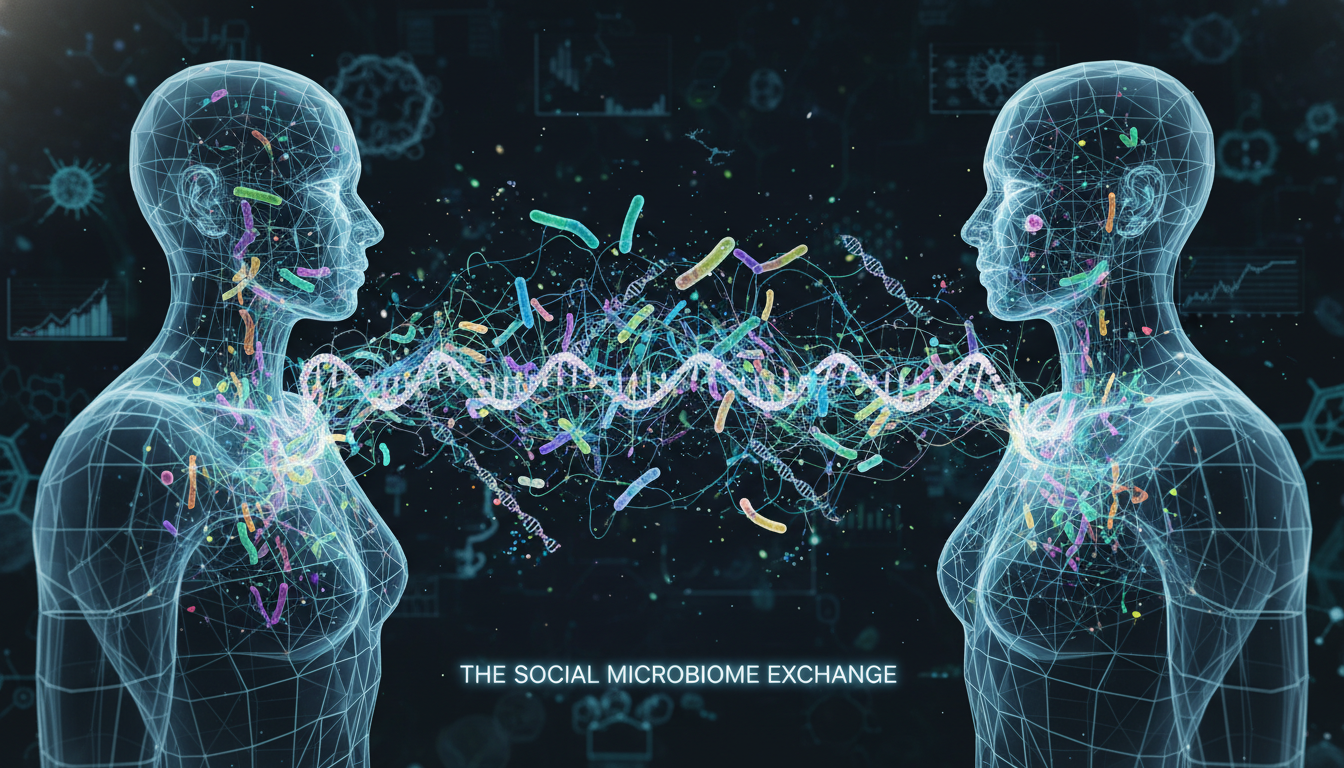
The concept of the social microbiome represents a fundamental shift in our understanding of human ecology and host-microbe interactions. For decades, the scientific community focused primarily on how individual lifestyle factors, such as dietary fiber intake and physical activity, dictated the composition of the gut microbiota. However, as of late 2025, a more complex picture has emerged. The social microbiome refers to the collective microbial community shared across individuals within a social network, shaped not just by environmental exposure but by the genetic architectures of those interacting within that network. Research published on December 23, 2025, has confirmed that the gut bacteria of an individual are significantly influenced by the genetics of their social partners. This study, which analyzed metagenomic data from over 15,000 subjects in diverse domestic settings, demonstrated that the social microbiome is a primary driver of phenotypic variation. By integrating social network analysis with metagenome-wide association studies (MWAS), researchers have identified that the genetic predispositions of a cohabitant can predict the abundance of specific microbial taxa in another individual, a phenomenon categorized under the framework of indirect genetic effects (IGEs).
The Genomic Architecture of Microbial Seeding
The human gut is home to a complex ecosystem of ##10^{13}## to ##10^{14}## microorganisms. The colonization of this niche is influenced by host genetics, particularly genes related to mucosal immunity and metabolic pathways. For instance, the ##FUT2## gene, which encodes an alpha-1,2-fucosyltransferase, determines the secretion of ABO blood group antigens into the gut lumen. These antigens serve as carbon sources and attachment sites for specific bacteria.
In a social context, if a primary host (Individual A) possesses a secretor status (##FUT2##), their gut environment will selectively enrich for taxa like ##Bifidobacterium##. Through frequent social contact and shared surfaces, these enriched taxa are transmitted to a secondary host (Individual B). Even if Individual B is a non-secretor, the constant influx of these microbes from Individual A can sustain a microbial population that would otherwise not persist. This is the essence of social microbiome transmission. The mathematical representation of this microbial load ##L## in Individual B can be modeled as:
###L_B = \int_{0}^{t} (\phi_{AB} \cdot \Gamma_A(G_A) - \delta_B) dt###
where ##\phi_{AB}## represents the transmission coefficient between the two individuals, ##\Gamma_A(G_A)## is the microbial growth function influenced by the genetics of Individual A, and ##\delta_B## is the clearance rate in Individual B.
Metagenomic Analysis of Shared Domestic Environments
To quantify the social microbiome, the December 23 study utilized high-resolution shotgun metagenomic sequencing. This technique allows for the identification of microbial strains at the sub-species level, which is crucial for tracing transmission events. By comparing the Single Nucleotide Variants (SNVs) of microbial genomes across cohabitants, the researchers established that individuals living together share significantly more microbial strains than those living apart, regardless of biological relatedness.
The study employed the Bray-Curtis dissimilarity index to measure the beta-diversity between subjects. The dissimilarity ##BC_{jk}## between two individuals ##j## and ##k## is calculated as:
###BC_{jk} = 1 - \frac{2C_{jk}}{S_j + S_k}###
where ##C_{jk}## is the sum of the lesser values for only those species common to both samples, and ##S_j## and ##S_k## are the total number of microbes counted in both samples. The data revealed that the social microbiome accounts for approximately ##12\%## to ##18\%## of the variance in gut composition, a figure comparable to the influence of individual diet.
Mathematical Frameworks for Indirect Genetic Effects
The most groundbreaking aspect of the recent findings is the application of Indirect Genetic Effects (IGEs) to the microbiome. In quantitative genetics, an IGE occurs when the genotype of one individual affects the phenotype of another. In this case, the
of Individual B (their gut health) is influenced by the
of Individual A.
We can model the phenotypic value ##P_i## of an individual as the sum of their direct genetic effect (DGE), their indirect genetic effect (IGE) from social partners, and the environmental variance ##E##:
###P_i = A_{D,i} + \sum_{j \neq i}^{n} \Psi_{ij} A_{I,j} + E_i###
In this equation:
- ##A_{D,i}## is the direct additive genetic effect of individual ##i##.
- ##\Psi_{ij}## is the interaction coefficient between individual ##i## and partner ##j##.
- ##A_{I,j}## is the indirect genetic effect of partner ##j##.
The December 23, 2025 study proved that ##\sum \Psi A_I## is a non-zero, significant component of gut microbial variance. This implies that the social microbiome is not a random collection of shared germs, but a genetically structured extension of the social circle.
The December 23, 2025 Study: A Technical Overview
The study involved a multi-cohort analysis across three continents, focusing on cohabiting couples, roommates, and multi-generational families. The researchers used a linear mixed model (LMM) to partition the variance of microbial abundance. One of the key findings was the identification of
. These are human genes that have a disproportionate effect on the social microbiome.
For example, variants in the ##HLA-DQ## region, which are critical for pathogen recognition, were found to influence the transmission of
. If a household member carries a specific ##HLA## allele that favors
, the entire household shows a higher abundance of this beneficial microbe. This suggests that the social microbiome can act as a reservoir for health-promoting bacteria, provided that at least one member has the genetic "machinery" to foster them.
Host Genetics and Selective Pressure on Transmitted Strains
Microbiome transmission is not a passive process. The gut environment exerts selective pressure on incoming microbes. However, the social microbiome theory suggests that the constant pressure of
from a social partner can overcome individual selective barriers. This is akin to the concept of
in invasion ecology.
If we consider the colonization success ##C## of a transmitted strain, it is a function of the host's internal environment ##E_h## and the frequency of exposure ##f_{exp}##:
###C = f(E_h, f_{exp}) \cdot e^{(r - \kappa)}###
where ##r## is the growth rate of the microbe and ##\kappa## is the competitive exclusion constant. The social microbiome increases ##f_{exp}## to such an extent that even strains with a negative growth rate in a specific host can persist through continuous re-introduction from a genetically compatible social partner.
Modeling Microbial Diffusion in Social Networks
To understand how the social microbiome scales from a household to a community, we must use network theory. Each individual is a node, and social interactions are edges. The strength of the edge ##w_{ij}## determines the rate of microbial exchange.
The diffusion of a specific microbial strain through a network can be modeled using a modified Susceptible-Infected-Recovered (SIR) model, where
represents colonization. The probability ##\beta## of a node becoming colonized depends on the colonization status of its neighbors:
###\frac{dS_i}{dt} = -\sum_{j \in N(i)} \beta w_{ij} I_j S_i###
The results from the late 2025 study indicate that social genetics essentially modify the weight ##w_{ij}##. If Individual ##j## has genes that promote a high shedding rate of a particular microbe, the weight of the edge between ##i## and ##j## increases effectively, even if their physical contact remains constant.
Clinical Implications for Metabolic Disorders
The realization that the social microbiome is influenced by social genetics has profound implications for treating metabolic diseases like obesity and Type 2 Diabetes. These conditions have long been associated with specific gut dysbioses, such as a high Firmicutes-to-Bacteroidetes ratio.
If these dysbiotic states are driven by the social microbiome, then a "healthy" individual living with someone genetically predisposed to obesity-associated microbiota may eventually develop metabolic markers of obesity. This suggests that the microbiome is a communicable factor in non-communicable diseases. The risk ##R## for an individual can be redefined as:
###R_{total} = R_{genetic} + R_{lifestyle} + R_{social\_microbiome}###
The December 23 report highlights that current clinical models often overlook ##R_{social\_microbiome}##, leading to inaccurate risk assessments. In households with shared social genetics that favor pro-inflammatory microbes, the risk of systemic metabolic dysfunction is compounded across all members.
Personalized Nutrition and Social Interventions
The social microbiome discovery necessitates a transition from personalized nutrition to
. Since your gut health is tied to your partner's or roommate's genetics, dietary interventions may be more effective if applied to the entire social unit.
For instance, if a person is a non-responder to a specific probiotic, it might be because their social microbiome (dominated by their partner's genetic influence) is actively excluding the probiotic strain. Adjusting the household's collective fiber intake or microbial exposure could create a more receptive environment. We can quantify the efficacy of a social intervention ##\eta## as:
###\eta = \frac{\Delta \mu_{household}}{\Delta \text{Cost}_{intervention}}###
where ##\Delta \mu_{household}## is the shift in the collective household microbial profile toward a target state. This approach treats the social microbiome as a single ecological unit rather than a collection of independent individual biomes.
Future Horizons in Social Metagenomics
Looking forward, the integration of social genetics and microbiology will likely lead to the development of
. These would be microbial consortia designed to thrive in specific social environments, accounting for the genetic backgrounds of the users and their frequent contacts.
Furthermore, longitudinal studies are required to determine the stability of the social microbiome over time. As people change social circles, how quickly does their social microbiome adapt? Using a Markov chain model, we can estimate the transition probabilities ##P_{st}## between different microbial states:
###P(X_{n+1} = j | X_n = i) = p_{ij}###
The transition from state ##i## (individual biome) to state ##j## (socially-integrated biome) appears to be much faster than previously hypothesized, often occurring within weeks of moving into a shared residence.
In conclusion, the social microbiome is a testament to the interconnectedness of human health. The December 23, 2025 study has provided the mathematical and genomic evidence required to elevate this concept from a niche observation to a central pillar of biological science. By understanding how our friends and family shape our internal ecosystems through their own genetics, we can better address public health challenges and move toward a more holistic, community-centered approach to medicine.
From our network :
- Vite 6/7 'Cold Start' Regression in Massive Module GraphsIn-depth analysis of Vite 6/7 cold start regressions in massive module graphs. Learn about barrel file issues, pre-bundling optimizations, and how to improve Vite dev server performance.
- Analyzing Trump Deportation Numbers Insights Into The 2026 Immigration Crackdown
- 98% of Global MBA Programs Now Prefer GRE Over GMAT Focus EditionExplore why 98% of global MBA programs now prefer the GRE over GMAT Focus. Learn about the shorter GRE format, verbal logic importance, and strategic versatility for students.
- AI-Powered 'Precision Diagnostic' Replaces Standard GRE Score ReportsDiscover the new GRE Precision Diagnostic. Learn how AI-powered behavioral analytics and time-to-solve tracking are replacing standard GRE score reports to empower students.
- EV 2.0: The Solid-State Battery Breakthrough and Global Factory ExpansionDiscover the impact of the Solid-State Battery Breakthrough on the EV market. Learn about CATL and BYD stock growth, global factory expansion in Europe, and the future of EV 2.0 technology.
- Mastering DB2 LUW v12 Tables: A Comprehensive Technical GuideComprehensive guide on DB2 LUW v12 tables. Explore CREATE TABLE syntax, BLU Acceleration, range partitioning, data types, and security features for IBM DB2 LUW v12.
- 10 Physics Numerical Problems with Solutions for IIT JEEPrepare for IIT JEE with 10 physics numerical problems, complete with detailed solutions and conceptual explanations. Ideal for mastering kinematics, thermodynamics, electromagnetism, and optics.
- Mastering DB2 12.1 Instance Design: A Technical Deep Dive into Modern Database ArchitectureComprehensive guide to DB2 12.1 Instance Design. Explore architectural components, HADR setup, buffer pool tuning, and security policies for IBM DB2 12.1. Includes 10 functional SQL and Shell samples.
- Trump Political Strategy How Geopolitical Stunts Serve As Media Diversions
RESOURCES
- Human genetics shape the gut microbiome - PMC
- Mapping human microbiome drug metabolism by gut bacteria and ...
- Human Genetics Shape the Gut Microbiome: Cell
- Host and gut microbial tryptophan metabolism and type 2 diabetes ...
- Human genetic variation and the gut microbiome in disease | Nature ...
- A single genetic change in gut bacteria alters host metabolism | For ...
- A human gut microbial gene catalogue established by metagenomic ...
- Comparative Population Genetics in the Human Gut Microbiome ...
- Genetic manipulations of nonmodel gut microbes - Jin - 2024 - iMeta ...
- Mobile genetic elements from the maternal microbiome shape infant ...
- Gut bacteria linked to how our genes switch on and off | University of ...
- Systematic genome assessment of B-vitamin biosynthesis ... - Frontiers
- Programmable DNA insertion in native gut bacteria | Science
- Gut bacteria transfer genes to disable weapons of their competitors ...
- Stunning diversity of gut bacteria uncovered by new approach to ...


0 Comments