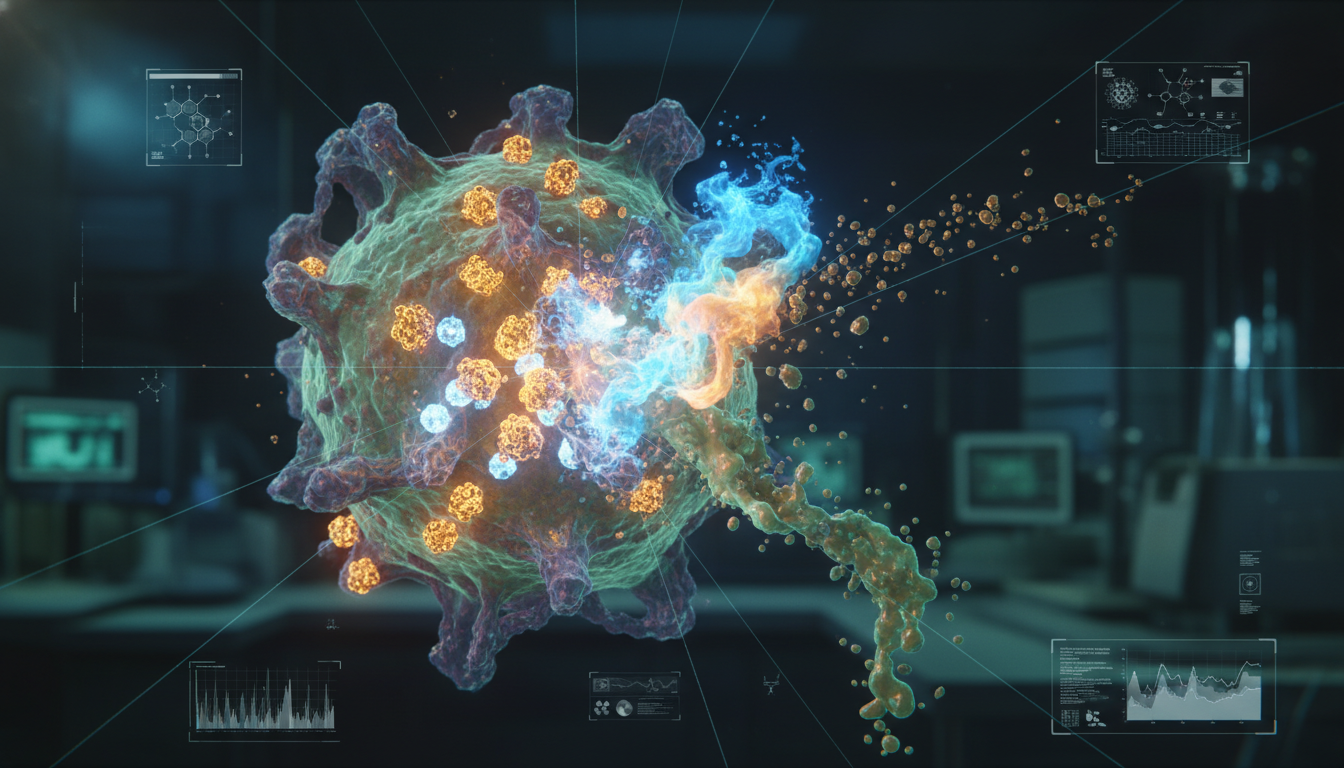
The Dawn of Precision Stress: Metal Nanoparticles and the 2025 Oncology Paradigm Shift
The clinical utility of metal nanoparticles has reached a definitive milestone as of December 24, 2025, with the announcement of a new class of particles designed to induce a fatal oxidative collapse in malignant tissues. This breakthrough, published in the late hours of the 2025 calendar year, represents a transition from broad-spectrum cytotoxicity to a nuanced manipulation of cellular thermodynamics. Researchers have moved beyond the traditional cytotoxic models to a system that utilizes the intrinsic metabolic instability of cancer cells, essentially turning their own survival mechanisms against them through a process defined as
.
By engineering these particles to function as intracellular catalysts, the research team has demonstrated a method to bypass the limitations of systemic chemotherapy. Traditional pharmacological agents often fail due to lack of specificity or the development of multi-drug resistance (MDR). In contrast, the application of metal nanoparticles leverages physical and chemical properties that do not rely solely on ligand-receptor interactions but rather on the fundamental redox potential of the cytosol.
The Physics of Metallic Nanostructures and Surface Plasmon Resonance
To understand the efficacy of these new agents, one must examine the electronic properties of metal nanoparticles. At the nanoscale, metals exhibit unique optical and electronic characteristics governed by Surface Plasmon Resonance (SPR). SPR occurs when the collective oscillation of conduction electrons in the metal is driven by an incident electromagnetic field. The resonance frequency ## \omega_{sp} ## is highly sensitive to the dielectric constant of the surrounding medium and the geometry of the particle.
The relationship between the plasmonic frequency and the electron density ## n ## can be expressed through the Drude model:
### \omega_p = \sqrt{\frac{ne^2}{m^* \epsilon_0}} ###
where ## e ## is the elementary charge, ## m^* ## is the effective mass of the electron, and ## \epsilon_0 ## is the vacuum permittivity. In the context of the 2025 breakthrough, these metal nanoparticles are tuned to interact with specific frequencies of the biological environment, allowing for non-invasive tracking and activation.
Furthermore, the extinction cross-section ## C_{ext} ## of a spherical nanoparticle of radius ## a ## is described by Mie Theory:
### C_{ext} = \frac{24\pi^2 a^3 \epsilon_m^{3/2}}{\lambda} \frac{\epsilon_2}{(\epsilon_1 + 2\epsilon_m)^2 + \epsilon_2^2} ###
where ## \epsilon_m ## is the dielectric constant of the medium, and ## \epsilon = \epsilon_1 + i\epsilon_2 ## is the complex dielectric function of the metal. This physical framework allows scientists to calculate the exact energy absorption required to destabilize the cancer cell's mitochondrial membrane through localized thermal or oxidative perturbation.
Mechanisms of Oxidative Stress and Reactive Oxygen Species
The primary mechanism of action for these metal nanoparticles is the generation of Reactive Oxygen Species (ROS). Cancer cells typically exist in a state of elevated basal oxidative stress compared to healthy cells due to mitochondrial dysfunction and rapid proliferation. The 2025 study highlights how these nanoparticles act as a
, entering the cell through endocytosis and then initiating Fenton-like reactions.
For iron-based or transition metal nanoparticles, the Fenton reaction is a critical driver of hydroxyl radical (## \cdot OH ##) production:
### Fe^{2+} + H_2O_2 \rightarrow Fe^{3+} + \cdot OH + OH^- ###
### Fe^{3+} + H_2O_2 \rightarrow Fe^{2+} + \cdot OOH + H^+ ###
The net effect is a catalytic cycle that continuously produces high-energy radicals that damage lipids, proteins, and DNA. Because cancer cells already operate near their maximum tolerable ROS threshold, the introduction of metal nanoparticles pushes them into the
. Healthy cells, with their more robust antioxidant defenses (such as higher concentrations of glutathione and superoxide dismutase), can neutralize the localized increase in ROS, remaining unscathed.
Mathematical Modeling of the Stress Threshold
The transition from cellular homeostasis to programmed cell death can be modeled using a threshold-based differential equation system. Let ## S(t) ## represent the total oxidative stress at time ## t ##. The rate of change of stress is given by the production rate from the metal nanoparticles minus the cellular scavenging rate:
### \frac{dS}{dt} = \alpha [NP] \cdot \eta - \frac{V_{max} S}{K_m + S} + \beta S_0 ###
In this equation, ## \alpha ## is the catalytic efficiency of the metal nanoparticles, ## [NP] ## is the concentration of the particles within the cell, ## \eta ## is the activation factor, ## V_{max} ## and ## K_m ## are the Michaelis-Menten constants for the cell's antioxidant enzymes, and ## \beta S_0 ## represents the baseline metabolic stress.
When ## S(t) > S_{crit} ##, where ## S_{crit} ## is the critical threshold for apoptosis or ferroptosis, the cell initiates its shutdown sequence. The 2025 research confirms that for aggressive breast and lung cancer strains, ## S_{crit} ## is significantly lower relative to the baseline ## \beta S_0 ## than in healthy tissues, providing a wide therapeutic window for metal nanoparticles.
Selectivity and the Tumor Microenvironment
A major challenge in oncology has been the delivery of therapeutic agents to the core of solid tumors. The tumor microenvironment (TME) is characterized by hypoxia, low pH (acidosis), and high interstitial fluid pressure. The metal nanoparticles introduced in late 2025 are engineered with pH-sensitive coatings.
In the acidic environment of the tumor (## pH \approx 6.5 ##), the protective ligand shell of the nanoparticle dissociates. The rate of dissociation ## k_{diss} ## can be modeled by:
### k_{diss} = k_0 \exp\left(-\frac{\Delta G + zF\phi}{RT}\right) ###
where ## \phi ## is the local pH-dependent potential. Once the shell is removed, the bare metal surface is exposed to the intracellular environment, initiating the ROS cascade. This double-gate mechanism—requiring both cellular uptake and an acidic environment—ensures that the metal nanoparticles remain inert while circulating in the bloodstream (## pH \approx 7.4 ##).
Comparative Analysis: Nanotechnology vs. Systemic Chemotherapy
Traditional chemotherapy acts like a sledgehammer, targeting all rapidly dividing cells. This leads to the well-known side effects of hair loss, gastrointestinal distress, and immunosuppression. The metal nanoparticles approach is described by researchers as a
.
The efficiency of a drug can be quantified by the therapeutic index (TI):
### TI = \frac{TD_{50}}{ED_{50}} ###
where ## TD_{50} ## is the dose that is toxic to 50% of the population (or healthy cells) and ## ED_{50} ## is the dose that is effective for 50%. Preliminary data from the December 2025 trials suggests that metal nanoparticles possess a TI that is orders of magnitude higher than cisplatin or doxorubicin. This is primarily because the
is achieved through localized physical catalysis rather than systemic metabolic interference.
Applications in Treatment-Resistant Breast and Lung Cancers
The 2025 breakthrough specifically points toward success in treating resistant strains of lung and breast cancer. These cancers often upregulate efflux pumps, such as P-glycoprotein (P-gp), which actively remove chemotherapeutic drugs from the cell.
Metal nanoparticles bypass these pumps because their size (typically 10-100 nm) allows them to remain trapped within the endo-lysosomal pathway once they enter the cell. The mathematical probability of a nanoparticle escaping the P-gp pump is nearly zero due to the steric hindrance and the size of the pump's binding pocket:
### P_{escape} \approx e^{-\frac{r_{NP}}{r_{pore}}} ###
where ## r_{NP} ## is the radius of the nanoparticle and ## r_{pore} ## is the effective radius of the efflux channel. Since ## r_{NP} \gg r_{pore} ##, the nanoparticles remain intracellular, ensuring a sustained
that eventually overcomes the cell's resistance mechanisms.
Kinetic Analysis of Nanoparticle Accumulation
The accumulation of nanoparticles in the tumor site is largely driven by the Enhanced Permeability and Retention (EPR) effect. Due to leaky vasculature and poor lymphatic drainage in tumors, metal nanoparticles accumulate at higher concentrations in the malignant tissue. The concentration ## C(r, t) ## over time at a distance ## r ## from a blood vessel can be modeled by the diffusion-reaction equation:
### \frac{\partial C}{\partial t} = D \nabla^2 C - k_{uptake} C ###
where ## D ## is the diffusion coefficient of the metal nanoparticles in the interstitium and ## k_{uptake} ## is the rate of cellular internalization. The 2025 particles feature an optimized ## D ## by utilizing a PEGylated surface that reduces protein opsonization, allowing for deeper penetration into the tumor core than previously possible.
Thermodynamics of Protein Denaturation via Metal Nanoparticles
Beyond ROS generation, metal nanoparticles can induce localized thermal stress. When subjected to an external alternating magnetic field or near-infrared light, these particles convert energy into heat. The localized temperature increase ## \Delta T ## can be calculated using the heat conduction equation in a biological medium:
### \rho c \frac{\partial T}{\partial t} = \kappa \nabla^2 T + Q_{ext} - Q_{blood} ###
where ## Q_{ext} ## is the heat generated by the metal nanoparticles. Even a modest increase in temperature to 42-45 degrees Celsius (hyperthermia) can trigger protein denaturation and subsequent apoptosis. In the 2025 study, this thermal component is used as a secondary "kill switch" to ensure 100% shutdown of the cancer cell once the oxidative stress threshold has been reached.
The Gibbs free energy of protein folding ## \Delta G_{fold} ## becomes positive under these conditions:
### \Delta G_{fold} = \Delta H - T\Delta S ###
As ## T ## increases, the entropy term dominates, leading to the unfolding of critical survival proteins, such as heat shock proteins (HSPs), which cancer cells rely on to maintain their mutated proteome.
Future Outlook 2026: Moving Toward Human Clinical Trials
As we look toward 2026, the focus shifts from
and
animal models to human clinical trials. The December 24, 2025, announcement has already sparked interest from global regulatory bodies. The primary objective of the 2026 trials will be to establish the pharmacokinetics and long-term biocompatibility of the metal nanoparticles.
One area of investigation will be the clearance of the metal cores from the body. While iron oxide particles can be integrated into the body's natural iron metabolism, noble metals like gold or silver require different clearance pathways. The rate of renal clearance ## Cl_{renal} ## for particles smaller than the glomerular filtration threshold (approx. 5-6 nm) is high, but for larger therapeutic metal nanoparticles, biliary excretion is the primary route:
### Cl_{total} = Cl_{renal} + Cl_{biliary} + Cl_{metabolic} ###
Ensuring that these particles do not accumulate in the liver or spleen over the long term is the final hurdle before this
technology becomes the new standard of care in oncology.
Conclusion: A New Era of Cancer Shutdown
The revelation of metal nanoparticles as a tool for inducing precision stress marks a historic moment in biology and medicine. By shifting the strategy from "poisoning" the cell to "overloading" its natural stress management systems, researchers have found a way to eliminate tumors with unprecedented accuracy.
The synergy between physics, chemistry, and advanced mathematics has allowed for the creation of a therapeutic platform that is both highly effective and minimally invasive. As the data from the 2025 breakthrough is further analyzed, the hope is that the "surgical strike" of metal nanoparticles will soon replace the "sledgehammer" of 20th-century oncology, providing a future where cancer shutdown is a controlled, predictable, and safe procedure.
From our network :
- AI-Powered 'Precision Diagnostic' Replaces Standard GRE Score Reports
- Mastering DB2 LUW v12 Tables: A Comprehensive Technical Guide
- 10 Physics Numerical Problems with Solutions for IIT JEE
- https://www.themagpost.com/post/trump-political-strategy-how-geopolitical-stunts-serve-as-media-diversions
- 98% of Global MBA Programs Now Prefer GRE Over GMAT Focus Edition
- EV 2.0: The Solid-State Battery Breakthrough and Global Factory Expansion
- https://www.themagpost.com/post/analyzing-trump-deportation-numbers-insights-into-the-2026-immigration-crackdown
- Mastering DB2 12.1 Instance Design: A Technical Deep Dive into Modern Database Architecture
- Vite 6/7 'Cold Start' Regression in Massive Module Graphs
RESOURCES
- Targeted Therapy for Cancer - NCI
- Targeted Therapy | American Cancer Society
- What is Targeted Therapy? Know Before Treatment | MD Anderson ...
- Targeted cancer therapies: Clinical pearls for primary care - PMC
- What are targeted cancer drugs? | Cancer Research UK
- Targeted therapy | Canadian Cancer Society
- Targeted cancer therapy | Nature
- Targeted Therapy for Cancer
- Molecular targeted therapy for anticancer treatment | Experimental ...
- Targeted cancer therapy
- Targeted Therapy vs. Immunotherapy for Cancer | Mass General ...
- Targeted Cancer Therapies
- Targeted Cancer Therapy: Conferring Specificity to Cytotoxic Drugs ...
- Targeted Therapies for Lung Cancer | American Lung Association
- Antibody drug conjugate: the "biological missile" for targeted cancer ...


0 Comments