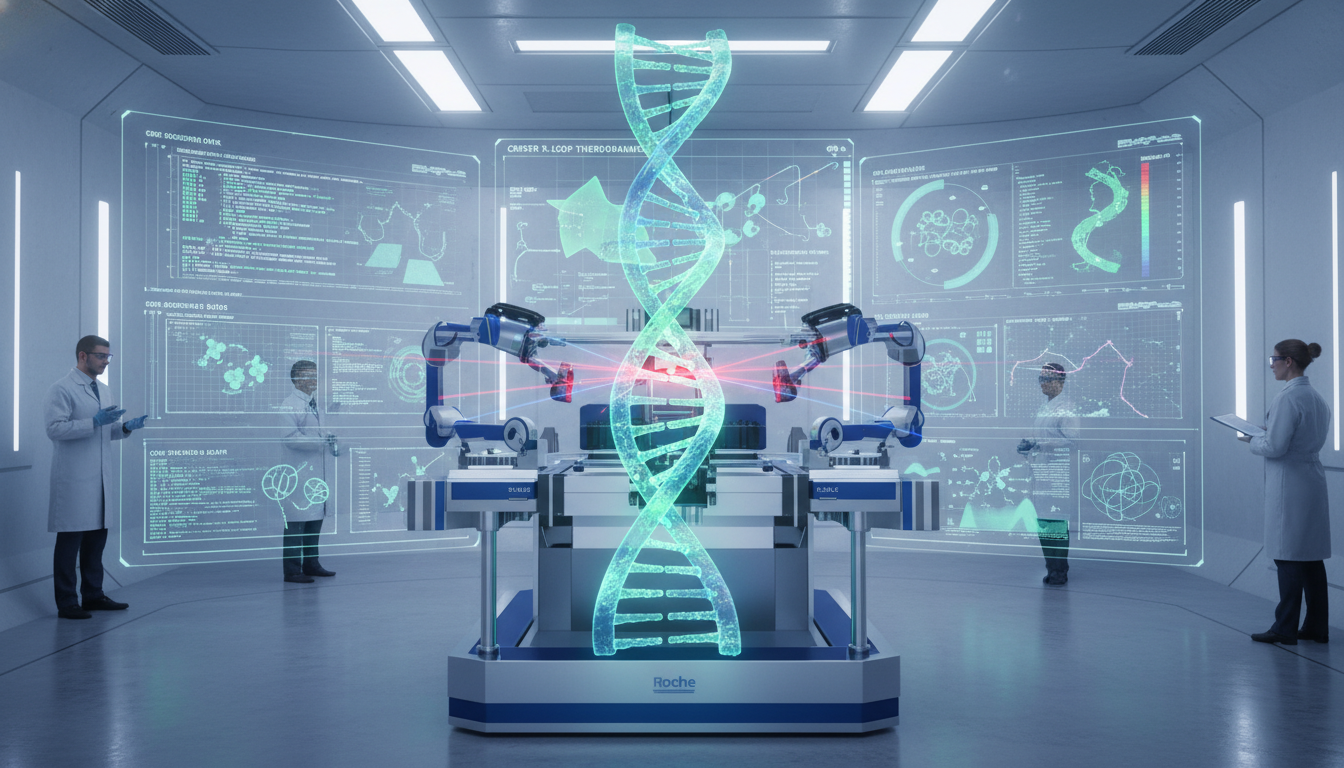
The era of Personalized CRISPR and Record-Breaking DNA Sequencing has officially arrived, marking a definitive transition from generalized medical protocols to high-resolution, individualized therapeutic interventions. On December 24, 2025, the global scientific community reflected on a year of unprecedented milestones that have effectively compressed decades of anticipated progress into a single calendar year. Central to this transformation is the integration of ultra-rapid genomic diagnostic pipelines with bespoke gene-editing delivery systems, a combination that has saved the lives of neonatal patients previously deemed untreatable due to the rarity of their genetic variations.
The significance of these developments is best understood through the lens of the N-of-1 trial paradigm. Historically, drug development has relied on large-scale clinical trials to establish efficacy across broad populations. However, for infants born with ultra-rare mutations, there is no "broad population." The successful application of a custom-tailored CRISPR edit for a patient with a unique genetic profile signifies that the clinical trial and the treatment are now a singular, unified event. This shift is predicated on two technological pillars: the ability to sequence a human genome in less than four hours and the computational capacity to design, validate, and manufacture a personalized molecular tool in real-time.
The Architecture of Sequencing by Expansion: Breaking the Four-Hour Barrier
The recent Guinness World Record for the fastest human whole-genome sequencing (WGS), achieved by a collaborative team from Roche Sequencing Solutions, Broad Clinical Labs, and Boston Children’s Hospital, was not merely an incremental speed improvement. The team clocked a complete sequencing-to-diagnosis workflow at 3 hours and 57 minutes, shattering the previous record of 5 hours and 2 minutes. This breakthrough was facilitated by a novel biochemical process known as Sequencing by Expansion (SBX).
SBX differs fundamentally from traditional Sequencing-by-Synthesis (SBS) or standard nanopore translocation. In SBX, the target DNA molecule is converted into a synthetic "expansomer." This process involves the circularization of genomic DNA followed by the synthesis of a physical surrogate that is significantly larger than the original template. This expansion allows the detection hardware to resolve individual bases with higher signal-to-noise ratios, effectively mitigating the error rates typically associated with rapid, high-throughput systems.
The throughput of such a system can be modeled by the relationship between the translocation velocity ##v## and the sampling frequency ##f_s##. To maintain a base-calling accuracy above a specific threshold, the spatial resolution must satisfy the Nyquist-Shannon criteria relative to the physical distance between nucleotide analogs in the expansomer. If the expanded distance between bases is ##\Delta L##, the requirement is:
###f_s \geq \frac{2v}{\Delta L}###
By increasing ##\Delta L## through biochemical expansion, the system can tolerate higher translocation velocities ##v## without exceeding the bandwidth of the sensors. This physical "scaling up" of the DNA molecule is the primary driver behind the record-breaking speeds, as it permits the use of massively parallel sensor arrays that would otherwise be confounded by the stochastic noise inherent in sub-nanometer measurements.
Mathematical Foundations of Rapid Genomic Alignment
Achieving a sub-four-hour turnaround requires more than just fast hardware; it demands a radical optimization of the bioinformatics pipeline. The alignment of millions of short or long reads to a 3-billion-base reference genome is a computationally intensive task, traditionally bounded by ##O(N \cdot M)## complexity in standard dynamic programming approaches like Smith-Waterman.
To reach the speeds necessary for same-day NICU diagnosis, the Roche-Boston Children's team utilized a combination of Most Significant Digit (MSD) radix sorts and a specialized variant of the Myers adaptive wave algorithm. These algorithms are designed to exploit the cache-coherent architectures of modern GPUs, specifically leveraging the NVIDIA Parabricks suite.
In this context, the alignment problem is framed as finding the minimum edit distance ##d(S, T)## between a read ##S## and a reference segment ##T##. The Myers algorithm optimizes this by representing the alignment matrix as a bit-vector, transforming the calculation into a series of bitwise operations. For a sequence of length ##w## (where ##w## is the word size of the processor), the transition can be calculated in ##O(1)## time.
The complexity of finding all statistically significant local alignments between two genome sequences of length ##G## and ##H## using the FastGA framework (developed for such high-speed tasks) can be approximated by:
###T(G, H) = O\left(\frac{G \cdot H \cdot p}{w}\right)###
where ##p## represents the probability of a match at any given position and ##w## is the parallelization factor. By implementing cache-local architectures and minimizing logical bit-shifting operations, the pipeline ensures that the computational latency does not become a bottleneck as the raw data throughput from the SBX instrument increases.
CRISPRzip and the Thermodynamics of Bespoke Guide RNA Design
Once a life-threatening mutation is identified through record-breaking sequencing, the focus shifts to the design of the personalized CRISPR therapy. For N-of-1 cases, the guide RNA (gRNA) must be optimized not for a general population, but for the specific cis-regulatory and epigenetic landscape of the individual patient. This requires a deep understanding of the thermodynamic landscape of R-loop formation.
The binding of the Cas9-gRNA complex to the target DNA is a multi-step process governed by the free energy change ##\Delta G##. The "CRISPRzip" model, a mechanistic kinetic framework utilized in late 2025, describes this process as a movement through a sequence-dependent energy landscape. The probability ##P## of successful cleavage at a target site can be modeled using a Boltzmann distribution:
###P(binding) = \frac{e^{-\Delta G / k_B T}}{1 + e^{-\Delta G / k_B T}}###
where ##k_B## is the Boltzmann constant and ##T## is the absolute temperature. The total free energy ##\Delta G_{total}## is the sum of the nucleic acid hybridization energy and the protein-mediated contributions:
###\Delta G_{total} = \Delta G_{hybridization} + \Delta G_{protein} + \Delta G_{supercoiling}###
In personalized medicine, the ##\Delta G_{supercoiling}## term is particularly critical, as individual variations in chromatin density can significantly alter the accessibility of the target locus. High-speed sequencing provides the necessary data to perform these thermodynamic simulations in hours, ensuring that the designed gRNA has a high on-target affinity while maintaining an off-target probability ##P_{off}## that satisfies the safety constraint:
###\sum_{i=1}^{n} P_{off, i} < \epsilon###
where ##\epsilon## is the maximum allowable cumulative risk for the specific clinical context.
The First N-of-1 Success: The Case of KJ Muldoon
The practical application of these technologies was most vividly demonstrated in the treatment of KJ Muldoon, an infant diagnosed with a severe form of carbamoyl phosphate synthetase 1 (CPS1) deficiency. This metabolic disorder prevents the liver from processing ammonia, leading to rapid neurological decline. KJ was the first patient to receive a truly "bespoke" CRISPR edit, where the molecular tool was manufactured specifically to correct a mutation that existed in no other recorded patient.
The treatment utilized lipid nanoparticles (LNPs) to deliver the Cas9 mRNA and the custom gRNA directly to the liver. The kinetics of the LNP-mediated delivery can be described by a first-order absorption model, where the concentration of the therapy in the hepatic tissue ##C_h(t)## follows:
###\frac{dC_h}{dt} = k_a D e^{-k_a t} - k_e C_h###
where ##k_a## is the absorption rate constant, ##k_e## is the elimination rate constant, and ##D## is the administered dose. Because the therapy was designed with the patient’s exact genomic data, researchers could calibrate the dose ##D## to achieve maximum saturation of the target hepatocytes while staying below the threshold of systemic toxicity.
By December 2025, follow-up data showed that KJ had achieved stable ammonia levels and was meeting developmental milestones, including taking his first steps. This success has provided a blueprint for other "ultra-rare" conditions, proving that the timeline from "diagnosis by sequencing" to "therapeutic intervention" can be compressed into a timeframe relevant for acute clinical care.
Bioinformatics in the NICU: Real-Time Variant Interpretation
The transition to Personalized CRISPR and Record-Breaking DNA Sequencing necessitates a sophisticated bioinformatics infrastructure within the hospital environment. It is no longer sufficient to move data to the cloud for analysis; the latency of data transfer (often gigabytes of raw signal data) becomes the primary bottleneck.
To address this, edge computing nodes equipped with dedicated genomic accelerators (ASICs) are now being integrated into neonatal intensive care units (NICUs). These systems perform real-time variant calling using Bayesian statistical models. The goal is to calculate the posterior probability ##P(M | D)## that a patient has a specific mutation ##M## given the observed sequencing data ##D##:
###P(M | D) = \frac{P(D | M) P(M)}{P(D)}###
In a rapid-sequencing scenario, the prior probability ##P(M)## is informed by the clinical presentation (e.g., hyperammonemia in the case of CPS1), while the likelihood ##P(D | M)## is derived from the base-calling quality scores. As the SBX instrument streams data, the posterior probability is updated iteratively. Once ##P(M | D)## crosses a predefined confidence threshold (usually ##> 0.999##), the diagnostic report is generated automatically, triggering the automated gRNA design pipeline.
Ethical and Economic Implications of Scaling Bespoke Medicine
While the technical hurdles of Personalized CRISPR and Record-Breaking DNA Sequencing are being overcome, the challenge of scalability remains. The cost of developing a unique therapeutic for a single individual is currently exorbitant. However, proponents of the N-of-1 model argue that the long-term cost of untreated rare diseases—including lifetime intensive care, lost productivity, and social support—far outweighs the initial investment in precision medicine.
The economic feasibility of this model can be analyzed using a cost-benefit function ##B(t)##:
###B(t) = \int_{0}^{L} [C_{standard}(t) - C_{bespoke}(t)] dt###
where ##L## is the expected lifespan, ##C_{standard}## is the cost of conventional supportive care, and ##C_{bespoke}## is the total cost of the personalized intervention. For many neonatal conditions, the integral yields a positive value within the first five to ten years of life, making a strong case for the integration of these technologies into standard insurance and public health frameworks.
Furthermore, the "platformization" of CRISPR and sequencing means that as the fixed costs of hardware and regulatory frameworks are amortized over more patients, the marginal cost of each new N-of-1 therapy will decrease exponentially. This follows a pattern similar to Wright's Law in manufacturing, where the cost of a technology drops by a fixed percentage for every doubling of cumulative production.
Future Directions: Towards a Proactive Genomic Standard of Care
As we move into 2026, the scientific community is looking beyond reactive treatments for rare diseases toward a more proactive model of genomic health. The convergence of Personalized CRISPR and Record-Breaking DNA Sequencing suggests a future where every newborn receives a whole-genome sequence at birth as part of a routine screening program.
The technical capacity for such a system already exists. The challenge lies in the societal and regulatory adaptation to a world where genetic defects are no longer "fate" but "bugs" that can be patched with high-precision molecular code. The success of the Roche and Boston Children's Hospital team has demonstrated that we can read the code of life in hours. The success of patients like KJ Muldoon has demonstrated that we can rewrite it just as fast.
The focus now shifts to refining the delivery mechanisms—ensuring that CRISPR effectors can reach tissues like the brain or the heart with the same efficiency currently seen in the liver—and hardening the cybersecurity of genomic data. In the era of N-of-1 medicine, your DNA is not just your biological identity; it is the source code for your survival, and its protection is as vital as the therapies themselves.
From our network :
- AI-Powered 'Precision Diagnostic' Replaces Standard GRE Score ReportsDiscover the new GRE Precision Diagnostic. Learn how AI-powered behavioral analytics and time-to-solve tracking are replacing standard GRE score reports to empower students.
- Mastering DB2 LUW v12 Tables: A Comprehensive Technical GuideComprehensive guide on DB2 LUW v12 tables. Explore CREATE TABLE syntax, BLU Acceleration, range partitioning, data types, and security features for IBM DB2 LUW v12.
- 98% of Global MBA Programs Now Prefer GRE Over GMAT Focus EditionExplore why 98% of global MBA programs now prefer the GRE over GMAT Focus. Learn about the shorter GRE format, verbal logic importance, and strategic versatility for students.
- Analyzing Trump Deportation Numbers Insights Into The 2026 Immigration Crackdown
- Vite 6/7 'Cold Start' Regression in Massive Module GraphsIn-depth analysis of Vite 6/7 cold start regressions in massive module graphs. Learn about barrel file issues, pre-bundling optimizations, and how to improve Vite dev server performance.
- Trump Political Strategy How Geopolitical Stunts Serve As Media Diversions
- Mastering DB2 12.1 Instance Design: A Technical Deep Dive into Modern Database ArchitectureComprehensive guide to DB2 12.1 Instance Design. Explore architectural components, HADR setup, buffer pool tuning, and security policies for IBM DB2 12.1. Includes 10 functional SQL and Shell samples.
- EV 2.0: The Solid-State Battery Breakthrough and Global Factory ExpansionDiscover the impact of the Solid-State Battery Breakthrough on the EV market. Learn about CATL and BYD stock growth, global factory expansion in Europe, and the future of EV 2.0 technology.
- 10 Physics Numerical Problems with Solutions for IIT JEEPrepare for IIT JEE with 10 physics numerical problems, complete with detailed solutions and conceptual explanations. Ideal for mastering kinematics, thermodynamics, electromagnetism, and optics.
RESOURCES
- Broad Clinical Labs sets new GUINNESS WORLD RECORDS™ title ...
- Fastest DNA sequencing technique helps undiagnosed patients find ...
- New DNA sequencing technique sets world record
- Genomics, in a flash: A DNA sequencing world record - Roche
- Broad Clinical Labs Sets New GUINNESS WORLD RECORDS ...
- Guinness World Record Awarded for Fastest DNA Sequencing ...
- World Record Set For Fastest Genome Sequencing
- Record-Breaking DNA Sequencing Technology Could Transform ...
- Scientist who sequenced genome in record time on what's next
- “A new frontier”: Fastest ever DNA sequencing technique achieved ...
- World record for fastest whole genome sequencing paves the way ...
- New GUINNESS WORLD RECORDS™ Title Set for Fastest Genetic ...
- Scientists Set New World Record for Fastest Human Whole Genome ...
- Fastest Genome Sequencing with Dr. Euan Ashley | Stanford Health ...
- From 13 Years to 13 Hours: Rady Children's Institute for Genomic ...




0 Comments