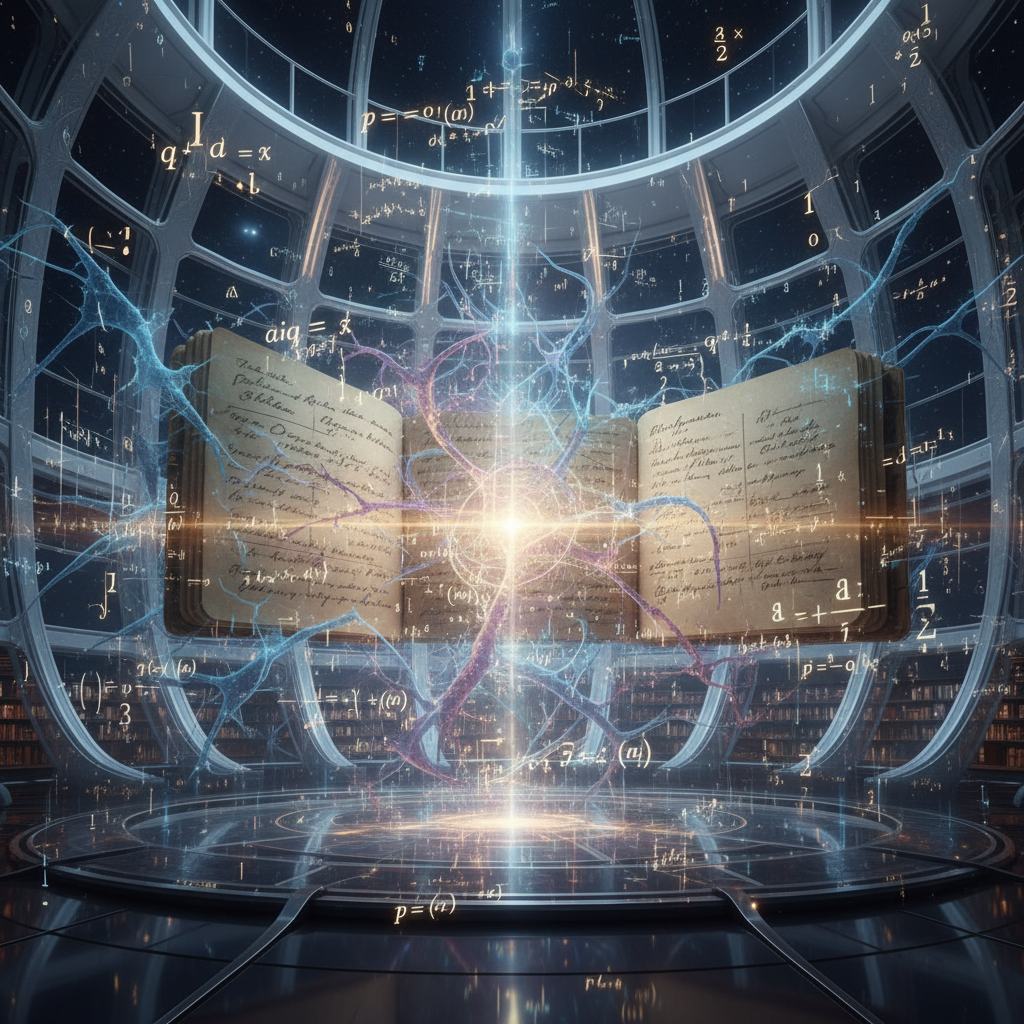
National Mathematics Day 2025 serves as a critical juncture where the historical legacy of Srinivasa Ramanujan meets the cutting-edge requirements of the modern artificial intelligence era. As the global scientific community pauses to reflect on the 138th birth anniversary of the Indian mathematical prodigy, the focus has shifted from mere historical reverence to the active application of his theories in high-performance computing, quantum physics, and algorithmic optimization. The celebration, observed annually on December 22, highlights how mathematics, once perceived as a domain of abstract logic, has become the foundational infrastructure for the digital age.
On This Page
- The Theoretical Foundations of National Mathematics Day 2025
- Ramanujan’s Partition Functions and Algorithmic Complexity
- Mock Theta Functions: From Ramanujan’s Deathbed to Black Hole Entropy
- Mathematics as the Language of Innovation in AI
- Ganit Week and the Democratization of Mathematics
- Computational Number Theory and Security
- The Global Impact of the Ramanujan Legacy
- Conclusion: The Infinite Horizon of 2025
We Also Published
The Theoretical Foundations of National Mathematics Day 2025
The significance of National Mathematics Day 2025 lies in its ability to bridge the gap between 20th-century number theory and 21st-century technological breakthroughs. Srinivasa Ramanujan, despite lacking formal training in advanced mathematics during his early years, contributed nearly 3,900 results. Today, these formulas are not just museum pieces but active tools in computational research. The mathematical rigor established by Ramanujan provides the necessary framework for handling large-scale data sets and complex neural network architectures.
In the context of 2025, mathematical research in India is experiencing a renaissance. The Department of Science and Technology (DST) and organizations like the Indian Institute of Technology are leveraging Ramanujan’s "Mock Theta Functions" to explore new frontiers. The transition from classical logic to modular forms has enabled researchers to develop more efficient error-correcting codes, which are essential for stable data transmission in 5G and 6G networks.
Ramanujan’s Partition Functions and Algorithmic Complexity
One of the most profound areas of Ramanujan’s work celebrated during National Mathematics Day 2025 is the study of partition functions. A partition of a positive integer ##n## is a way of writing ##n## as a sum of positive integers. Ramanujan, in collaboration with G.H. Hardy, developed an asymptotic formula for the partition function ##p(n)##, which is given by:
### p(n) \sim \frac{1}{4n\sqrt{3}} \exp \left( \pi \sqrt{\frac{2n}{3}} \right) ###This formula was a groundbreaking achievement in analytic number theory because it provided a highly accurate approximation for values of ##p(n)## that were previously thought to be unpredictable. In the realm of computer science, the study of partitions is vital for understanding the complexity of algorithms. Specifically, in the field of AI, data structures that manage hierarchical information often rely on partition theory to optimize memory allocation. When an AI model processes "tokens" or data fragments, the way these fragments are grouped (or partitioned) determines the efficiency of the model’s inference phase.
Furthermore, Ramanujan’s congruences for the partition function, such as ##p(5n+4) \equiv 0 \pmod{5}##, have found applications in cryptography. These properties allow for the creation of secure hashing algorithms that are resistant to specific types of mathematical attacks, ensuring that the digital infrastructure discussed during National Mathematics Day 2025 remains robust against emerging cyber threats.
Mock Theta Functions: From Ramanujan’s Deathbed to Black Hole Entropy
Perhaps the most enigmatic of Ramanujan's contributions are the "Mock Theta Functions," introduced in his final letter to Hardy in 1920. For nearly a century, these functions remained a mystery until researchers like Ken Ono and Kathrin Bringmann provided a formal definition within the framework of harmonic Maass forms. During the seminars for National Mathematics Day 2025, physicists highlighted how these functions are now used to calculate the entropy of black holes.
The Bekenstein-Hawking entropy formula relates the entropy of a black hole to its surface area, but the microstate counting required for a full quantum mechanical description involves modular forms. Ramanujan’s mock modular forms allow physicists to account for these microstates in string theory. The mathematical expression of a mock theta function often takes the form of an infinite series, such as:
### f(q) = \sum_{n=0}^{\infty} \frac{q^{n^2}}{(1+q)^2(1+q^2)^2\dots(1+q^n)^2} ###This technical convergence of number theory and theoretical physics underscores why National Mathematics Day 2025 is more than a cultural event; it is a celebration of the universal language that decodes the cosmos. The ability to model the behavior of singularities using Ramanujan’s notebooks demonstrates the timeless nature of his intuitive genius.
Mathematics as the Language of Innovation in AI
In the tech-heavy landscape of 2025, Artificial Intelligence is no longer just about code; it is about the underlying linear algebra, calculus, and number theory. The "Ramanujan Machine," a project that uses AI to discover new mathematical conjectures, has become a focal point of discussion. This synergy creates a feedback loop where AI helps discover new math, which in turn improves AI algorithms.
Ramanujan’s work on continued fractions and infinite series is particularly relevant to the optimization of Deep Learning models. For example, his identity for ##1/\pi##:
### \frac{1}{\pi} = \frac{2\sqrt{2}}{9801} \sum_{k=0}^{\infty} \frac{(4k)!(1103+26390k)}{(k!)^4 396^{4k}} ###This series converges extraordinarily rapidly, with each term providing approximately eight additional decimal places of accuracy. In modern computation, such rapid convergence is the holy grail of efficiency. Whether it is calculating the weights in a neural network or optimizing the gradient descent in a backpropagation algorithm, the principles of rapid convergence and series manipulation derived from Ramanujan's techniques are indispensable.
Ganit Week and the Democratization of Mathematics
To ensure that the legacy of Ramanujan reaches the grassroots level, National Mathematics Day 2025 included the widespread "Ganit Week" initiative. Educational institutions across India transformed into hubs of mathematical inquiry. Unlike traditional rote learning, these initiatives focused on "Intuitive Mathematics"—the style Ramanujan was famous for. Students participated in math olympiads that linked abstract formulas to real-world applications, such as the math behind search engine ranking algorithms and the probability models used in stock market predictions.
Schools utilized interactive software to visualize Ramanujan’s modular equations, allowing students to see the geometric beauty of his algebraic results. By integrating history with modern utility, Ganit Week aims to inspire the next generation of mathematicians who will lead India's tech sectors. The objective is to move away from the "fear of math" and toward an understanding of math as a tool for empowerment. National Mathematics Day 2025 emphasizes that every smartphone, every satellite, and every medical imaging device is a testament to mathematical principles.
Computational Number Theory and Security
As we navigate the complexities of 2025, the security of global financial systems rests on the shoulders of computational number theory. Ramanujan’s insights into highly composite numbers and the distribution of prime numbers are foundational to modern encryption standards. Prime numbers are the building blocks of RSA encryption, and Ramanujan’s work on the prime-counting function and the properties of divisors has helped refine the algorithms that generate these secure keys.
The National Mathematics Day 2025 conferences often feature discussions on post-quantum cryptography. As quantum computers threaten current encryption methods, researchers are looking toward more complex mathematical structures, such as lattices and elliptic curves—fields that have been deeply influenced by the Ramanujan-Hardy circle method. The circle method provides a way to represent an integer as a sum of other integers with specific properties, often involving complex integration along a contour:
### r_s(n) = \frac{1}{2\pi i} \int_{\mathcal{C}} \frac{f(z)^s}{z^{n+1}} dz ###This method has evolved into a standard tool for solving additive problems in number theory, proving essential for both theoretical research and practical cryptographic applications.
The Global Impact of the Ramanujan Legacy
While celebrated with great fervor in India, the impact of Ramanujan's work is truly global. Institutions like the Royal Society of London continue to publish research papers that build upon his initial findings. In 2025, the collaboration between Indian and international mathematicians has reached new heights, with joint research programs focusing on "Ramanujan Graphs." These are d-regular graphs whose spectral properties make them excellent expander graphs, which are crucial in designing efficient communication networks and data centers.
National Mathematics Day 2025 highlights that Ramanujan was not just an "Indian" mathematician but a global intellectual asset. His ability to perceive patterns where others saw chaos has inspired researchers in fields as diverse as genomics and climate modeling. In genomics, the statistical methods used to sequence DNA often rely on combinatorial mathematics that traces its lineage back to Ramanujan's work on partitions and permutations.
Conclusion: The Infinite Horizon of 2025
As National Mathematics Day 2025 concludes, the message is clear: the spirit of Srinivasa Ramanujan is more alive than ever. His journey from a clerk in the Madras Port Trust to a Fellow of the Royal Society is a story of pure, unadulterated intellectual power. By celebrating his birth anniversary, we are not just looking back at the past; we are looking forward to a future where mathematics continues to be the primary engine of human progress.
Whether it is through the development of "Greener AI" that requires less computational energy thanks to optimized Ramanujan-inspired algorithms, or the exploration of the quantum realm through mock modular forms, the legacy of 1920 continues to define 2025. Mathematics remains the ultimate tool for decoding the universe, and Ramanujan remains its most profound practitioner. As India continues its trajectory as a global technology leader, the mathematical foundations reinforced on this day will serve as the bedrock for all future innovations.
From our network :
- Vite 6/7 'Cold Start' Regression in Massive Module GraphsIn-depth analysis of Vite 6/7 cold start regressions in massive module graphs. Learn about barrel file issues, pre-bundling optimizations, and how to improve Vite dev server performance.
- Mastering DB2 LUW v12 Tables: A Comprehensive Technical GuideComprehensive guide on DB2 LUW v12 tables. Explore CREATE TABLE syntax, BLU Acceleration, range partitioning, data types, and security features for IBM DB2 LUW v12.
- Trump Political Strategy How Geopolitical Stunts Serve As Media Diversions
- EV 2.0: The Solid-State Battery Breakthrough and Global Factory ExpansionDiscover the impact of the Solid-State Battery Breakthrough on the EV market. Learn about CATL and BYD stock growth, global factory expansion in Europe, and the future of EV 2.0 technology.
- Analyzing Trump Deportation Numbers Insights Into The 2026 Immigration Crackdown
- 98% of Global MBA Programs Now Prefer GRE Over GMAT Focus EditionExplore why 98% of global MBA programs now prefer the GRE over GMAT Focus. Learn about the shorter GRE format, verbal logic importance, and strategic versatility for students.
- Mastering DB2 12.1 Instance Design: A Technical Deep Dive into Modern Database ArchitectureComprehensive guide to DB2 12.1 Instance Design. Explore architectural components, HADR setup, buffer pool tuning, and security policies for IBM DB2 12.1. Includes 10 functional SQL and Shell samples.
- 10 Physics Numerical Problems with Solutions for IIT JEEPrepare for IIT JEE with 10 physics numerical problems, complete with detailed solutions and conceptual explanations. Ideal for mastering kinematics, thermodynamics, electromagnetism, and optics.
- AI-Powered 'Precision Diagnostic' Replaces Standard GRE Score ReportsDiscover the new GRE Precision Diagnostic. Learn how AI-powered behavioral analytics and time-to-solve tracking are replacing standard GRE score reports to empower students.
RESOURCES
- The Mathematical Legacy of Srinivasa Ramanujan | Springer Nature ...
- Srinivasa Ramanujan - Wikipedia
- Ramanujan's Long Legacy | Scientific American
- Srinivasa Ramanujan: The Man Who Knew Infinity – A Legacy ...
- The Mathematical Legacy of Srinivasa Ramanujan
- The legacy of Srinivasa Ramanujan - The Hindu
- Srinivasa Ramanujan: His Life, Legacy, and Mathematical Influence ...
- What do you think about Srinivasa Ramanujan and his legacy to ...
- #srinivasaramanujan #nationalmathematicsday #inspiration #india ...
- Srinivasa Ramanujan | Mathematician, Biography, Contributions ...
- Srinivasa Ramanujan: His Life, Legacy, and Mathematical Influence ...
- A legacy that's infinite ∞. Srinivasa Ramanujan uncovered patterns ...
- Srinivasa Ramanujan | Biography, Facts & Legacy - Lesson | Study ...
- Analytic and Combinatorial Number Theory: The Legacy of ...
- Mathematical Wizard Srinivasa Ramanujan and His Legacy | Exotic ...


0 Comments