The Cognitive Architecture of Experiential Math Learning
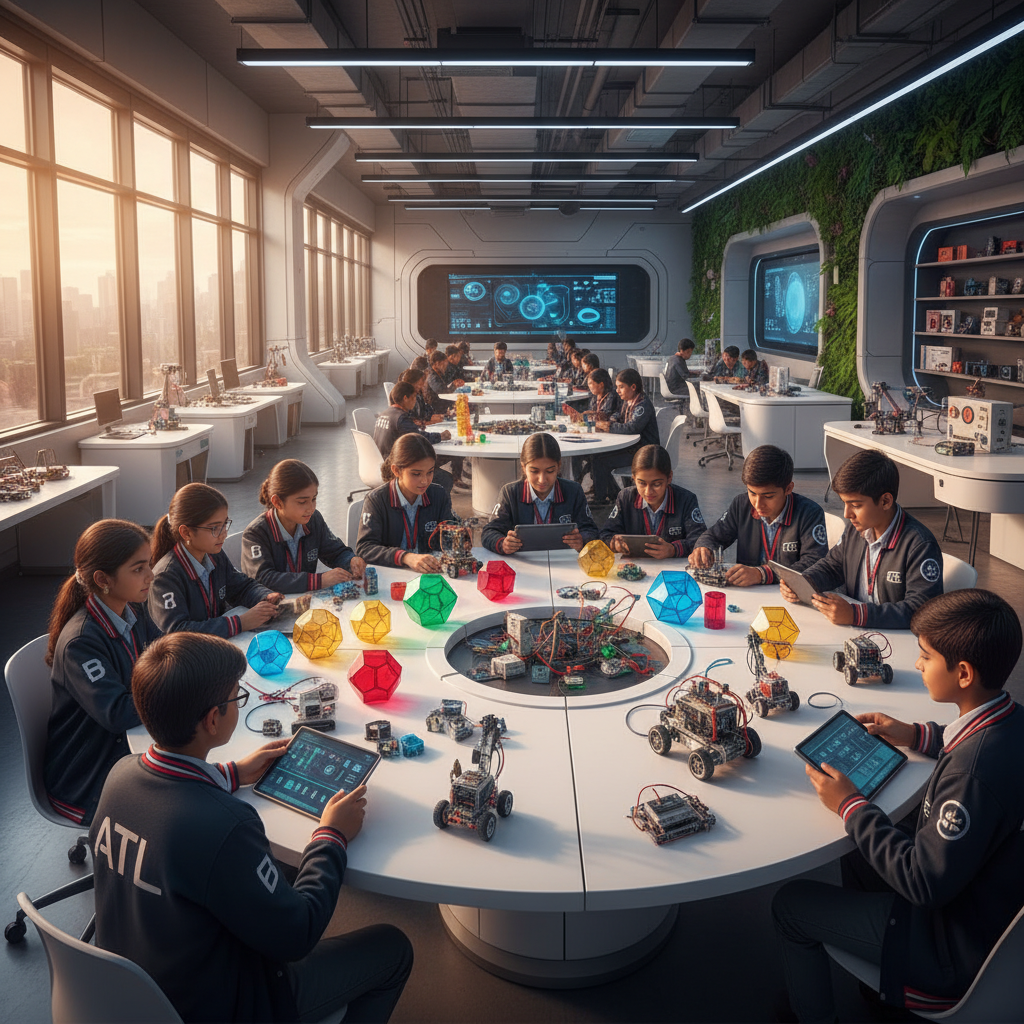
Experiential math learning has emerged as a critical pedagogical intervention in India, designed to dismantle the cognitive barriers associated with 'math phobia.' This psychological phenomenon, characterized by tension and anxiety that interferes with the manipulation of numbers and the solving of mathematical problems, is being countered by a shift from abstract theory to tangible interaction. By engaging students through tactile and kinesthetic stimuli, educators are stimulating the prefrontal cortex, which is responsible for logical reasoning, while simultaneously reducing activity in the amygdala, the brain's fear center. The expansion of the Ramanujan Math Park in Andhra Pradesh and the proliferation of Atal Tinkering Labs represent a systemic shift toward this neuro-educational model.
On This Page
- The Cognitive Architecture of Experiential Math Learning
- Geometric Interpretation in Math Parks: From Cycloids to Catenaries
- Atal Tinkering Labs: Integrating Algebra and Computational Thinking
- Statistical Literacy and Probability through Interactive Gaming
- DIKSHA and the Digital Public Infrastructure for Ganit
- Kinesthetic Mathematics: The Geometry of Local Crafts and Farming
- The Impact of 'Math Labs' on Scientific Temper and Logical Thinking
- India’s Future as a Global Technology Leader through Experiential Learning
We Also Published
The traditional "chalk and talk" method often fails to provide the necessary spatial-visual connections required for deep understanding. In contrast, experiential modules allow students to explore the Golden Ratio ##\phi##, defined by the quadratic equation:
###x^2 - x - 1 = 0###where the positive root is ##\phi = \frac{1 + \sqrt{5}}{2} \approx 1.618##. In a math lab setting, students don't just memorize this constant; they measure the proportions of sunflower seeds or the spirals of a seashell, grounding the irrational number in physical reality. This empirical approach ensures that mathematical concepts are perceived not as arbitrary rules, but as the underlying logic of the natural world.
Geometric Interpretation in Math Parks: From Cycloids to Catenaries
One of the primary features of the Ramanujan Math Park is its use of large-scale physical models to demonstrate complex geometric and calculus-based concepts. A prominent example is the Brachistochrone curve, which is the path of fastest descent under gravity. To the naked eye, a straight line might seem the quickest, but through experiential learning, students observe that a cycloid—the curve traced by a point on the rim of a circular wheel as it rolls along a straight line—is actually faster.
The parametric equations for a cycloid, where ##r## is the radius and ##\theta## is the angular displacement, are given by:
###x = r(\theta - \sin \theta)######y = r(1 - \cos \theta)###When students race balls down different tracks at a math lab, they witness the physical manifestation of the calculus of variations. This visceral experience bridges the gap between the abstract integral ##\int \sqrt{\frac{1 + (y')^2}{2gy}} dx## and the physical reality of velocity and acceleration. Similarly, the study of catenaries—the shape a hanging chain assumes under its own weight—introduces students to hyperbolic functions like ##y = a \cosh(x/a)##. These structures, often found in the architecture of the Agastya International Foundation's math parks, transform static geometry into a dynamic exploration of forces and equilibrium.
Atal Tinkering Labs: Integrating Algebra and Computational Thinking
The government's commitment to establishing 50,000 additional Atal Tinkering Labs (ATLs) is a significant milestone for STEM education trends India. These labs serve as the interface between traditional mathematics and modern engineering. In an ATL environment, algebra is no longer a sequence of isolated variables; it becomes the language of robotics and sensor integration. For instance, when a student programs a drone, they must calculate its trajectory using three-dimensional coordinate geometry.
Consider the calculation of a robot's position in a 2D plane using a displacement vector ##\vec{d}##. If a robot moves from point ##(x_1, y_1)## to ##(x_2, y_2)##, the magnitude of the displacement is calculated using the distance formula derived from the Pythagorean theorem:
###d = \sqrt{(x_2 - x_1)^2 + (y_2 - y_1)^2}###In ATLs, students apply these formulas to real-world sensors (ultrasonic, infrared). If a sensor detects an obstacle, the logic gates—based on Boolean algebra—execute a decision-making process. This integration of coding kits and experiential math learning allows students to see the immediate consequence of their mathematical calculations. By manipulating variables in a Python script or an Arduino IDE, they are performing live algebraic substitutions, which solidifies their understanding of functions and variables more effectively than repetitive textbook exercises.
Statistical Literacy and Probability through Interactive Gaming
Probability is often one of the most abstract topics for middle and high school students in India. To combat this, math labs utilize physical probability simulators, such as the Galton Board (or bean machine). This device demonstrates the Central Limit Theorem and how binomial distributions converge toward a normal distribution as the number of trials increases.
The probability of a ball landing in a specific bin ##k## after passing through ##n## rows of pegs is modeled by the binomial distribution formula:
###P(k; n, p) = \binom{n}{k} p^k (1-p)^{n-k}###where ##p## is the probability of the ball bouncing to the right (typically ##0.5##). As students watch hundreds of balls form a "bell curve," they gain an intuitive grasp of the Normal Distribution:
###f(x) = \frac{1}{\sigma\sqrt{2\pi}} e^{-\frac{1}{2}\left(\frac{x-\mu}{\sigma}\right)^2}###This experiential approach is particularly effective in rural communities, where educators relate probability to local contexts like agricultural yields or weather patterns. By gamifying these concepts, math labs reduce the "fear of failure" and encourage students to analyze risks and outcomes logically. This is a crucial skill for building the scientific temper required for India’s future workforce.
DIKSHA and the Digital Public Infrastructure for Ganit
The success of physical math parks is amplified by India's digital public infrastructure, specifically the DIKSHA platform. While physical labs provide the tactile experience, DIKSHA provides the linguistic and interactive bridge. By offering content in multiple Indian languages, it removes the "double burden" of learning a new language and a complex subject simultaneously. This is essential for fostering an inclusive "math culture."
DIKSHA's interactive modules often use simulations to explain linear equations and trigonometric ratios. For example, a student can manipulate a virtual right-angled triangle to see how the sine of an angle ##\theta## changes relative to the opposite side and the hypotenuse:
###\sin(\theta) = \frac{\text{Opposite}}{\text{Hypotenuse}}###This digital-physical synergy allows for a "blended learning" environment. A student might play with a physical prism in a Ramanujan Math Park to observe light refraction and then use a DIKSHA simulation to calculate the refractive index ##n## using Snell's Law:
###n_1 \sin(\theta_1) = n_2 \sin(\theta_2)###This multi-modal approach ensures that different learning styles—visual, auditory, and kinesthetic—are all addressed, significantly reducing the prevalence of math phobia India.
Kinesthetic Mathematics: The Geometry of Local Crafts and Farming
One of the most innovative aspects of experiential math learning in India is its connection to indigenous knowledge systems. In rural math labs, students analyze the geometry of local crafts, such as weaving and pottery. The patterns in traditional 'Kolams' (floor art) provide a perfect gateway to symmetry, tessellations, and graph theory.
A tessellation involves covering a plane with one or more geometric shapes with no overlaps or gaps. For a regular polygon to tessellate the plane, the interior angle ##\alpha## must be a divisor of ##360^\circ##. The interior angle of a regular ##n##-gon is given by:
###\alpha = \frac{(n-2) \times 180^\circ}{n}###Students learn that only equilateral triangles (##60^\circ##), squares (##90^\circ##), and regular hexagons (##120^\circ##) can form regular tessellations. By creating these patterns with physical tiles, they internalize the properties of interior and exterior angles. Furthermore, relating math to farming—such as calculating the area of irregular fields or the volume of water required for irrigation—makes the subject highly relevant. Measuring the volume ##V## of a cylindrical water tank becomes a practical necessity rather than a dry exercise:
###V = \pi r^2 h###This contextualization is vital for marginalized communities, as it transforms math from an "exam hurdle" into a "survival and growth tool."
The Impact of 'Math Labs' on Scientific Temper and Logical Thinking
The transition from "I can't do math" to "I can build with math" marks a fundamental shift in the Indian student's psyche. The "Ganit" (Math) labs are designed to be "interactive playgrounds" where the focus is on the process of discovery rather than the accuracy of the final answer. This aligns with the scientific method: observation, hypothesis, experimentation, and conclusion.
In these labs, students are encouraged to test the Euler’s Polyhedron Formula for themselves using 3D models of platonic solids. By counting the vertices ##V##, edges ##E##, and faces ##F##, they verify the invariant:
###V - E + F = 2###Whether they are handling a tetrahedron, a cube, or a dodecahedron, the result remains consistent. This discovery-based learning builds resilience. If a student's calculation doesn't match the physical reality, they are encouraged to troubleshoot and re-evaluate their steps—a core component of STEM education. This grassroots movement is not just about improving test scores; it is about cultivating a generation of logical thinkers who can navigate the complexities of the 21st-century technological landscape.
India’s Future as a Global Technology Leader through Experiential Learning
As India looks toward 2030 and beyond, its status as a global technology leader depends on its ability to produce high-caliber scientists, engineers, and data analysts. This pipeline begins at the primary and secondary levels. By scaling Atal Tinkering Labs and math parks, the nation is investing in a robust foundation of mathematical literacy. Experiential math learning ensures that the upcoming workforce is not just proficient in rote computation but is capable of high-level abstract reasoning and innovative problem-solving.
The shift towards hands-on labs also addresses the gender gap in STEM. Studies have shown that girls often perform better in math when it is presented in a collaborative, hands-on environment rather than a competitive, lecture-based one. By democratizing access to these resources through initiatives like Atal Innovation Mission, India is tapping into its full intellectual potential. The narrative is changing; math is becoming a medium for creativity. As students use coding to visualize the Fibonacci sequence or use physical pendulums to study simple harmonic motion, they are participating in a global tradition of scientific inquiry. The formula for the period ##T## of a simple pendulum:
###T \approx 2\pi \sqrt{\frac{L}{g}}###is no longer just ink on a page; it is the rhythm of a swinging weight that the student has measured and timed themselves. This is the essence of modern Indian education: a synthesis of ancient mathematical heritage and cutting-edge experiential pedagogy.
From our network :
- Vite 6/7 'Cold Start' Regression in Massive Module GraphsIn-depth analysis of Vite 6/7 cold start regressions in massive module graphs. Learn about barrel file issues, pre-bundling optimizations, and how to improve Vite dev server performance.
- Mastering DB2 12.1 Instance Design: A Technical Deep Dive into Modern Database ArchitectureComprehensive guide to DB2 12.1 Instance Design. Explore architectural components, HADR setup, buffer pool tuning, and security policies for IBM DB2 12.1. Includes 10 functional SQL and Shell samples.
- AI-Powered 'Precision Diagnostic' Replaces Standard GRE Score ReportsDiscover the new GRE Precision Diagnostic. Learn how AI-powered behavioral analytics and time-to-solve tracking are replacing standard GRE score reports to empower students.
- 98% of Global MBA Programs Now Prefer GRE Over GMAT Focus EditionExplore why 98% of global MBA programs now prefer the GRE over GMAT Focus. Learn about the shorter GRE format, verbal logic importance, and strategic versatility for students.
- Mastering DB2 LUW v12 Tables: A Comprehensive Technical GuideComprehensive guide on DB2 LUW v12 tables. Explore CREATE TABLE syntax, BLU Acceleration, range partitioning, data types, and security features for IBM DB2 LUW v12.
- Analyzing Trump Deportation Numbers Insights Into The 2026 Immigration Crackdown
- EV 2.0: The Solid-State Battery Breakthrough and Global Factory ExpansionDiscover the impact of the Solid-State Battery Breakthrough on the EV market. Learn about CATL and BYD stock growth, global factory expansion in Europe, and the future of EV 2.0 technology.
- Trump Political Strategy How Geopolitical Stunts Serve As Media Diversions
- 10 Physics Numerical Problems with Solutions for IIT JEEPrepare for IIT JEE with 10 physics numerical problems, complete with detailed solutions and conceptual explanations. Ideal for mastering kinematics, thermodynamics, electromagnetism, and optics.
RESOURCES
- Ramanujan Math Park - Wikipedia
- Ramanujan Math Park in India | IMAGINARY
- The Ramanujan Math Park is dedicated to mathematics education ...
- Ramanujan Maths Park
- The Ramanujan Math Park is dedicated to mathematics education ...
- Celebrating Ramanujan's 131st Birthday
- Agastya Foundation's Ramanujan Math Park FEATURED! YourStory ...
- Ramanujan Math Park - WikiMathCom
- National Mathematics Day: Inside Ramanujan Maths ... - DailyGood
- What if children didn't associate maths with stress or failure? At ...
- Ramanujan Math Park | YourStory
- 2/n In the Agastya Foundation, is the Ramanujan mathematics Park ...
- Mathematics | The Park School of Baltimore
- Agastya International Foundation | Empowering STEAM Education ...
- Srinivasa Ramanujan: The Mathematical Genius from India


0 Comments