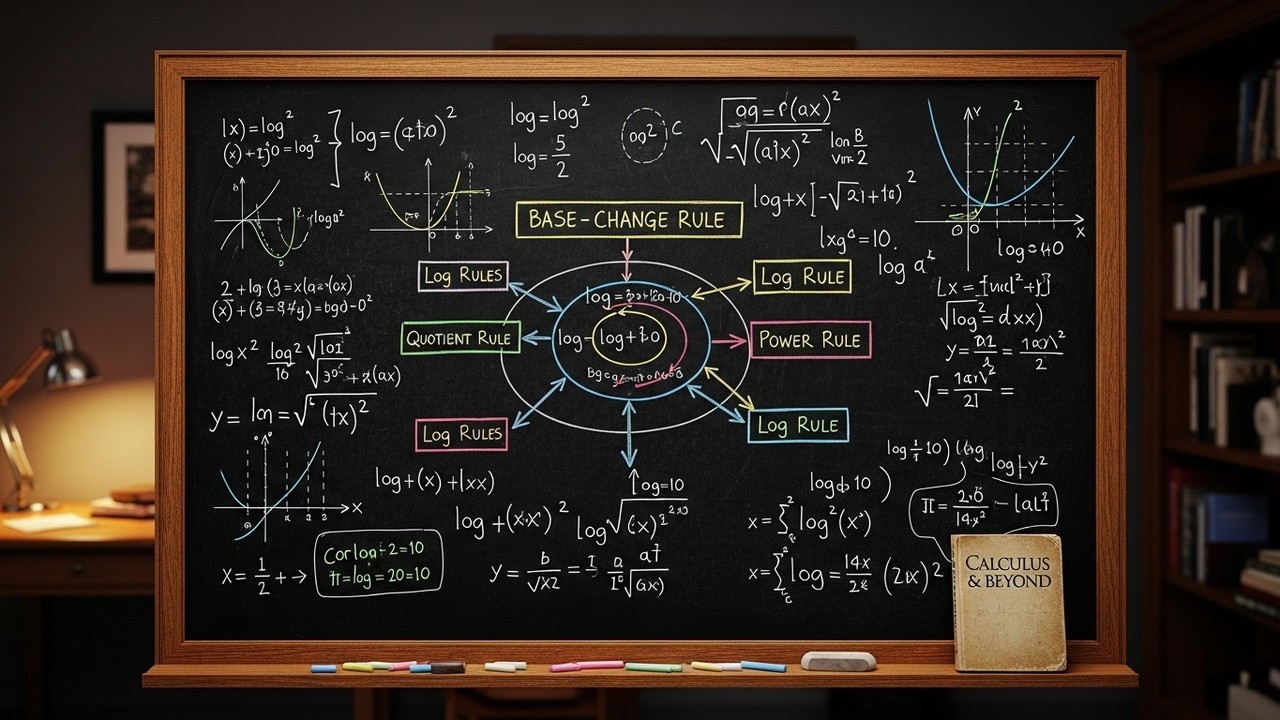
Logarithms rules and properties unlock a powerful toolkit for decoding exponential relationships that appear across algebra, science, and data. When you see magnitudes change, logs translate multiplicative growth into additive steps, turning complex equations into manageable sequences. In this guide, we treat logarithms as both a computational convenience and a conceptual lens, revealing how bases shape how information scales. We’ll trace the core definitions, derive the standard laws, and illustrate base changes with practical problems. By the end, you’ll see how log identities simplify expressions, confirm domain restrictions, and apply logarithms to growth and decay models with confidence.
On This Page
In this rigorous guide, we explore logarithms—their definitions, laws, and the tricks that simplify complex equations. You'll see how log identities translate exponential growth into additive steps, and how the base of a logarithm changes the landscape of a problem. From theory to practice, this post builds intuition and procedural fluency in equal measure.
Laws of Logarithms
Product, Quotient, and Power Rules
Logarithms transform products into sums, quotients into differences, and powers into multiples. Specifically, log_a(MN) = log_a M + log_a N, log_a(M/N) = log_a M − log_a N, and log_a(M^k) = k log_a M. These laws underpin efficient simplification of expressions and solution of equations where multiple logarithms appear.
Applying the product rule, log_a(MN) = log_a M + log_a N is often the initial step in factoring complex logarithmic expressions. The quotient rule, log_a(M/N) = log_a M − log_a N, helps when a ratio is inside the log. Finally, the power rule states log_a(M^k) = k log_a M, enabling extraction of exponents.
Understanding these rules improves mental math speed and reduces algebraic clutter. When used judiciously, they reveal additive structures hidden in multiplicative relationships, enabling cleaner equations and solvable gaps between the left and right sides of an equation.
Throughout, remember the base a must be positive and not equal to 1; this constraint ensures the logarithm is well-defined and injective, preserving the one-to-one correspondence between exponentials and logarithmic values.
Applying Laws to Simplify Expressions
Consider an expression such as log_a(MN/ P^2). Using laws, this becomes log_a M + log_a N − 2 log_a P. Breaking down complex terms with these rules reduces the problem to a combination of simpler logs with the same base.
In practice, grouping terms by common bases and applying the product and quotient rules yields a more tractable form. This approach often leads to a solvable equation or a straightforward evaluation, especially when M, N, and P are powers of the same base.
Moreover, recognize opportunities to combine multiple logs into a single log: log_a(X) + log_a(Y) = log_a(XY), and so forth, allowing a unifying expression that can be inverted or solved with the exponential form as needed.
Finally, verify using a quick domain test: the argument of every log must be positive. If a simplification yields a negative argument, revisit steps to avoid invalid solutions.
Change of Base Formula
Derivation and Intuition
The change of base formula provides a bridge between different logarithmic bases: log_b N = log_k N / log_k b for any positive base k ≠ 1. This relationship allows computations to be carried out in a base you’re comfortable with, commonly base 10 or base e, depending on context.
Intuitively, logs measure how many times the base must be multiplied by itself to reach the argument. Changing the base rewrites that count in terms of another unit of measurement; the ratio of logs in the new base captures this conversion factor elegantly.
From a computational standpoint, choose a base that makes arithmetic easiest. If you know common logarithms or natural logarithms, switch to those and apply the formula to avoid awkward numbers or to leverage calculator functionality.
As a rule of thumb, use consistency: convert all logs to a single base before applying laws or solving equations. This keeps the algebra clean and minimizes mistakes that arise from mixing bases.
Problem Statement
Evaluate the basic logarithmic condition: log_2(x - 1) = 3. Consider domain restrictions: x - 1 > 0.
### log_2(x - 1) = 3 ###
Solution
Step 1: Exponential form (Isolate the inner argument)
From the definition of logarithms, log_a N = x is equivalent to a^x = N. Applying this to log_2(x - 1) = 3 gives 2^3 = x - 1, hence x = 9. This step translates the logarithmic statement into a straightforward exponential equality.
Domain checks are essential: since log functions require a positive argument, x - 1 > 0, so x > 1. The derived solution x = 9 satisfies this constraint, confirming its validity.
Step 2: Verification
Substitute back: log_2(9 - 1) = log_2(8) = 3, which matches the given equation. This cross-check reinforces that the solution lies within the permissible domain and is unique for this simple equation.
Step 3: Alternative perspective
One may also consider converting to a straight exponential equation: 2^3 = 8 and then equating to x - 1. This reinforces the inverse relationship between logarithms and exponentials and helps in visualizing the problem in a different light.
Worked Examples
Evaluate log_2 32 using base-10 or natural logs: log_2 32 = log_10 32 / log_10 2. Numerically, log_10 32 ≈ 1.50515 and log_10 2 ≈ 0.30103, giving ≈ 5.0. This demonstrates the practical utility of the change of base formula for nonstandard bases.
Another example: log_3 81. Using base-10 logs, log_3 81 = log_10 81 / log_10 3 ≈ 1.9085 / 0.4771 ≈ 4.0, since 3^4 = 81. The calculation confirms the exact integer result, illustrating how the formula preserves exactness when possible.
For a more challenging case, compute log_(1/2) 8. With the formula, log_(1/2) 8 = log_10 8 / log_10 (1/2). Since log_10 (1/2) is negative, the ratio yields a negative exponent consistent with 0.5^x = 8, which is x = −3. The method generalizes across bases with consistent procedure.
Finally, discuss the domain: logs require positive arguments, so base selection must ensure all intermediate expressions remain defined. The change of base formula itself does not alter domains, but pay attention to the sign of logs when the base lies between 0 and 1.
Solving Logarithmic Equations
Step-by-Step Framework
To solve log equations, first ensure the argument is positive. Then convert the logarithmic statement to exponential form. If multiple logs appear, combine them using the product, quotient, and power rules to collapse the equation to a single logarithm or a simple exponential, and solve accordingly.
As a practical workflow: (1) check domain; (2) combine logs using identities; (3) exponentiate; (4) verify the solution in the original domain. This framework reduces errors arising from domain violations or extraneous solutions.
When equations involve multiple terms, consider rewriting everything with the same base or using the change of base formula to simplify calculations. This often reveals cancellations or straightforward exponents, yielding clean, verifiable results.
Always conclude with a domain check. A solution that satisfies the equation but violates the argument positivity is invalid, so discard any extraneous results found during algebraic manipulation.
Worked Examples
Example 1: Solve log_2(x) + log_2(x - 1) = 3. Combine logs: log_2(x(x - 1)) = 3. Exponentiate: x(x − 1) = 8. Solve the quadratic x^2 − x − 8 = 0, yielding x = 3 or x = −2. Domain requires x > 1, so only x = 3 is valid.
Example 2: Solve log_5(x^2 − 4) = 2. Exponentiate: x^2 − 4 = 25. Thus x^2 = 29, giving x = ±√29. Domain constraints require x^2 − 4 > 0, which is satisfied for both x values, but check that the argument inside the log remains positive for each candidate.
Example 3: Solve log_a(x − 2) = log_a(3) with a > 0, a ≠ 1. If the logs share the same base, then x − 2 = 3, so x = 5. The domain condition x − 2 > 0 is satisfied, confirming the solution.
Example 4: Solve log_10(x) = log_10(2x − 3). Equate arguments after ensuring domain: x = 2x − 3 implies x = 3. Check domain: x > 0 and 2x − 3 > 0, which holds for x = 3. Solution is x = 3.
Applications: Exponential Growth and Decay
Modeling with Logs
Logs appear naturally in models of exponential growth and decay. The logarithm function linearizes multiplicative processes, turning a compounding process over time into a linear relationship that can be analyzed with slope and intercept interpretation. This makes logs indispensable in fields like biology, chemistry, and finance.
Consider a population P(t) = P_0 e^{kt}. Taking logs yields ln P(t) = ln P_0 + kt, which is a linear equation in t. This facilitates estimation of the growth rate k from observational data by linear regression, transforming a nonlinear model into a tractable one.
Similarly, in radioactive decay, N(t) = N_0 e^{−λt} is linearized by natural logs: ln N(t) = ln N_0 − λt. This simplifies interpretation of decay constants and half-life calculations, and highlights the constant proportional change that makes logs a natural fit for these problems.
When communicating results, reports often present data on a logarithmic scale to compress wide ranges of values and to emphasize relative changes. Understanding log properties thus enhances both the modeling and the presentation of exponential phenomena across disciplines.
Domain and Restrictions in Logs
Key Domain Rules
The logarithm log_a x is defined only for x > 0 and a > 0, a ≠ 1. This foundational rule governs every step of log-based reasoning. Always check the arguments of every logarithm before proceeding with algebraic manipulations.
When combining logarithms, ensure the resulting argument remains positive. If an operation yields a negative or zero argument, the solution is invalid, and you must revisit the prior steps to avoid extraneous results.
In problems with multiple logs, the domain of the combined expression is the intersection of the individual domains. Practically, this means solving inequalities that arise from each log’s argument being positive and from any algebraic constraints.
Domain awareness also guards against misinterpretations when using the change of base formula. Although the base remains positive and not equal to 1, you must ensure that all transformed expressions stay within the allowed domain range.
Common Pitfalls and Tips
Tricks to Avoid Extraneous Solutions
Extraneous solutions commonly appear when squaring both sides or converting to exponential form without proper domain checks. Always substitute potential solutions back into the original logarithmic equation to confirm validity.
Another pitfall is neglecting the base when applying log properties. See that log_a x is not simply log x; the base a must be consistently accounted for in all manipulations.
Be mindful of the base range: bases between 0 and 1 invert monotonicity, which can invert intuitive conclusions if not handled carefully. Track the direction of inequalities when bases < 1 are involved, and adjust steps accordingly.
Finally, practice with a mix of natural and common logarithms to sharpen a flexible skill set. Proficiency emerges from repeated application across varied problem types, not from memorization alone.
Worked Examples: Step-by-Step Solutions
Example 1
Solve log_4(x) + log_4(x − 1) = 2. Combine logs: log_4(x(x − 1)) = 2. Exponentiate: x(x − 1) = 16. Solve x^2 − x − 16 = 0 to get x = (1 ± √(1 + 64))/2 = (1 ± √65)/2. Domain requires x > 1 and x − 1 > 0, so only x = (1 + √65)/2 is valid.
Example 2: Solve log_2(x^2 − 3x) = 3. Exponentiate: x^2 − 3x = 8. Solve x^2 − 3x − 8 = 0, giving x = (3 ± √(9 + 32))/2 = (3 ± √41)/2. Check domain: both roots satisfy x^2 − 3x > 0; only valid values pass the original equation’s domain check.
Example 3: Solve log_10(x − 2) = 1. Exponentiate: x − 2 = 10, hence x = 12. Verify x − 2 > 0, which holds, confirming the solution.
Example 4: Solve log_b(x) = log_b(y) with x,y > 0. If logs share the same base and are defined, then x = y. This straightforward result emphasizes consistency in base choice and domain constraints.
Similar Problems and Quick Solutions
Problem 1: Simplify log_3(81) + log_3(3)
log_3(81) + log_3(3) = log_3(81 × 3) = log_3(243) = 5.
Problem 2: Solve log_5(x^2 − 4) = 2
x^2 − 4 = 25 => x^2 = 29 => x = ±√29; domain requires x^2 − 4 > 0, both satisfy, so both are valid.
Problem 3: Solve log_2(x − 1) = 2
x − 1 = 4 => x = 5; domain x > 1 holds, solution valid.
Problem 4: Solve log_10(x) = log_10(2x − 1)
x = 2x − 1 implies x = 1; domain requires x > 0 and 2x − 1 > 0, which is satisfied for x = 1.
Problem 5: Change of base calculation
log_{2} 10 = log_{10} 10 / log_{10} 2 ≈ 1 / 0.30103 ≈ 3.3219, illustrating a base-change result.
The Final Solution
Logarithms rules and properties stand as a cohesive framework for translating exponential processes into linear or algebraic forms. Mastery comes from fluency in the product, quotient, and power laws, the ability to perform clean base changes, and careful domain checks that prevent invalid conclusions. With these tools, you can elegantly solve a broad spectrum of problems, from routine manipulations to intricate exponential-growth models, while maintaining mathematical rigor and clarity.
RESOURCES
- Properties of Log - What are Logarithmic Properties?
- Logarithm Base Properties
- Logarithmic Properties
- Logarithm Rules and Properties
- Intro to logarithm properties (article) | Khan Academy
- Properties of Exponents and Logarithms
- PROPERTIES OF LOGARITHMS
- List of logarithmic identities - Wikipedia
- Logarithm Rules | ChiliMath
- logarithms - Mathematical Grammar - "laws" or "properties ...






0 Comments