Understanding Arithmetic and Geometric Progressions is fundamental in mathematics, serving as a gateway to more advanced concepts. These sequences and series are not only crucial for academic success but also find extensive applications in various real-world scenarios, from finance and physics to computer science. This exploration will delve into the core principles of Arithmetic Progressions (AP), Geometric Progressions (GP), and Harmonic Progressions (HP). We will cover the basics, key formulas, and how to apply them. This information is essential for anyone looking to strengthen their mathematical foundation and solve complex problems.
On This Page
- Understanding Arithmetic Progressions (AP)
- Delving into Geometric Progressions (GP)
- Harmonic Progression (HP) Explained
- Problem-Solving with Progressions
- Illustrative Examples and Solutions
- Similar Problems and Quick Solutions
- Problem 1: Find the 10th term of an AP: 3, 7, 11, ...
- Problem 2: Find the sum of the first 5 terms of a GP with a = 1 and r = 3.
- Problem 3: If the 2nd term of an AP is 8 and the 5th term is 17, find the first term and common difference.
- Problem 4: Find the 5th term of the HP: 1/2, 1/4, 1/6, ...
- Problem 5: Determine the common ratio in the GP: 5, 10, 20, ...
- RESOURCES
Understanding Arithmetic Progressions (AP)
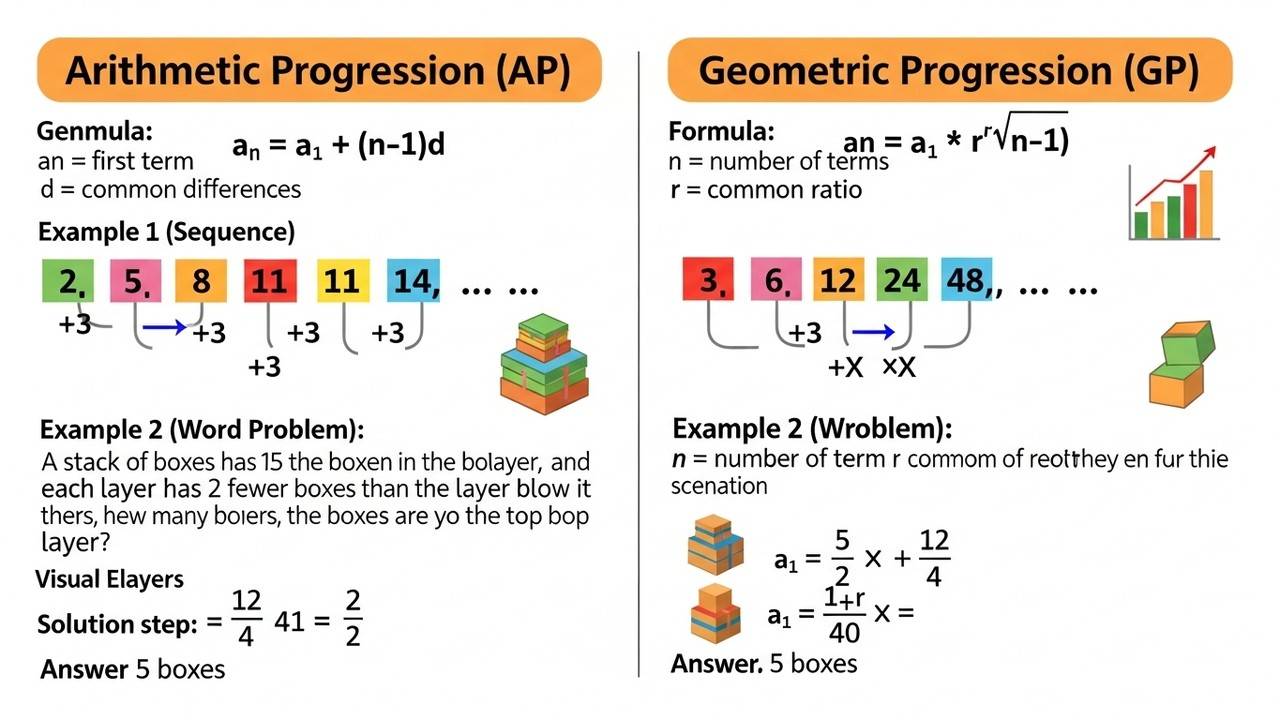
An Arithmetic Progression (AP) is a sequence of numbers in which the difference between any two consecutive terms is constant. This constant difference is known as the common difference, often denoted by 'd'. The first term of the AP is usually represented by 'a'. The general form of an AP can be expressed as: a, a+d, a+2d, a+3d, and so on. For instance, the sequence 2, 4, 6, 8, ... is an AP where a = 2 and d = 2. The beauty of APs lies in their predictable nature, allowing us to determine any term in the sequence without having to calculate all the preceding terms. The ability to quickly identify and work with APs is a cornerstone of mathematical problem-solving.
Key Formulas for APs
The nth term of an AP, often denoted as ##a_n##, can be found using the formula: ##a_n = a + (n-1)d##. Here, 'n' represents the position of the term in the sequence. The sum of the first 'n' terms of an AP, denoted as ##S_n##, is given by: ##S_n = n/2 [2a + (n-1)d]## or alternatively, ##S_n = n/2 [a + a_n]##. These formulas are indispensable tools for solving problems related to APs. They enable us to calculate specific terms, the sum of a series of terms, and even deduce the properties of the progression itself, making it easier to tackle complex problems.
Examples of APs in Number Systems
Consider the sequence of even numbers: 2, 4, 6, 8, 10, ... This is a classic example of an AP, with a common difference of 2. The sequence of odd numbers: 1, 3, 5, 7, 9, ... is another AP, with a common difference of 2. Also, the sequence of multiples of 5: 5, 10, 15, 20, ... forms an AP, where the common difference is 5. These simple examples demonstrate how APs can be found within various number systems. The ease with which we can identify and work with these sequences underscores their fundamental importance in mathematics and related fields.
Applications of APs
Arithmetic Progressions have numerous applications in real-world scenarios. For example, they can model situations where there is a constant rate of increase or decrease. Consider a savings plan where you deposit a fixed amount each month; the total savings form an AP. Another example is the distance covered by a moving object with constant acceleration. APs are also used in finance, physics, and computer science to model and solve problems. Understanding the principles of APs allows one to analyze and predict patterns in various fields, highlighting the wide-ranging utility of these mathematical concepts.
Delving into Geometric Progressions (GP)
A Geometric Progression (GP) is a sequence of numbers where each term after the first is found by multiplying the previous one by a fixed, non-zero number called the common ratio, denoted by 'r'. The general form of a GP is: a, ar, ar², ar³, and so on, where 'a' is the first term. For instance, the sequence 2, 4, 8, 16, ... is a GP where a = 2 and r = 2. GPs are fundamental in mathematics, particularly in the study of exponential growth and decay. The ability to understand and apply GP concepts is crucial in various areas of science and finance.
Key Formulas for GPs
The nth term of a GP, ##a_n##, can be determined using the formula: ##a_n = a r^(n-1)##. The sum of the first 'n' terms of a GP, ##S_n##, is given by: ##S_n = a (1 - r^n) / (1 - r)##, when ##r ≠ 1##. If ##r = 1##, then ##S_n = na##. In the case of an infinite geometric series, where ##|r| < 1##, the sum to infinity (##S_∞##) is given by: ##S_∞ = a / (1 - r)##. These formulas are essential for analyzing and solving problems related to GPs, providing the means to calculate specific terms, sums, and understand the behavior of infinite series.
Examples of GPs in Number Systems
Consider the sequence 3, 6, 12, 24, ... This is a GP with a common ratio of 2. Another example is the sequence 1, 1/2, 1/4, 1/8, ... This is a GP with a common ratio of 1/2. The sequence 10, 100, 1000, ... is also a GP, with a common ratio of 10. These examples illustrate how GPs can appear in various number systems. The ability to identify and work with these sequences is crucial for solving various mathematical and real-world problems. Recognizing the common ratio is the key to understanding the underlying pattern and applying appropriate formulas.
Applications of GPs
Geometric Progressions are used extensively in various fields, including finance, physics, and computer science. In finance, GPs model compound interest, where the investment grows exponentially. In physics, GPs are used to describe exponential decay, such as the decay of radioactive substances. In computer science, they can model the growth of algorithms or the efficiency of certain processes. Understanding GPs allows for accurate predictions and analysis of phenomena involving exponential growth or decay. These applications showcase the importance of GPs in both theoretical and practical contexts.
Harmonic Progression (HP) Explained
A Harmonic Progression (HP) is a sequence of numbers whose reciprocals form an Arithmetic Progression (AP). If a sequence is an HP, then the reciprocals of its terms will form an AP. For example, if a, b, c are in HP, then 1/a, 1/b, 1/c are in AP. There isn't a straightforward formula to directly calculate the nth term or the sum of an HP like there is for AP and GP. Instead, problems involving HPs are often solved by converting them into equivalent AP problems. This understanding is crucial for solving complex problems involving HP, requiring a solid grasp of AP and its reciprocal relationship.
Finding the nth Term in HP
To find the nth term of an HP, first, take the reciprocals of the terms in the HP to form an AP. Then, use the formula for the nth term of an AP to find the nth term of the AP. Finally, take the reciprocal of this result to find the nth term of the original HP. For instance, if we have an HP 1/2, 1/4, 1/6, we can form the AP 2, 4, 6. Then, the nth term of the AP is ##a_n = a + (n-1)d##, and the nth term of the HP is ##1/a_n##. This method allows us to solve problems related to HPs by leveraging our understanding of APs.
Summation in Harmonic Progression
Unlike APs and GPs, there is no direct formula to calculate the sum of terms in an HP. Problems involving the sum of terms in an HP often require converting the HP into an AP, performing calculations on the AP, and then converting the result back. This conversion involves finding the reciprocals of the HP terms, calculating the sum of the corresponding AP terms, and interpreting the result within the context of the original HP. This approach highlights the importance of understanding the relationship between AP and HP for effective problem-solving. The approach emphasizes the importance of using the properties of APs and GPs to solve problems related to HP.
Applications of HPs
Harmonic Progressions find their applications in various fields, including physics and music. In physics, HPs are used in problems related to the average speed of a moving object when it covers equal distances at different speeds. Also, they are used in the study of wavelengths and frequencies. In music, HPs are related to the harmonic series, which determines the frequencies of overtones in musical instruments. Understanding HPs allows one to analyze and solve problems in these diverse fields, showcasing the interdisciplinary nature of mathematical concepts. The HP is thus a valuable tool in understanding and solving problems across multiple domains.
Problem-Solving with Progressions
Solving problems related to Arithmetic, Geometric, and Harmonic Progressions often involves applying the formulas and techniques discussed earlier. A key aspect of problem-solving is to identify the type of progression involved and then apply the relevant formulas. For instance, in an AP, you might use ##a_n = a + (n-1)d## to find a specific term or ##S_n = n/2 [2a + (n-1)d]## to find the sum of a series. In a GP, you would use ##a_n = a r^(n-1)## and ##S_n = a * (1 - r^n) / (1 - r)##. Practicing different types of problems will help you master these concepts.
Strategies for Solving AP and GP Problems
When approaching AP and GP problems, it is crucial to first identify the given information, such as the first term, common difference (or ratio), and number of terms. Next, determine what is being asked, such as a specific term or the sum of the series. Then, choose the appropriate formula and substitute the known values. Finally, solve the equation to find the unknown quantity. For example, if you are given the first term, common difference, and the number of terms in an AP and asked to find the sum, you would use the formula for ##S_n##. This systematic approach helps in avoiding errors and ensures efficient problem-solving.
Tackling HP Problems
Problems involving Harmonic Progressions require a slightly different approach. Since there are no direct formulas for HP, you must convert the HP into an AP by taking the reciprocals of the terms. Then, use the formulas for AP to solve the problem. For example, if you are given three terms in HP and asked to find a relationship between them, you would convert them into an AP, and then use the properties of AP. This method requires a good understanding of the relationship between AP and HP. Practice problems and consistent application are crucial for mastery of these techniques.
Advanced Problem-Solving Techniques
For advanced problems, especially those encountered in competitive exams like JEE, you may need to combine the concepts of AP, GP, and HP. Often, these problems involve multiple progressions or require creative application of the formulas. For example, you might be given a problem that combines an AP and a GP, requiring you to use the formulas for both. Also, it may involve finding the relationship between the terms of different progressions. Practice solving such problems will enhance your problem-solving skills. These problems often test your ability to apply the fundamental concepts in innovative ways.
Illustrative Examples and Solutions
Let's work through a few examples to illustrate the concepts discussed. These examples will cover different types of problems related to Arithmetic, Geometric, and Harmonic Progressions. We will demonstrate how to apply the formulas and techniques to arrive at solutions. These examples are designed to help you understand the practical application of the concepts and build your confidence in solving similar problems.
Example 1: Solving an AP Problem
Problem: If the 3rd term of an AP is 5 and the 7th term is 17, find the first term (a) and the common difference (d). Solution: We know that ##a_3 = a + 2d = 5## and ##a_7 = a + 6d = 17##. Solving these two equations simultaneously, we get: Subtracting the first equation from the second, we get ##4d = 12##, so ##d = 3##. Substituting d = 3 in the first equation, we get ##a + 2*3 = 5##, so ##a = -1##. Therefore, the first term is -1, and the common difference is 3. This example demonstrates how to use the nth term formula to find the unknown variables.
Example 2: Solving a GP Problem
Problem: Find the sum of the first 10 terms of the GP: 2, 4, 8, ... Solution: In this GP, the first term (a) is 2, and the common ratio (r) is 2. Using the formula for the sum of the first n terms of a GP, ##S_n = a (1 - r^n) / (1 - r)##, we get: ##S_10 = 2 (1 - 2^10) / (1 - 2) = 2 (1 - 1024) / -1 = 2 (-1023) / -1 = 2046##. Thus, the sum of the first 10 terms is 2046. This illustrates how to apply the sum formula in a GP.
Example 3: Solving an HP Problem
Problem: If a, b, c are in HP, show that ##b = 2ac / (a + c)##. Solution: Since a, b, c are in HP, then 1/a, 1/b, 1/c are in AP. In an AP, the middle term is the average of the other two, so ##2/b = 1/a + 1/c##. Multiplying both sides by abc, we get ##2ac = b(a + c)##. Therefore, ##b = 2ac / (a + c)##. This demonstrates how to convert an HP problem to an AP problem. The process illustrates the relationship between the terms in a harmonic progression.
Final Solution
In summary, we have explored the intricacies of Arithmetic, Geometric, and Harmonic Progressions. We have reviewed key formulas, demonstrated problem-solving strategies, and provided illustrative examples. The ability to identify and work with these progressions is fundamental to a strong mathematical foundation. By practicing these examples, you can build a solid understanding of how to approach and solve problems related to sequences and series.
Similar Problems and Quick Solutions
Problem 1: Find the 10th term of an AP: 3, 7, 11, ...
Solution: 39
Problem 2: Find the sum of the first 5 terms of a GP with a = 1 and r = 3.
Solution: 121
Problem 3: If the 2nd term of an AP is 8 and the 5th term is 17, find the first term and common difference.
Solution: a = 2, d = 3
Problem 4: Find the 5th term of the HP: 1/2, 1/4, 1/6, ...
Solution: 1/10
Problem 5: Determine the common ratio in the GP: 5, 10, 20, ...
Solution: 2
RESOURCES
- Arithmetic and geometric progressions
- Arithmetic and Geometric Sequences (Economics)
- Arithmetic-Geometric Progression | Brilliant Math & Science Wiki
- Arithmetic and Geometric Progressions
- Geometric progression - Wikipedia
- sequences and series - Why is a geometric progression called so ...
- Arithmetic Progression| Geometric Progression| Formulas - Cuemath
- arithmetic progressions - Confused with the sequences and series ...
- Geometric Progressions on Elliptic Curves
- Large sets avoiding infinite arithmetic/geometric progressions



1 Comment